
Which Factory Options Change Tacoma Aftermarket Fitment?
Verify fitment with the merchant before you buy.
Reviewed by DoesItFit Editorial · How we evaluate compatibility
YEAR AND TRIM ARE NOT ENOUGH
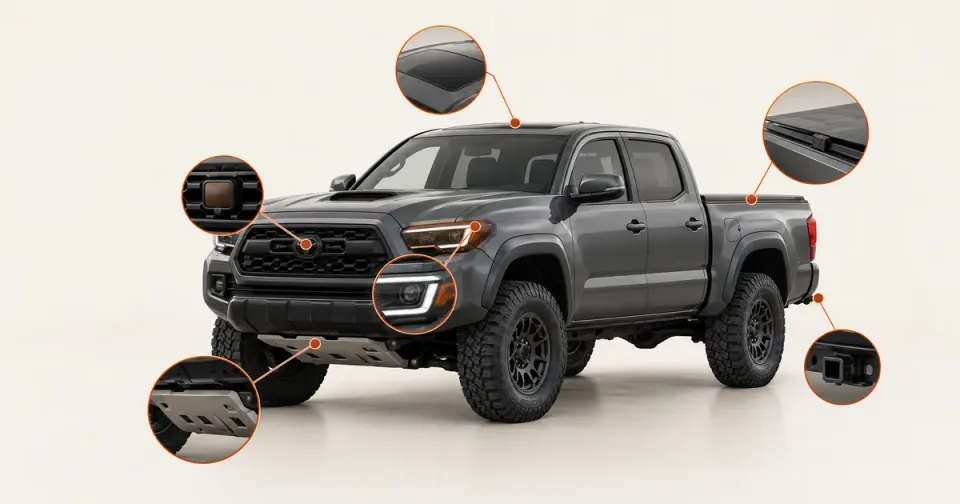
Factory cameras, safety sensors, lamp type, bed hardware, roof features, armor, towing equipment, powertrain and suspension can all change Tacoma aftermarket fitment. None is automatically a conflict. A conflict exists when the new part shares its mount, clearance, connector, calibration or operating path.
The pre-purchase factory-equipment checklist
| Inspect before buying | Parts commonly affected | What the product documentation must address |
|---|---|---|
| TSS radar/garnish and front camera | Grilles, bumpers, winch mounts, light bars | Sensor/camera retention, required bracket or garnish, unobstructed operation and any service procedure |
| Parking sonar and surround cameras | Front/rear bumpers, grilles, mirrors | Exact sensor count/location, retain/relocate route and exclusions |
| Halogen/projector vs factory LED lamps | Headlights, fog lights, wiring kits | Original lamp type, connectors, control electronics and conversion requirements |
| Bed rails, factory cover and tie-downs | Tonneau covers, racks, MOLLE panels, extenders, mats | Shared rail space, clamp/mount, opening path and required adapters |
| Power tailgate | Bed mats, covers and tailgate accessories | Clearance and operation with the named tailgate system |
| Moonroof and roof attachments | Roof racks, light bars, antennas, rooftop loads | Cab/roof application, sunroof operation and load limits |
| Factory skids, crossmembers and recovery points | Armor, bumpers, winches and recovery hardware | What stays, what is removed, shared fasteners and required support hardware |
| Hitch, 7-pin and brake-control equipment | Rear bumpers, exhaust, towing accessories | Hitch/receiver retention, connector location, clearance and rated system |
| Gas/hybrid and leaf/coil configuration | Skids, exhaust, intake and suspension | Exact powertrain, drivetrain, rear suspension and load application |
| Seat airbags/occupancy equipment | Seats, bases, covers and cabin electronics | SRS-compatible application and documented installation/service path |
The point is not to reject every modified truck. It is to find the interface where two systems meet before money or safety depends on a guess.
Cameras, radar and parking sensors
Front-end fitment changed inside the third generation. Toyota made TSS-P standard across all 2018 Tacoma grades. For 2020, Toyota added PVM or MTM camera availability to named configurations while keeping equipment grade- and package-dependent. See Toyota's 2018 TSS-P update and 2020 camera/equipment changes.
A bumper or grille listing should therefore say more than “fits 2016–2023 Tacoma.” Depending on the truck, it may need to address:
- a TSS garnish or radar path;
- an OEM front-camera bracket and cutout;
- parking-sonar holes or retainers;
- PVM/MTM camera visibility; and
- calibration or service instructions where the factory system requires them.
Do not assume that physically relocating a camera or sensor preserves its field of view or safety-system performance. If the maker documents only the metal fit, the electronics result remains unknown.
Factory lighting type
Two Tacomas with the same model year and grade can still differ when lighting was optional or package-based. Toyota's 2023 equipment matrix lists several headlight configurations, including projector-beam and LED systems, across different grades/packages. Review Toyota's 2023 equipment matrix.
For a headlight, fog-light kit, grille light or replacement harness, photograph the existing lamp label and connector. Confirm whether the product is designed for factory halogen/projector or factory LED equipment. A housing that bolts to the body is not proven electrically compatible.
The same rule applies to turn signals, DRLs and taillamps: match the complete factory lighting system, not just the outer shape.
Bed rails, covers, tie-downs and tailgate equipment
Bed accessories compete for a small number of interfaces. The factory deck/utility rail, tonneau rails, MOLLE panels, tie-down hardware, bed extender and rack clamps can occupy the same space or block one another's movement.
Check four things together:
- exact bed length;
- rail or clamp used by each product;
- full opening path of the cover and tailgate; and
- fasteners or tie-downs that the installation removes or traps.
Use the exact guide for known fourth-gen decisions:
- Tri-fold covers and the 2024–2026 deck rail system
- Toyota inner-bed MOLLE panels with the genuine hard tonneau
- OEM bed extender with the factory tri-fold cover
- Fourth-gen bed mat under factory tie-downs
- 2024 bed mat with the power tailgate
A product working with the bare bed does not prove it works with these installed systems.
Moonroof, roof mounts and antennas
A roof rack can bolt on yet interfere with sunroof tilt/slide, a light bar, antenna, wind deflector or another roof accessory. It must also have a documented load path and rating for the intended use.
State whether the truck has a moonroof and whether you need it to open fully. Then check the rack, wind deflector and mounted accessory as one system. Use the Tacoma roof-rack, sunroof, noise and load guide or the third-gen rack, sunroof and light-bar guide for those narrower decisions.
Factory armor, crossmembers and recovery points
Underbody parts are sensitive to what the truck already has. A factory skid, crossmember, recovery point or bumper can share mounting holes with an aftermarket plate, bracket or winch system.
One current fourth-gen example shows why inspection matters: RCI's named front skid-mounting crossmember is intended for 2024+ Tacomas that do not already have the factory front crossmember. RCI tells the buyer to check the truck and uses that support to mount named OEM TRD Pro/Trailhunter skid applications on specified configurations. That claim does not transfer to another skid or bracket. See the exact crossmember decision.
Before ordering armor, photograph the mounting area and record every factory/aftermarket plate already installed. Ask whether oil service, drain access, recovery points and shared fasteners remain usable.
Hitch, towing wiring and rear-bumper equipment
A rear bumper, spare-tire carrier, exhaust or recovery point can conflict with the receiver, trailer connector, sensors or spare-tire path. Confirm whether the truck has a factory hitch and 7-pin connector; do not infer those from a “tow package” label alone.
For brake-control wiring, use the Tacoma tow-package and brake-controller wiring guide. Keep towing ratings separate from physical fit: an aftermarket bumper or suspension part does not increase the certification-label, axle or Toyota towing limits.
Gas vs hybrid, drivetrain and rear suspension
The fourth-generation Tacoma makes powertrain and suspension checks especially important. Toyota documents i-FORCE gas and i-FORCE MAX hybrid configurations, plus different rear suspension layouts by grade/configuration. Most launch grades used an available coil-spring multi-link rear suspension, while SR, SR5 XtraCab and TRD PreRunner retained leaf springs. Review Toyota's fourth-generation configuration overview.
Those differences can change applications for:
- skid plates and catalytic guards;
- intake and exhaust parts;
- shocks, springs, spacers and lift kits;
- underbody storage or auxiliary equipment; and
- components routed near hybrid hardware.
“2024+ Tacoma” is incomplete when the part touches one of those systems. Require the exact powertrain, drivetrain and suspension application.
Seats, airbags and occupancy systems
Seat covers, replacement seats and seat bases can interact with side airbags, wiring, occupancy classification and seat-position sensing. Do not bypass a connector or ignore an SRS warning to make a seat physically fit.
For a third-gen seat replacement, follow the 2023 Tacoma driver-seat and SRS warning guide. For another year or product, require documentation for that exact seat/SRS configuration.
How to record the truck before shopping
Collect these items once and keep them with your build notes:
- VIN and model year;
- cab and measured bed length;
- grade and option/package or build-sheet details;
- engine/powertrain, transmission and drivetrain;
- leaf- or coil-rear suspension where applicable;
- photos of the grille, cameras, sensors, lamps and connectors;
- photos of bed rails, cover hardware, roof and underbody mounts; and
- exact part numbers for installed accessories.
Then send the manufacturer a system-level question, not “Will it fit my Tacoma?”
> Does SKU ABC-123 fit a 2023 TRD Off-Road Double Cab with factory MTM, LED headlights and parking sonar, while retaining every factory function?
Compatibility snapshot
| Product/application | Vehicle configuration | Result | Required check |
|---|---|---|---|
| Exact SKU names the year/grade and installed option | Matching Tacoma | Documented with stated conditions | Follow exclusions and installation/service notes |
| Part lists year/trim but omits a system in the same mounting area | Truck has that system | Unknown until confirmed | Ask maker about retention, clearance and calibration |
| Part explicitly excludes the factory camera/cover/hybrid/etc. | Truck has excluded equipment | Does not fit that configuration | Choose the documented application; do not improvise |
| “Universal” part | Any Tacoma | Conditional | Verify mount, load, wiring, clearance and operation |
Bottom line
Factory equipment changes fitment when it shares the aftermarket part's space, mount, connector, calibration or movement path. Record the actual truck, not only its trim badge. If the product maker does not address an installed system, the honest verdict is unknown until confirmed.
For third-generation front-end parts, continue with the 2016–2019 vs 2020–2023 Tacoma refresh guide.
Sources & notes
- Toyota: 2018 Tacoma TSS-P update, accessed 2026-10-13. Establishes factory safety equipment across the 2018 lineup; not an aftermarket fitment approval.
- Toyota: 2020 Tacoma refresh, accessed 2026-10-13. Documents grade/configuration-specific grille, lighting, camera and interior changes.
- Toyota: 2023 Tacoma eBrochure, accessed 2026-10-13. Equipment matrix showing lighting, camera, sonar, moonroof and package variation.
- Toyota: 2024 Tacoma engineering overview, accessed 2026-10-13. Documents fourth-generation gas/hybrid, suspension and configuration differences.
- RCI: fourth-gen Tacoma front skid-mounting crossmember, accessed 2026-10-13. Product-specific example requiring inspection for the factory crossmember.