
Which Tacoma Front Bumper Should You Choose: Low-Profile or Full Replacement, Steel or Aluminum?
Verify fitment with the merchant before you buy.
Reviewed by DoesItFit Editorial · How we evaluate compatibility
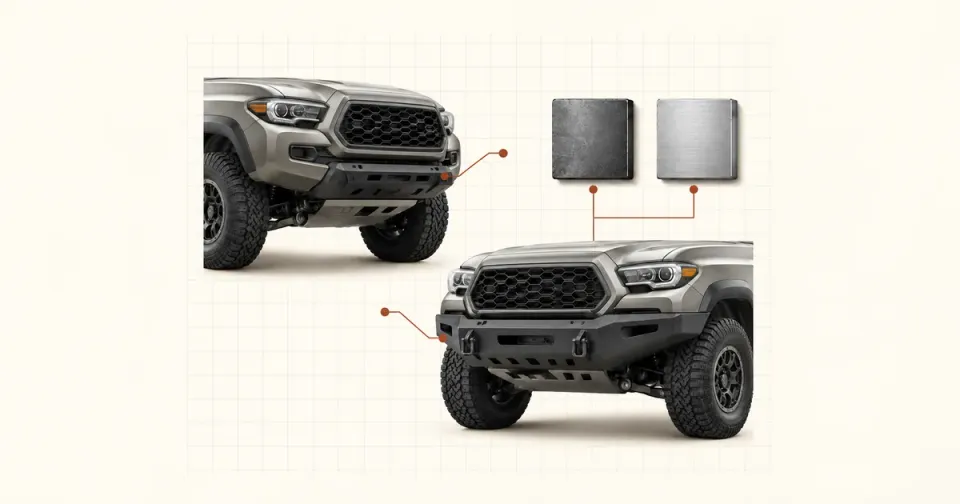
CHOOSE COVERAGE FIRST, MATERIAL SECOND
Choose a low-profile bumper when you want compact winch/recovery integration while retaining more factory fascia; choose a full-width replacement when broader front and corner coverage justifies more size, weight and integration work. Then compare steel and aluminum only within an exact design. Material alone does not establish fitment, protection or recovery strength.
What is the practical difference between low-profile and full replacement?
The names are not controlled standards. Manufacturers also use terms such as covert, hybrid, plate, full-width and high-clearance. Judge the exact product by the bodywork it replaces, its corner coverage, frame mounts and accessory envelope—not by the category label alone.
Low-profile or covert
A low-profile bumper usually replaces or reinforces the center portion while retaining more factory plastic at the corners. It can create a compact winch, fairlead, light and recovery interface with less visual and physical bulk than a broad bumper.
That does not mean no cutting or negligible weight. CBI's 2024–2026 Tacoma Covert bumper is a current steel example: CBI lists it at 85 lb before a winch and light bar, requires trimming the plastic factory bumper, and says most winches up to 10,000 lb fit under its stated packaging conditions. Review CBI's exact Covert application.
Choose this path when the real goal is compact winch/recovery integration and retaining more factory fascia—not when you need the broadest corner coverage.
Full-width or full-replacement style
A broad replacement bumper extends the protection and accessory envelope toward both corners. It can provide more room for hoops, lighting and recovery features, but normally adds more structure and creates more interfaces with factory trim, fog lights, skids, sensors and airflow.
“Full replacement” still does not promise that every factory plastic panel disappears or that installation is cut-free. C4's 2024–2026 Overland bumper, for example, requires cutting factory plastic and lists 114–138 lb depending on bull-bar configuration. C4 explicitly names TSS and parking-sensor compatibility, warns that some trucks may require TSS recalibration and says factory fog lights are not supported. Review C4's exact Overland application.
Choose this path when broader coverage and its accessory space solve a real use case and you accept the exact product's weight and integration work.
What must the bumper retain on your Tacoma?
Before comparing materials, inventory the truck:
- front camera or Panoramic View Monitor hardware;
- Toyota Safety Sense/cruise radar and its aiming area;
- parking sensors and brackets;
- factory fog lights and wiring;
- air dam, splash panels, washer tank and factory skid;
- factory tow/recovery hardware; and
- license plate and airflow path.
Require the exact bumper and selected hoop to name every system you need. “Sensor compatible” is incomplete when the truck has parking sonar, a camera and radar. A different hoop, winch control box, fairlead, light or plate mount can also enter a camera/radar view or conflict with airflow.
Use the 2024+ Tacoma front-bumper installation checklist for the complete pre-purchase audit.
Steel or aluminum: what changes?
Material choice changes mass, corrosion behavior, fabrication/repair options and how a specific design handles the intended use. But thickness, alloy, shape, welds, mounts, bracing and recovery-point design matter with the material. Do not rank two unknown bumpers by the metal name.
CBI's 2016–2023 Tacoma Classic bumper offers a useful same-design comparison. CBI lists a 110 lb steel option and a 55 lb aluminum option, with cutting required for the product. The maker describes aluminum as the weight-saving choice and steel as its higher-durability/strength choice. Those weights and descriptions belong to this named bumper—not every Tacoma bumper. Compare CBI's Classic material options.
Choose the documented steel option when
- the manufacturer recommends it for the expected impact and abuse;
- the extra mass fits the truck's front-load and payload plan;
- local steel repair/fabrication is part of your ownership plan; and
- the exact finish and maintenance requirements are acceptable.
Choose the documented aluminum option when
- reducing front and payload mass materially improves the build;
- the maker offers the same required mounting, coverage and recovery functions in aluminum;
- its documented use envelope matches your terrain; and
- you have an acceptable inspection and repair path for that construction.
Never infer recovery capacity from steel versus aluminum alone. Require a manufacturer-defined load path, frame mounting and recovery guidance for the exact bumper.
Calculate installed weight, not catalogue weight alone
Start with the selected bumper and hoop, then add the exact winch, fairlead, rope, lights, brackets, skid and hardware. Subtract only factory components the instructions actually remove. The result affects payload and front axle/suspension load; it does not automatically require a lift or prove that a particular spring is correct.
Use the remaining Tacoma payload guide before combining a bumper with sliders, racks, a tent, occupants and cargo.
Before you buy
- Write the exact Tacoma year, trim, cab, powertrain and factory-system inventory.
- Decide whether the job needs compact central integration or broader corner/front coverage.
- Choose the exact bumper, material, hoop, winch, fairlead, lights and plate mount.
- Read the current instructions for cutting, transferred equipment, brackets and wiring.
- Obtain written confirmation for every camera, sensor, radar, fog light or skid not explicitly named.
- Add complete installed weight and confirm payload, ride height and suspension compatibility.
- Check freight inspection, finish and return restrictions before ordering or coating anything.
Compatibility snapshot
| Exact application | Category/material | Result | Required check |
|---|---|---|---|
| CBI Covert, 2024–2026 Tacoma | Compact/low-profile, steel, 85 lb before winch/light | Documented example | Cutting, exact winch packaging and factory-system retention |
| C4 Overland, 2024–2026 Tacoma | Broad bumper, 114–138 lb by bull bar | Documented example | Cutting, camera, TSS/parking sensors, fog lights and calibration |
| CBI Classic, 2016–2023 Tacoma | 110 lb steel or 55 lb aluminum | Both materials documented for this design | Exact application, cutting, use and accessory configuration |
| Any bumper selected only by “steel,” “aluminum” or style label | Unspecified Tacoma/configuration | Unknown until documented | Exact SKU, mounts, coverage, systems, recovery path and weight |
Bottom line
First choose the coverage and integration that solve the job: compact low-profile for a focused center/winch solution, or broad replacement for more corner/front coverage. Then choose steel or aluminum inside a documented product design using its real option weight, construction, factory-system support and use guidance. The best material cannot rescue the wrong bumper application.
Sources & notes
- CBI Offroad: 2024–2026 Tacoma Covert front bumper, accessed 2026-10-15. Product-specific low-profile steel construction, 85 lb listed weight, cutting requirement and winch boundary; it does not define every low-profile bumper.
- C4 Fabrication: 2024–2026 Tacoma Overland front bumper, accessed 2026-10-15. Product-specific cutting, 114–138 lb option range, TSS/parking-sensor, recalibration and factory-fog boundaries; front-camera retention is not explicit on the cited page.
- CBI Offroad: 2016–2023 Tacoma Classic front bumper, accessed 2026-10-15. Same-product steel/aluminum options and listed 110/55 lb weights; not a universal material comparison.