
Will Aftermarket Wheels Fit Your Tacoma? Check More Than Offset
Verify fitment with the merchant before you buy.
Reviewed by DoesItFit Editorial · How we evaluate compatibility
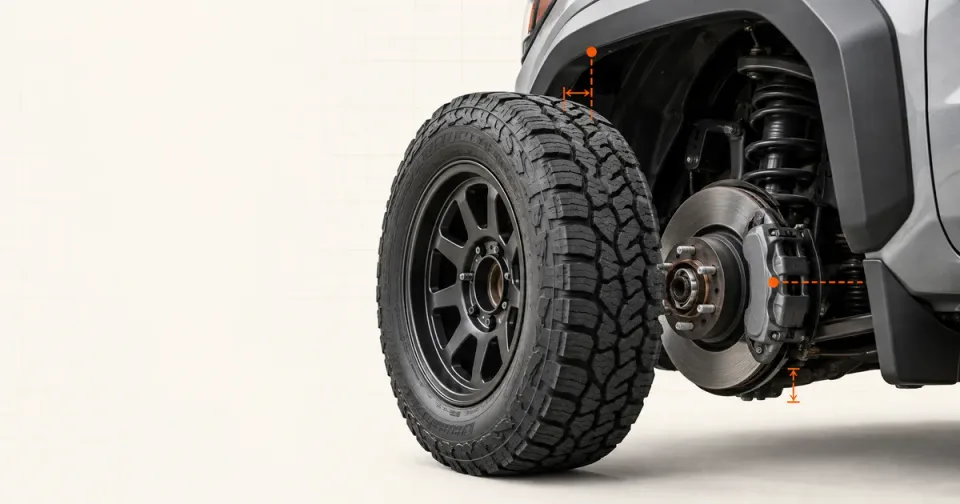
FITS ONLY IF THE COMPLETE INTERFACE MATCHES
A different offset can fit, but matching offset—or matching bolt pattern—does not prove that a wheel fits your Tacoma. Confirm the exact truck and wheel SKU, then check center bore, lug hardware, load rating, brake profile, width, offset/backspacing, tire dimensions and moving clearance together.
Tacoma wheel-fitment snapshot
| Interface | A match proves | A match does not prove |
|---|---|---|
| Bolt pattern | The holes share a circle and lug count | Correct center bore, lug seat, brake clearance or load rating |
| Center bore and hub seating | The wheel can locate and sit flat as designed | Correct hardware, offset or spoke clearance |
| Diameter, width and spoke/barrel profile | The wheel has defined geometry | Brake clearance until the exact profile is approved/test-fitted |
| Offset/backspacing | The mounting pad's position relative to the wheel | Tire clearance without wheel width and tire dimensions |
| Exact tire SKU | The real diameter, width and approved rim range can be checked | No rubbing until steering and suspension travel are verified |
Start with the exact truck—not “a Tacoma”
Toyota's 2021 source book identifies different factory wheel-and-tire combinations by configuration. That alone disproves the idea that every Tacoma in one model year has one stock reference. Begin with the wheel, tire, brakes and suspension actually on the truck. Use Toyota's source book to identify the factory configuration.
Generation is not enough either. Some early Tacoma configurations use a different lug count from the later six-lug trucks buyers often assume. If you are working with an early truck, start with the five-lug Tacoma lift and wheel-fitment boundary rather than copying a later application.
Why the bolt pattern is only the first gate
A shared bolt pattern means only that the lug holes are arranged on the same circle. Tire Rack's fitment process separately checks center bore, hub height/interference, wheel load capacity, lug hardware, TPMS, brake profile and suspension clearance. Review the full set of wheel-fitment interfaces.
The wheel must sit flat against the hub using the installation method and hardware specified for that application. A center bore that is too small cannot seat over the hub. A larger multi-application bore may require the wheel maker's approved centering system. Lug thread and seat style must also match the wheel—not merely screw onto the stud.
Offset and backspacing need wheel width
Offset is the distance between the wheel's mounting surface and its centerline. Backspacing describes the distance from the mounting surface to the inner edge. Both describe where the wheel sits, but neither has a useful clearance meaning without wheel width.
Moving the package outward can add inner suspension clearance while reducing clearance at the outer liner, mud flap, body-mount area or fender. Moving it inward creates the opposite risk. Increasing wheel width can consume space on both sides even when the offset number stays the same. See Tire Rack's offset explanation.
Then add the tire. Its actual section width and diameter—not just the nominal sidewall label—determine the moving envelope. If the tire size is changing too, use the Tacoma tire-size and no-rub decision guide.
Wheel diameter does not guarantee brake clearance
A larger-diameter wheel can still contact a caliper if the barrel or spoke profile is wrong. Tire Rack documents brake fitment as a three-dimensional profile check; diameter alone is insufficient. Read how brake-profile clearance is evaluated.
Require the wheel manufacturer or seller to approve the exact wheel SKU for the exact year, trim and brake package. If the application is undocumented, test-fit the bare wheel before mounting the tire. Tire Rack's installation manual calls for confirming full hub seating and brake/suspension clearance during that process. Review the wheel test-fit procedure.
The exact inputs a fitment answer needs
Bring all of these to the decision:
- Tacoma model year, trim, drivetrain and factory brake/suspension package;
- exact wheel brand, model and SKU;
- diameter, width, offset/backspacing, bolt pattern and center bore;
- wheel load rating and approved lug hardware/seat;
- TPMS compatibility;
- exact tire SKU, load range and measured dimensions;
- lift/level, upper-control-arm, alignment/caster and body modifications; and
- required clearance standard: ordinary road use, full lock in reverse, compression or off-road articulation.
An answer missing one of the mounting interfaces may still rule a wheel out, but it cannot responsibly approve it.
Before you mount tires
- Confirm the wheel maker lists the exact Tacoma application.
- Check that the wheel seats fully and flat on the hub.
- Use only the documented lug hardware and installation procedure.
- Verify wheel load capacity against the truck's required axle loading.
- Test brake-caliper, suspension and hub clearance with the bare wheel.
- Add the exact tire dimensions and check inner and outer clearance.
- After installation, verify full lock forward/reverse and the suspension travel required for the truck's use.
- Follow the vehicle and wheel maker's torque and re-torque instructions.
Bottom line
Do not approve a Tacoma wheel by offset, diameter or bolt pattern alone. A documented exact-SKU application must match the hub and hardware, carry the required load, clear the brakes and suspension, and place the intended tire where it clears through the motion you require. Until those checks are complete, the correct result is unknown, not “probably fits.”
Sources & notes
- 2021 Toyota Tacoma source book, accessed 2026-10-15. Factory wheel/tire reference; not aftermarket approval.
- Tire Rack wheel-fitment engineering checklist, accessed 2026-10-15. General interface requirements; not a Tacoma SKU approval.
- Tire Rack wheel-offset guide, accessed 2026-10-15. Defines offset and its relationship to width/clearance.
- Tire Rack brake-clearance guide, accessed 2026-10-15. Explains why wheel diameter alone does not establish caliper clearance.
- Tire Rack Tire & Wheel Owner's Manual, accessed 2026-10-15. General hub-seating, hardware and test-fit procedure.