
What Recovery Gear and Ratings Should a Tacoma Owner Buy First?
Verify fitment with the merchant before you buy.
Reviewed by DoesItFit Editorial · How we evaluate compatibility
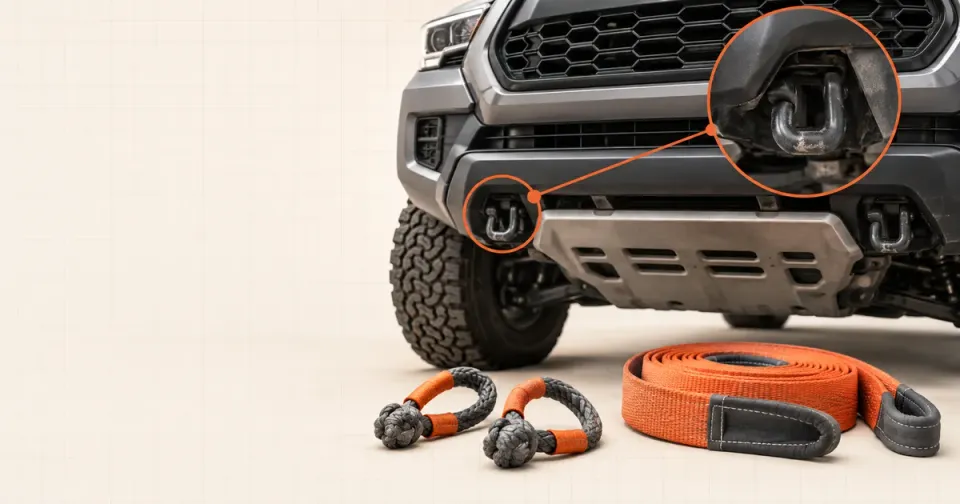
START WITH RATED ATTACHMENT POINTS
Identify vehicle-specific recovery points and their documented limits before buying ropes, shackles or a winch kit. Do not treat an emergency towing eyelet, a tow ball, or unverified hardware as an off-road recovery anchor. Recovery safety depends on the complete recovery train: attachment points, every connecting component, the load and the technique.
Recovery-system snapshot
| Starting point | Verdict | Why | Required check |
|---|---|---|---|
| Traction boards, shovel, tire-air tools and communications | Appropriate low-risk starting layer | They can reduce the need for a loaded pull. | Match equipment to terrain and practice its use. |
| Rated rope/strap with documented vehicle-specific recovery points | Use only as a complete rated system | Every anchor and connector affects the load path. | Verify points, connectors, method and ratings together. |
| Emergency towing eyelet, tow ball or unknown bumper tab | Do not assume recovery-rated | Appearance or towing use does not establish off-road recovery capacity. | Obtain exact manufacturer documentation. |
| Winch system | Advanced, configuration-specific layer | Requires an engineered mount, line, anchor and rigging plan. | Confirm the truck, bumper and winch system before purchase. |
A tow eyelet is not a universal recovery point
Toyota's 2024 Tacoma manual allows its emergency towing eyelets only for a temporary, low-speed tow on hard-surfaced roads and warns against sudden starts that put excessive stress on the eyelets, cables or chains. That is not an approval for off-road snatch recovery. Establish the exact truck's recovery-point options first. Read Toyota's emergency-towing limits.
Toyota's 2024 brochure lists recovery-point equipment by trim, while ARB describes its recovery points as vehicle-specific. Together, these make the core rule clear: identify the Tacoma generation, trim and bumper, then obtain the documentation for the exact attachment point before connecting load-bearing gear. See Toyota's 2024 recovery-point equipment and ARB's vehicle-specific recovery points.
Buy a staged kit, not a bag of unverified hardware
Start with equipment that does not turn the truck into a projectile hazard: a tire-pressure solution, traction boards, gloves, a shovel appropriate to the terrain and a communications/route plan. Add a recovery strap or kinetic rope only after the anchor points and every connecting component are documented for the vehicle and intended method. Add a winch only when the truck has a winch-capable mounting system and the buyer understands line, anchor and rigging requirements. ARB's recovery guidance emphasizes that suitable equipment and recovery technique belong together. Read ARB's recovery basics.
Ratings only work as a complete system
Do not combine a rated rope with an unverified hook, bumper tab, tow ball or random hardware-store connector. The attachment point, rope or strap, shackles, and any pulley or extension need compatible documented ratings for the expected load and recovery method. Inspect equipment before use and remove damaged components from service. If an anchor point, pull direction or load is uncertain, stop and use a qualified recovery service or trained guide.
Bottom line
For a first Tacoma recovery setup, do not start with a generic kit. Start by identifying your exact truck and its documented recovery points, then build upward from low-risk self-recovery equipment to compatible load-bearing gear only when the method, terrain and anchors are clear. If a winch is the next layer, see the third-gen low-profile winch fitment guide.
Sources & notes
- Toyota 2024 Tacoma emergency-towing guidance, accessed 2026-09-04. Limits emergency towing eyelets to a temporary low-speed hard-road tow; it is not off-road recovery guidance.
- Toyota 2024 Tacoma brochure, accessed 2026-09-04. Shows that recovery-point equipment varies by trim; check the exact vehicle.
- ARB recovery points, accessed 2026-09-04. Supports vehicle-specific recovery-point selection.
- ARB recovery basics, accessed 2026-09-04. Supports the system-and-technique framing; it is not a substitute for vehicle-specific recovery training.