
What Tire Sizes Fit a Tacoma Without Rubbing—Stock, Leveled, or Lifted?
Verify fitment with the merchant before you buy.
Reviewed by DoesItFit Editorial · How we evaluate compatibility
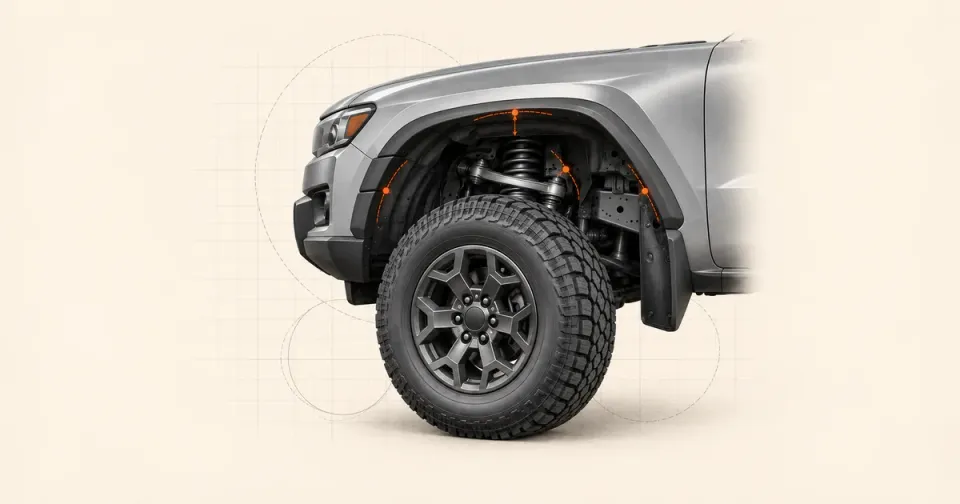
DEPENDS ON THE COMPLETE SETUP
There is no honest universal “largest tire” for a stock, leveled, or lifted Tacoma. Start with the truck's exact factory tire, then evaluate the exact tire SKU, wheel width and offset, suspension, alignment and the motion that must clear. A lift or level alone does not guarantee no rubbing.
Tacoma tire-fitment snapshot
| Setup | What is documented | Verdict | Required check |
|---|---|---|---|
| Stock Tacoma | Toyota documents factory tire sizes by exact grade/package | Use as the baseline, not an aftermarket maximum | Confirm the door placard and factory configuration. |
| Leveled 2024–2026 Tacoma with ReadyLIFT 66-54150 | ReadyLIFT lists 285/70R17 on a 17x8 +35 wheel as a no-trim example for its listed applications | Fits only within that named application | Check kit exclusions, exact tire dimensions and intended travel. |
| Lifted 2024–2026 Tacoma with ReadyLIFT 69-54300 | ReadyLIFT lists 285/75R17 on a 17x8 +35 wheel as a no-trim example | Fits only within that named application | Confirm suspension configuration, exclusions, offset and full-bump clearance. |
| Any different tire, wheel, kit or modified body clearance | No complete application has been established here | Unknown until confirmed | Require manufacturer application data and a physical clearance check. |
Why a generation-wide “maximum tire size” is misleading
Toyota does not equip every Tacoma in a generation with the same tire, wheel, suspension or brake package. The factory examples show the problem:
- Second generation: Toyota documented LT265/70R16 on the 2015 TRD Pro and 265/65R17 on the 2015 TRD Sport. Those are two factory configurations, not two universal second-generation limits. Review Toyota's 2015 Tacoma specifications.
- Third generation: Toyota's 2021 source book lists P245/75R16 for relevant SR5 configurations and P265/70R16 for particular other packages. “Stock 2021 Tacoma” is still incomplete without the grade and package. Check the 2021 Tacoma source book.
- Fourth generation: Toyota's 2026 material includes factory packages with nominal 32- and 33-inch tires, including 33-inch tires on TRD Pro and TRD Off-Road i-FORCE MAX. That complete factory engineering does not automatically transfer to another grade. See Toyota's 2026 lineup notes.
Use the truck's door placard and factory documentation as the starting point. A size fitted by Toyota proves that factory combination—not that every wheel, tire model or trim has the same clearance.
Stock suspension: the tire label is only the first input
Two tires with the same nominal size can have different measured diameter and section width. Load range, tread and approved measuring-rim width can change the real envelope. Wheel offset then moves that envelope inward or outward.
That is why a parked truck can look clear and still rub while reversing at full steering lock, entering a driveway, compressing one front corner or articulating off road. The front liner, mud flap, body-mount area, upper control arm and fender edge are separate clearance checks.
For one exact third-generation example, use the existing guide to check 265/75R16 on a stock 2021 Tacoma SR5. Its conditional result should not be generalized to every 265/75R16 tire or wheel.
Leveled Tacoma: require an exact kit-and-wheel result
A leveling kit changes ride height, but the product maker's own fitment table is what makes a tire example useful. ReadyLIFT lists 285/70R17 on a 17x8 +35 wheel as a no-trim setup for its 66-54150 1.5-inch kit on listed 2024–2026 Tacoma applications. The same page also names untested or excluded configurations. Read the complete 66-54150 application and tire table.
The useful claim is therefore not “a 1.5-inch level clears 285s.” It is: this manufacturer documents this tire size with this wheel width and offset on the listed trucks, subject to its exclusions and clearance notes. A different wheel or tire is a new fitment question.
Lifted Tacoma: more height does not remove every conflict
ReadyLIFT's 69-54300 three-inch kit illustrates the same boundary. Its published table lists 285/75R17 on a 17x8 +35 wheel as a no-trim combination for the kit's listed applications. It also shows that more aggressive wheel specifications can change the result and may require trimming. Review the 69-54300 fitment table and exclusions.
A lift can create vertical room at ride height, but it does not by itself settle rear-of-fender clearance during steering, upper-control-arm clearance, brake clearance or the tire's path at full compression. Alignment—especially caster—and the exact wheel position still matter.
Define what “without rubbing” means before buying
Choose the clearance standard you actually need:
- Normal road driving: straight ahead, ordinary turns and road compression.
- Full-lock road clearance: forward and reverse at both steering locks, including driveway transitions.
- Off-road clearance: steering combined with compression and articulation.
- No-trim requirement: no liner relocation, mud-flap removal, cutting or body-mount work.
A report that passes the first standard does not prove the third or fourth. Ask the tire, wheel or suspension manufacturer which condition its statement covers.
Before you buy
- Record the model year, trim/package, drivetrain and factory tire from the door placard.
- Get the exact tire SKU, load range, published diameter and section width.
- Get the wheel SKU, diameter, width, offset/backspacing, bolt pattern and center bore.
- Identify the exact level/lift part number and every manufacturer exclusion.
- Confirm brake, upper-control-arm, liner, mud-flap, body-mount and fender clearance.
- Plan for alignment, TPMS, spare-tire compatibility and speedometer effects.
- Treat undocumented combinations as unknown until the manufacturer or a qualified installer checks them.
If the wheel is also changing, use the complete Tacoma wheel-fitment checklist before relying on a tire-size recommendation.
Bottom line
The correct tire size is a complete configuration, not a generation-wide number. Factory sizes establish the baseline; a level or lift is useful only when a manufacturer documents the exact application, wheel and tire combination. Final no-rub confidence still requires the intended steering and suspension travel to clear on the actual truck.
Sources & notes
- Toyota 2015 Tacoma product information, accessed 2026-10-15. Factory second-generation examples only; not aftermarket approval.
- Toyota 2021 Tacoma source book, accessed 2026-10-15. Factory third-generation configuration reference only.
- Toyota 2026 Tacoma lineup, accessed 2026-10-15. Factory fourth-generation package examples only.
- ReadyLIFT 66-54150 leveling-kit fitment, accessed 2026-10-15. Applies only to the listed kit, vehicles, wheel/tire setup and exclusions.
- ReadyLIFT 69-54300 lift-kit fitment, accessed 2026-10-15. Applies only to the listed kit, vehicles, wheel/tire setup and exclusions.