
All-Terrain vs Mud-Terrain Tires for a Tacoma: Which Should You Choose?
Verify fitment with the merchant before you buy.
Reviewed by DoesItFit Editorial · How we evaluate compatibility
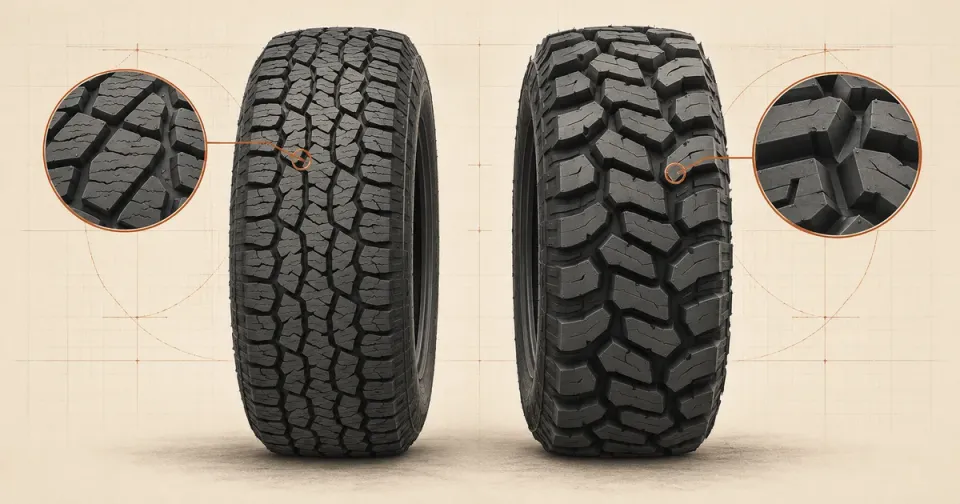
ALL-TERRAIN FOR MIXED USE; MUD-TERRAIN FOR A REAL MUD NEED
Choose all-terrain tires for a Tacoma that spends most of its time on pavement, gravel and mixed trails. Choose mud-terrain tires when repeated deep mud or demanding loose-terrain traction matters enough to accept more road noise, firmer ride, faster wear or lower efficiency in the exact tire you select. Then verify size, load, wheel and clearance separately.
The practical difference
| Decision | All-terrain | Mud-terrain |
|---|---|---|
| Best starting point | Daily driving plus gravel, rock, dirt and occasional mud | Frequent deep mud or loose off-road terrain where self-cleaning voids matter |
| Tread pattern | Usually smaller blocks, more edges/sipes and less open void | Usually larger blocks and wider, more open channels |
| Road priorities | Often better balanced for noise, wet handling, comfort, wear and efficiency | Those traits vary, but aggressive off-road tread usually asks for more compromise |
| Snow decision | Check the exact tire for the Three-Peak Mountain Snowflake mark | Do not infer severe-snow qualification from an M/T or M+S label |
| Tacoma fitment | Category name proves nothing; exact SKU must fit | Category name proves nothing; exact SKU must fit |
This is a category decision, not a universal ranking. One aggressive all-terrain may be heavier or louder than another maker's mild mud-terrain. Compare the exact size and construction you can actually buy.
Choose all-terrain for a daily-driven or mixed-use Tacoma
All-terrain is the stronger default when pavement is most of the mileage and trails include gravel, hardpack, rock and occasional mud. It preserves more room to prioritize wet-road behavior, noise, ride, tread life and fuel use while still adding off-road-oriented tread and construction.
Toyo's current Open Country A/T III is a useful named example, not a definition for every A/T. Toyo describes it as an on-/off-road all-terrain tire, lists wet handling, off-road grip, quiet ride and comfort features, and marks it Three-Peak Mountain Snowflake qualified. In Toyo's own product-family ratings, the A/T III scores below its Open Country M/T for off-road traction but above it for wet and winter handling, tread life, quiet ride, comfort and fuel efficiency. Review Toyo's A/T III product page.
Choose this category when the Tacoma must remain pleasant and predictable on ordinary trips and the off-road need is broad rather than dominated by deep mud.
Choose mud-terrain when mud or loose terrain is a repeated constraint
Mud-terrain earns its compromise when wide voids and tread evacuation solve a condition you encounter frequently. Toyo describes its Open Country M/T as an off-road maximum-traction tire and says its open shoulder channels eject mud and snow while over-the-shoulder tread helps in deep mud and snow. In the same Toyo comparison, it receives the highest off-road-traction score but lower road-oriented scores than the A/T III. Review Toyo's M/T product page.
That does not make every M/T unsuitable for pavement. It means you should demand a measurable reason to accept the exact tire's noise, ride, wear, wet-road, weight and efficiency characteristics. Appearance alone is not that reason.
If the truck reaches deep mud only once or twice a year, an appropriate all-terrain plus recovery planning may be the better ownership trade-off. If mud is a routine access condition, the more open M/T design can be the decisive tool.
A/T, M/T and snow markings answer different questions
“All-terrain,” “mud-terrain,” “all-season,” “M+S” and the Three-Peak Mountain Snowflake symbol are not interchangeable approvals.
The Three-Peak Mountain Snowflake is a performance-qualified severe-snow marking. USTMA's cited truck/bus definition requires a qualifying snow-grip result before the mountain-and-snowflake symbol may be used. That mark does not promise best braking on ice or make every marked all-terrain equivalent to a dedicated winter tire. Read USTMA's severe-snow definition.
Check the sidewall and current specification for the exact size. Do not assume every size in a tire family carries the same markings. For sustained cold, ice and packed-snow use, compare the separate winter-tire versus 3PMSF all-terrain decision.
Tread category does not establish Tacoma fitment
After choosing the category, restart the fitment check at the exact SKU. Record:
- Tacoma year, trim, drivetrain and factory tire placard;
- tire size, construction, service description, load ID and approved rim-width range;
- actual tire weight, inflated diameter and section width for that SKU;
- wheel diameter, width, offset, load capacity and lug-seat hardware;
- clearance at full steering lock and through compression/droop;
- front mud flap, cab mount, liner, upper-control-arm and suspension interfaces; and
- the size, pressure, storage clearance and rotation plan for the spare.
NHTSA's placard framework exists to identify the original tire size and recommended cold pressure and can include load index and speed rating. Start with the label and the exact model-year owner information; do not substitute the maximum pressure molded on the new tire. See NHTSA's placard documentation.
An LT or higher-load-range tire is not automatically the right upgrade. It may add mass and require a different pressure calculation while leaving the Tacoma's certified payload unchanged. Have the tire maker or a qualified tire professional approve the exact load/inflation setup.
For larger sizes, use the Tacoma tire-clearance guide. A lift or leveling kit does not guarantee clearance, and changing from A/T to M/T does not fix a diameter, width or wheel-offset conflict.
Compare exact tires with one worksheet
Do not compare one tire's marketing headline with another tire's owner review. Put the two exact SKUs side by side:
| Input | Tire A | Tire B |
|---|---|---|
| Exact product and size | ||
| Manufacturer-approved vehicle/wheel application | ||
| Load/speed rating and load ID | ||
| Approved rim width | ||
| Weight, diameter and section width | ||
| 3PMSF marking in this size | ||
| Wet-road, noise, ride and warranty documentation | ||
| Mud/rock/gravel features and intended use | ||
| Matching spare available and stowable |
The winner is the tire that meets every non-negotiable constraint with the fewest unnecessary compromises—not the tire with the most aggressive category label.
Compatibility snapshot
| Exact application | Vehicle/use | Result | Required check |
|---|---|---|---|
| Toyo Open Country A/T III in a documented compatible size | Mostly road plus mixed Tacoma trail use | Strong category example | Exact SKU, 3PMSF mark, load/speed, wheel and clearance |
| Toyo Open Country M/T in a documented compatible size | Tacoma regularly used in deep mud or demanding loose terrain | Conditional category example | Exact SKU, road trade-offs, load/speed, wheel and clearance |
| Any tire chosen only because it says A/T or M/T | Unspecified Tacoma and wheel | Unknown until confirmed | Full size/specification and vehicle application |
| Larger tire assumed to fit because the truck is lifted | Modified Tacoma | Do not assume fit | Full-lock and full-travel clearance plus alignment and spare |
Bottom line
For most mixed-use Tacomas, start with an all-terrain tire. Move to a mud-terrain only when regular deep mud or loose-terrain traction justifies the exact tire's road, weight, wear and efficiency compromises. Whichever category wins, fitment still depends on the exact size, construction, wheel, load/inflation plan, clearance and spare—not the letters A/T or M/T.
Sources & notes
- Toyo Tires: Open Country A/T III, accessed 2026-10-15. Named-product on-/off-road positioning, 3PMSF statement, features, warranty and Toyo's within-family performance ratings; not a universal description of all all-terrain tires.
- Toyo Tires: Open Country M/T, accessed 2026-10-15. Named-product off-road positioning, mud-evacuation features, size specifications and Toyo's within-family performance ratings; not a universal description of all mud-terrain tires.
- USTMA: severe-snow use definition, accessed 2026-10-15. Defines the performance threshold and sidewall symbol for the cited truck/bus severe-snow marking; it does not rank the tire's ice braking or warm-weather behavior.
- NHTSA: vehicle tire placard documentation, accessed 2026-10-15. Documents placard fields including original tire size and recommended cold inflation pressure; exact replacement approval still requires vehicle and tire-maker guidance.