
Tacoma Lift vs. Leveling Kit vs. Coilovers: Which Suspension Path Fits Your Goal?
Verify fitment with the merchant before you buy.
Reviewed by DoesItFit Editorial · How we evaluate compatibility
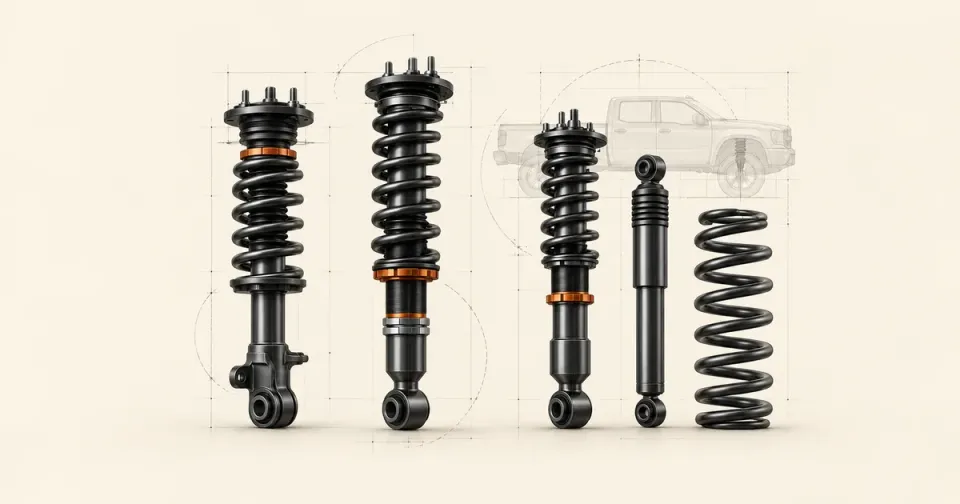
CHOOSE THE PARTS PATH THAT SOLVES THE JOB
Choose a compatible factory-shock leveling path for a modest stance change, replacement coilovers when you need a documented spring-and-damper package, and a coordinated lift when front/rear height and geometry must work as a system. If constant weight is the problem, select load-specific springs first; height alone is not the answer.
Suspension-path snapshot
| Primary goal | Better starting path | What it does not automatically solve |
|---|---|---|
| Reduce front rake while keeping compatible factory shocks | Exact preload/leveling product | Better damping, rear sag, payload or guaranteed tire clearance |
| Change front spring and damper behavior with ride-height adjustment | Vehicle-specific replacement coilover/front kit | Rear suspension, UCAs or a complete lift system |
| Coordinate front/rear height, travel and supporting geometry | Complete documented lift system | Universal trim fitment or every wheel/tire combination |
| Carry known permanent rear/front weight | Load-specific springs and matched damping | Higher certified payload/GVWR/GAWR |
| Fix leaks, looseness, damage or abnormal wear | Inspect and repair first | A lift is not a diagnosis |
“Leveling kit” describes a result, not one part design
The term can refer to a top spacer, preload collar, adjustable spring seat or replacement strut/coilover. Those parts do not alter the suspension in the same way, so shop by exact design and application.
Westcott's current 2024–2026 Tacoma preload-collar product is one factory-component path: it retains compatible factory shocks and springs, and its published lift differs for SR, TRD Pro, Limited with AVS and Trailhunter configurations. Westcott also calls for alignment and warns against stacking rear pucks. Review the trim-specific Westcott application.
That supports a narrow conclusion: a compatible preload product can be suitable when the main goal is stance while retaining the named factory components. It does not prove that every “leveling kit” preserves factory behavior or fits every fourth-generation suspension.
Coilovers change more than the visible height
A coilover combines the spring and damper around one assembly, but the category still does not guarantee adjustability, damping features or complete-vehicle coverage.
Bilstein's B8 6112 #47-333246 is a concrete example. Bilstein lists two 60 mm front dampers, two matched springs and spring seats, with snap-ring positions providing application-dependent front lift. The damping is non-adjustable even though the spring-seat height is adjustable. Review Bilstein 47-333246.
This path makes sense when that specific spring-and-damper package solves a ride-control or front-height goal. It remains a front kit. Do not assume the rear springs, rear shocks, UCAs or every required installation component are included.
For the narrower fourth-generation comparison, see Bilstein coilovers versus a preload-collar lift.
A complete lift is defined by its parts and application
Toyota's PTCCY-35380 demonstrates a coordinated system rather than a universal recipe. Toyota lists Bilstein-tuned front and rear shock absorbers, front coil springs and forged upper control arms, while limiting the application to hybrid TRD Sport and TRD Off-Road short-bed trucks. Review Toyota's exact TRD lift kit.
The lesson is not that every lift needs those parts. It is that a complete system names its front and rear components, exact vehicle application, wheel/tire boundary and supporting geometry. A front-only product sold by lift height should not be mistaken for that complete system.
If the path is already selected, use the fourth-generation Tacoma lift-installation checklist to plan professional work, alignment, headlight aim, applicable ADAS checks and finished clearance verification.
Constant load is a spring-selection problem before it is a stance problem
If a bumper, winch, drawers, topper, bed rack or RTT stays on the truck, measure its net installed weight. ARB/Old Man Emu's 1012K listing illustrates load-specific selection by publishing front and rear load bands for a named 2016–2023 Tacoma system. Review the OME 1012K load-specific application.
A front level does not correct rear sag from permanent cargo. A stiffer rear spring chosen without real load can also produce an unsuitable unloaded result. Start with the constant-rear-weight Tacoma suspension guide and the payload-after-modifications worksheet.
Load-specific suspension may improve stance and control; it does not create a new occupant-and-cargo placard value.
Tire clearance is a separate finished-vehicle test
More advertised lift does not guarantee more clearance everywhere. The exact wheel width/offset, tire dimensions, alignment/caster, liner, mud flap, body-mount area and suspension travel still decide rubbing.
Use the Tacoma tire-size no-rub guide after choosing the suspension path. Require a tire statement tied to the exact suspension kit, wheel and application rather than assuming a height number clears a nominal tire size.
What must be verified for every path?
- Exact generation, model year, trim, drivetrain, powertrain and factory suspension.
- Whether the truck has AVS, TRD Pro/Trailhunter hardware or another application boundary.
- Front and rear components included—and what remains factory.
- Target height at the truck's real permanent load.
- Wheel/tire clearance, shock travel, bump/droop limits and alignment range.
- Whether UCAs, bump stops, sway-bar parts, brake/ABS provisions or driveline checks are documented by that system.
- Professional installation requirements, alignment, headlight aim and applicable ADAS checks.
- Service, inspection and recheck instructions from the exact manufacturer.
Do not add a UCA, differential spacer or other corrective component from lift height alone. Follow the chosen system's documentation and the finished truck's measured geometry.
Bottom line
Use a compatible factory-shock leveling product when stance is the narrow goal. Choose replacement coilovers when their exact spring/damper design solves a control or adjustment need. Choose a coordinated lift when front and rear components and geometry must work together. If permanent weight is driving the decision, calculate the load first and select springs for it—without claiming extra payload.
Sources & notes
- Westcott Designs 2024–2026 Tacoma preload-collar kit, accessed 2026-10-15. Product-specific factory-shock/spring and trim-dependent lift claims; not universal leveling guidance.
- BILSTEIN B8 6112 #47-333246, accessed 2026-10-15. Documents one 2024–2026 Tacoma front spring/damper kit and its stated adjustment; not a complete rear lift.
- Toyota TRD Suspension Lift Kit PTCCY-35380, accessed 2026-10-15. Exact coordinated-system example with a narrow application; does not establish requirements for another kit.
- ARB/OME 1012K, accessed 2026-10-15. Exact load-banded system example; does not change Toyota's certified vehicle limits.