
How Much Tacoma Payload Is Left After Bumpers, Sliders, Racks, and an RTT?
Verify fitment with the merchant before you buy.
Reviewed by DoesItFit Editorial · How we evaluate compatibility
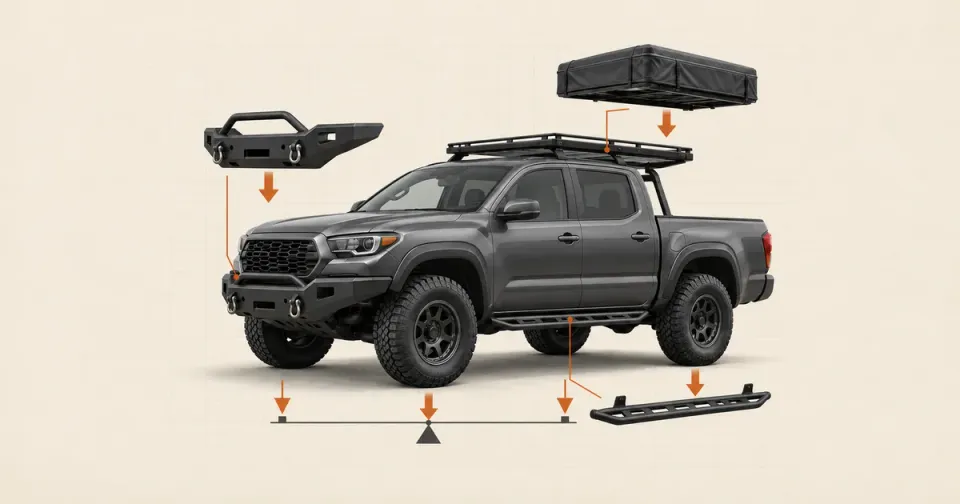
CALCULATE FROM YOUR TRUCK'S PLACARD
Remaining payload is the door-jamb occupant-and-cargo allowance minus people, net weight added by modifications, trip cargo and any trailer tongue load. Do not use a Tacoma brochure's maximum. Replacements require the new part's weight minus what came off, and the finished truck must remain within GVWR and both axle ratings.
Payload-accounting snapshot
| Input | How to count it | Common mistake |
|---|---|---|
| Door-jamb occupant-and-cargo limit | Starting allowance for the exact truck | Using an advertised maximum from another configuration |
| Added rack, tent, sliders, armor, drawers and gear | Subtract actual installed weight | Ignoring mounting hardware or permanently stored gear |
| Replacement bumper or other removed/replaced part | Subtract net change: installed minus removed | Charging the full new-product weight without credit for removed parts |
| Driver and passengers | Subtract their actual combined weight | Treating the driver as already excluded |
| Trailer tongue load | Subtract load transferred to the truck | Looking only at trailer weight rating |
| Front/rear axle load | Compare scale weight with each GAWR | Assuming total margin guarantees axle margin |
Start with the label on your Tacoma
Toyota's 2026 load-limit procedure begins with the vehicle placard statement: “The combined weight of occupants and cargo should never exceed” the value printed for that truck. Toyota then subtracts the combined occupant weight to determine available cargo/luggage capacity. Review Toyota's owner-manual load calculation.
That placard is more useful than “up to” payload advertising because Tacoma payload varies with cab, bed, drivetrain, powertrain, trim and equipment. Toyota's 2026 brochure also states that payload includes occupants, cargo and options and is limited by weight distribution. See Toyota's payload disclosure.
Record three limits from the exact truck:
- the occupant-and-cargo placard value;
- GVWR, the maximum allowed total vehicle weight; and
- front and rear GAWR, the maximum allowed weight on each axle.
Use the owner's manual for the truck's model year. The method here uses current 2026 Toyota documentation; it does not manufacture a payload number for another Tacoma.
Use one worksheet for permanent and trip weight
The practical calculation is:
remaining payload = placard allowance − occupants − net added modifications − trip cargo − trailer tongue load
Keep a build sheet with the source for every number. Manufacturer weights are useful planning inputs, but a scale is stronger when coatings, hardware, wiring, recovery gear and removed factory parts are uncertain.
For replacement parts, use the net change. If an aftermarket bumper weighs 114 lb but replaces factory pieces, the payload debit is not automatically 114 lb. Subtract the verified removed assembly weight or compare before/after scale readings under the same fuel and cargo conditions.
How quickly can common modifications add up?
Four current manufacturer examples show why this calculation matters:
- C4 lists 114 lb for its fourth-gen Overland front bumper without a bull bar. Check the exact C4 variant.
- Cali Raised lists approximately 125 lb per set for its fourth-gen Step Edition sliders. Check the exact slider configuration.
- Prinsu lists 45 lb for its 2024–2026 Tacoma Original roof rack. Check the rack specification.
- iKamper describes the Skycamp Mini 3.0 as 125 lb in its mounting guidance. Check the tent example.
Those published figures total 409 lb gross. That is not a recommended build and not its net payload debit: the bumper replaces factory parts, and the example omits a winch, lights, wiring, rack mounts, bedding, tools and other gear. Its purpose is to show that category-level estimates hide hundreds of pounds.
A scale resolves what product pages cannot
Use a vehicle scale with the truck in the state you want to evaluate:
- normal fuel level;
- driver and expected passengers aboard;
- permanent modifications and always-carried gear installed;
- trip cargo loaded and secured; and
- trailer connected with its real tongue load when towing.
Compare total scale weight with GVWR and each axle result with its GAWR. A build can be under the overall payload calculation yet overload the rear axle because an RTT, bed rack, drawers, spare tire and tongue load are concentrated rearward. A heavy bumper/winch can consume front-axle margin instead.
Toyota notes that optional equipment, passengers and cargo reduce towing capacity and that tongue weight is load placed on the hitch ball. Review Toyota's towing-weight definitions.
Heavier springs do not create a new payload label
Load-specific rear springs or dampers can improve loaded stance and motion control when correctly selected. They do not erase the truck's occupant-and-cargo placard, GVWR or axle ratings. Continue using the certified labels unless Toyota or an authorized legal recertification process supplies different documentation for that vehicle.
If constant rear weight is causing sag, use the separate Tacoma suspension guide for constant rear weight after establishing the real load. Suspension selection follows the weight calculation; it does not replace it.
Before you add the next modification
- Photograph the labels and keep the values in the build sheet.
- Record exact product variants, installed weights and removed-part weights.
- Include winch rope/fairlead, lights, wiring, coatings, brackets, tools, water and permanently stored recovery gear.
- Add people, pets and ordinary trip cargo.
- Include tongue load when towing.
- Check rack, roof, bed, tent and mounting-system limits separately; payload is not permission to exceed a component rating.
- Reweigh after a major build change.
For an RTT build, also compare roof-rack versus bed-rack limits and trade-offs. The lowest applicable vehicle or component limit still controls.
Bottom line
Your remaining payload is not a trim-level guess. Start with the exact door placard, subtract people and the net installed weight of modifications, then subtract trip cargo and tongue load. Finally, confirm total and front/rear axle weights on a scale. If any required weight is unknown, the honest result is unknown until measured.
Sources & notes
- 2026 Toyota Tacoma Owner's Manual, accessed 2026-10-15. Supplies Toyota's placard-based occupant/cargo calculation and vehicle-load-limit framework.
- 2026 Toyota Tacoma brochure, accessed 2026-10-15. States payload includes occupants, cargo and options and is limited by distribution; advertised figures remain configuration-specific.
- 2026 Tacoma trailer-towing manual section, accessed 2026-10-15. Defines towing-related loads and explains that equipment, passengers and cargo reduce capacity.
- C4 bumper, Cali Raised sliders, Prinsu rack and iKamper mounting guide, accessed 2026-10-15. Exact-product gross-weight examples only; not combined fitment or net payload approval.