
What Else Do You Need to Install a Lift on a 2024+ Tacoma?
Verify fitment with the merchant before you buy.
Reviewed by DoesItFit Editorial · How we evaluate compatibility
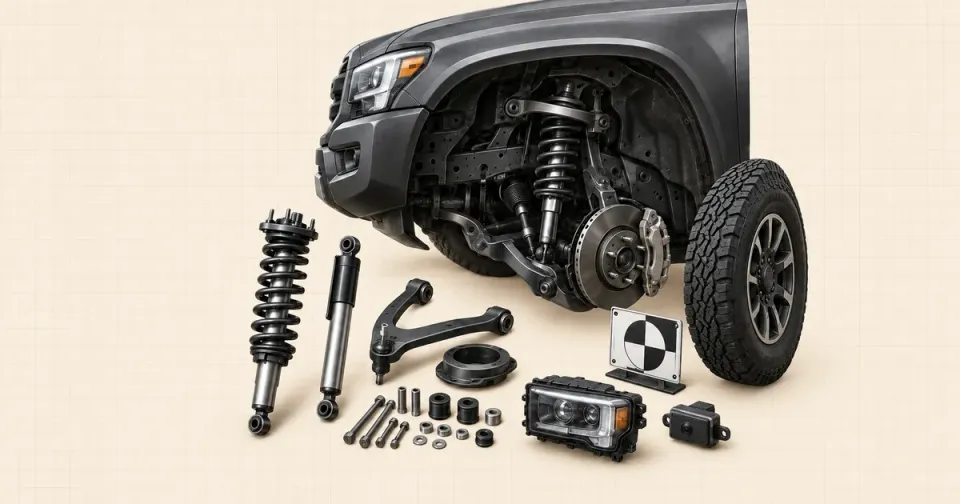
PLAN THE COMPLETE SYSTEM AND POST-INSTALL CHECKS
A 2024+ Tacoma lift needs more than a height number: exact trim/factory-suspension fitment, the complete front-and-rear parts list, professional installation, wheel alignment, headlight-aim and applicable ADAS checks, plus verification of wheels, tires, load and other modifications. UCAs or driveline parts are required only when the exact system documents them.
Start with the truck, not the advertised lift height
The fourth-generation Tacoma does not have one universal suspension configuration. Record the model year, grade, powertrain, cab/bed and factory suspension before choosing parts. Limited-grade Adaptive Variable Suspension is a particularly important boundary; a kit must explicitly support it rather than borrowing fitment from a TRD Off-Road or TRD Sport.
Use the exact kit application and current instructions. A page that lists “2024–2026 Tacoma” is a starting point, not permission to ignore factory suspension or other installed modifications.
Which parts belong in the lift system?
That depends on the named kit. Toyota's PTCCY-35380 listing illustrates how specific the package can be: Toyota names Bilstein-tuned front and rear shock absorbers, forged upper control arms and front coil springs, and limits the published application to hybrid TRD Sport and TRD Off-Road short beds. Review Toyota's exact TRD kit listing.
Bilstein's B8 6112 #47-333246 is a different product boundary. Its page describes a 2024–2026 Tacoma front suspension kit with two dampers, matched front springs and spring seats. That does not automatically supply a complete rear lift, upper control arms or every installation part for a buyer's target stance. Review Bilstein's current kit.
Before buying, list:
- exact left/right front assemblies and selected height setting;
- rear springs, spacers or shocks, if the plan changes rear height or load support;
- upper control arms only when included or required by the exact system;
- bump stops, sway-bar parts, brake-line/ABS provisions and fasteners named by the instructions; and
- any documented interaction check for CV axles, steering, driveline or existing aftermarket parts.
Do not add or omit a component from a generic internet checklist.
Is professional installation and alignment part of the job?
For the cited Bilstein system, yes. Bilstein's installation document says suspension-component installation requires special tools and expert knowledge and must be performed by a professional automotive suspension technician. Coilover spring assembly creates stored energy; this is not a casual compression task.
The same Bilstein instruction explicitly requires a wheel-alignment check and adjustment to vehicle-manufacturer specifications after installation. Read Bilstein instruction E-WM05-0000138AA.
Budget alignment as part of installation, not as an optional response to uneven tire wear. Use the finished ride height and normal vehicle load specified by the installer or manufacturer.
What electronic and lighting checks follow a lift?
Bilstein directs the installer to check and adjust headlight aim and, where applicable, check and recalibrate Advanced Driver Assistance Systems to the vehicle manufacturer's specifications. Toyota's driving-support excerpt also warns that non-genuine suspension or non-specified tire sizes can affect system operation. Review Toyota's driving-support guidance.
The exact service step depends on what changed and what the truck is equipped with. Confirm:
- headlamp aim at the finished ride height;
- TSS/ADAS warnings and the kit/vehicle calibration procedure;
- any camera or radar check required by Toyota or the installer; and
- correct operation after alignment and calibration.
No warning light by itself is not proof that sensor aim is correct.
Do you automatically need upper control arms?
No universal rule is supported. Toyota includes forged upper control arms in PTCCY-35380, but that proves the contents of that Toyota system—not that every 2024+ Tacoma lift requires aftermarket UCAs.
For another kit, follow its explicit application, geometry and alignment requirements. If target alignment cannot be achieved within the documented procedure or a component contacts through steering/suspension travel, stop and resolve the system with the kit maker or qualified installer rather than buying a generic corrective part by lift height alone.
Will the advertised lift clear the tires you want?
Not automatically. Bilstein says actual lift height depends on the factory suspension and condition, optional equipment/accessories, other modifications and wheel/tire combinations. Toyota recommends OEM wheels and tires for PTCCY-35380 and warns that sizes larger than 285/65R20 may contact surrounding parts on that named system.
For the finished truck, check clearance at full steering lock and through suspension travel, with the actual wheel width/offset, tire dimensions, liner, mud flaps and load. A lift number is not a tire-clearance guarantee.
Check load and condition before modifying height
Measure constant front and rear accessory/cargo load. A spacer or height setting does not create the spring rate or damping needed for unplanned constant weight. If the truck already has looseness, damaged dust covers, leaks, uneven ride height or abnormal tire wear, inspect and repair the baseline suspension before using a lift to mask the symptom.
After installation, follow the exact maker's fastener recheck, ride-height measurement and service guidance. Do not invent a universal re-torque interval.
Before you buy
Ask: “I have a [year/trim/powertrain/bed] Tacoma with [factory suspension], these wheels/tires and this constant load. Does this exact front-and-rear lift system include every required part, and what does it require for alignment, headlight aim, ADAS, UCA, CV/driveline and clearance checks?”
Get the current installation PDF before ordering. If the seller cannot identify the exact factory suspension and full kit contents, the installation plan remains incomplete.
Compatibility snapshot
| Product/application | Documented system boundary | Result | Required check |
|---|---|---|---|
| Toyota PTCCY-35380 | Hybrid TRD Sport/TRD Off-Road short bed; includes named front/rear dampers, front springs and UCAs | Narrow Toyota-listed system | Verify VIN application, OEM wheel/tire guidance and full instructions |
| Bilstein B8 6112 #47-333246 | 2024–2026 Tacoma front kit | Front suspension system, not a universal complete lift | Confirm trim/factory suspension, rear plan and professional installation |
| Any lift sold only by desired height | 2024+ Tacoma | Incomplete fitment claim | Require exact part numbers, truck configuration and system contents |
| UCA or driveline add-on chosen only from lift height | 2024+ Tacoma | Unknown until the exact system documents it | Use kit geometry/instructions and qualified inspection |
Bottom line
A complete 2024+ Tacoma lift plan includes exact vehicle-and-kit fitment, all required front/rear components, professional suspension work, alignment, headlight aim, applicable ADAS checks and finished tire/load/clearance verification. Do not treat UCAs, driveline parts or tire clearance as automatic conclusions from the advertised lift height.
If you are still choosing the suspension approach, compare Bilstein coilovers with a preload-collar lift before building the installation list.
Sources & notes
- BILSTEIN B8 6112 #47-333246, accessed 2026-10-15. Documents the 2024–2026 Tacoma front-kit application, contents and stated adjustment range; it does not establish complete rear, UCA or trim-specific compatibility.
- BILSTEIN mounting instruction E-WM05-0000138AA, accessed 2026-10-15. Requires professional installation and post-install alignment, headlight and applicable ADAS checks for the named instruction scope.
- Toyota TRD Suspension Lift Kit PTCCY-35380, accessed 2026-10-15. Defines the named Toyota kit's components, narrow application and wheel/tire warning; it does not approve other trims.
- Toyota 2024 Tacoma Hybrid driving-support excerpt, accessed 2026-10-15. Establishes that non-genuine suspension and non-specified tires can affect driving-support operation.