
How Do You Fix Tacoma Rear Sag From a Topper and Drawers?
Verify fitment with the merchant before you buy.
Reviewed by DoesItFit Editorial · How we evaluate compatibility
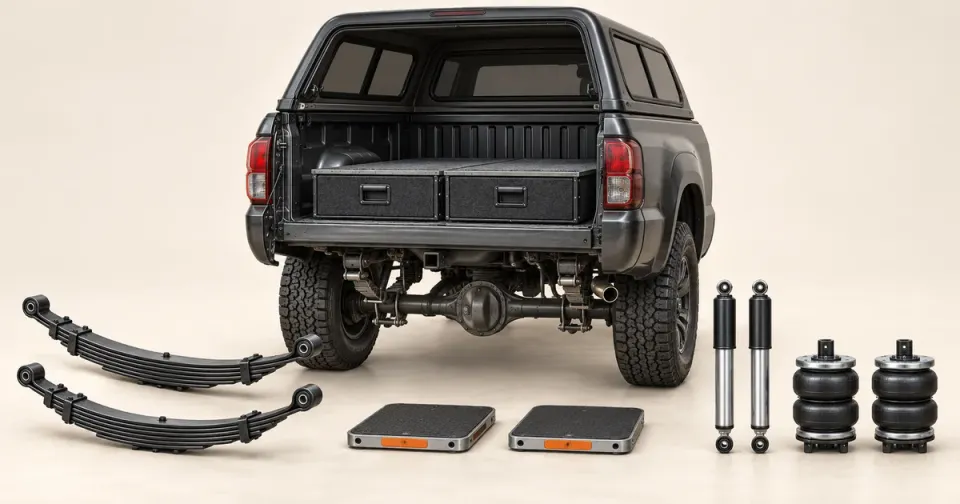
WEIGH FIRST; THEN MATCH THE REAR SPRING TO HOW THE LOAD IS USED
For a Tacoma carrying a topper, drawers and roughly 600 lb continuously, start with loaded axle weights and the truck's certified limits. A matched constant-load leaf system is the direct solution for permanent weight; adjustable air helpers suit loads that genuinely vary. Shocks control motion but do not carry static load. None of these parts increases payload, GVWR, rear GAWR, or tire and wheel ratings.
Rear sag is a measurement problem before it is a parts problem
“About 600 lb” is a useful starting estimate, but it is not the rear-axle load. A topper, drawer system, rear bumper, rack, tools and cargo sit at different distances from the axle. Occupants and front accessories change the complete vehicle calculation too.
Before ordering suspension parts:
- Record the Tacoma's model year, drivetrain, cab/bed and current suspension or lift.
- Read the occupant-and-cargo limit, GVWR, front GAWR and rear GAWR from the truck's labels.
- Measure hub-to-fender height at all four corners unloaded and in normal travel condition.
- Weigh the normally loaded truck with ordinary occupants, fuel and equipment; obtain separate front and rear axle weights.
- Inspect the existing leaves, shackles, bushings, bump stops, shocks, tires and wheels for wear or damage.
If the loaded truck exceeds a certified or component limit, the first correction is removing or redistributing weight. A taller or stiffer spring can restore ride height; it cannot make an overloaded Tacoma legal or mechanically approved.
Constant-load leaf springs are the direct path for permanent weight
A leaf spring carries static rear weight and establishes the loaded ride height. If the topper, drawers and core equipment stay installed for ordinary driving, choose a manufacturer load category that matches the measured permanent load and the exact Tacoma application.
ARB currently lists two Old Man Emu Nitro Plus system examples for 2016–2023 Tacoma:
| OME kit | Current advertised load configuration | Appropriate starting question |
|---|---|---|
| 1012K | Front 0 lb; rear 600 lb; 2-inch front/rear lift | Is the front near stock weight while the rear carries the constant build? |
| 1013K | Front 220–330 lb; rear 600 lb; 2-inch front/rear lift | Does the truck also carry documented permanent front weight? |
Do not substitute 1013K merely because both kits mention 600 lb at the rear; its front-load category is different. Also note a live-source conflict: ARB's 1012K title says 600 lb rear load while the specification block currently says 660 lb. Obtain written clarification from ARB or the installer before using that difference as a purchase boundary.
For a narrower medium-versus-constant-load leaf decision, the OME EL111R versus EL112R guide covers OME's separate 300 kg application. Do not combine leaf names and kit numbers without the current OME component list.
Air helpers make more sense when the load really changes
Air-helper springs supplement the existing leaf spring and can be adjusted for changing cargo or tongue load. Air Lift lists LoadLifter 5000 kit 57300 for 2005–2023 Tacoma 4WD and named 2WD leaf-over-axle applications. It specifies a 5–100 psi adjustment range and up to 5,000 lb of leveling capacity.
That 5,000 lb figure is the helper system's leveling capacity—not added Tacoma payload. The exact truck must still remain within its label, axle, tire and wheel limits.
Air helpers are a stronger candidate when:
- the topper or drawers are removable;
- the truck alternates between empty daily use and loaded trips;
- trailer tongue weight changes between trips; or
- left/right leveling needs controlled adjustment within the manufacturer's instructions.
For a truly constant 600 lb build, relying on high air pressure to compensate for an underspecified or worn leaf pack can leave the base suspension mismatched. The leaf system should first be healthy and appropriate for the permanent load.
Shocks do not fix static sag
The rear shock controls spring motion. It influences bounce, heat management and control over rough surfaces, but it does not hold the topper and drawers at ride height.
Select shocks after the spring path and final ride height are known. Confirm:
- exact Tacoma and drivetrain application;
- compressed and extended length at the resulting height;
- available bump and droop travel;
- reservoir, frame, tire and exhaust clearance;
- brake-hose and ABS-wire routing; and
- damping intended for the selected spring/load system.
A premium shock paired with the wrong leaf rate will not correct the underlying static-load mismatch.
Do you need both heavy leaves and air helpers?
Not automatically. A correctly selected constant-load leaf system may solve the permanent sag and motion baseline without air helpers. Adding air support can be justified when the load varies beyond that baseline, but it should not be treated as a mandatory bundle.
If both are proposed, require the installer to document:
- the normal leaf-supported ride height;
- minimum and normal air pressure;
- bump-stop and full-droop clearances;
- air-line routing and heat/abrasion protection;
- which load variation the air springs are meant to correct; and
- how the setup behaves if pressure falls to the allowed minimum.
Avoid tuning by appearance alone. A level bedside can coexist with insufficient bump travel, excessive rear-axle load or poor front-to-rear balance.
Toyota limits stay in force
Toyota's published 2023 Tacoma payload figures vary substantially by engine, transmission, drivetrain, cab/bed and trim. A brochure maximum is therefore not the payload of the truck in front of you.
Use the exact certification and tire-and-loading labels. Payload includes occupants, cargo and installed options. Compare loaded scale tickets with GVWR and both axle ratings, not just the rear stance. Also confirm the load index and pressure requirements of the fitted tires and the load rating of aftermarket wheels.
The remaining-payload guide provides the arithmetic for permanent accessories. If towing contributes to the sag, use the Tacoma towing-readiness checklist and count actual tongue load rather than treating an airbag setting as a towing-capacity increase.
Compatibility snapshot
| Loaded-truck condition | Best starting path | Evidence boundary |
|---|---|---|
| Roughly 600 lb stays on a 2016–2023 Tacoma | Exact constant-load leaf/system application such as the cited OME path | Confirm axle weights, 1012K/1013K front-load category and ARB's 600/660-lb inconsistency |
| Load varies substantially between empty and travel | Exact adjustable air-helper application such as Air Lift 57300 | Confirm drivetrain/suspension fit; helper capacity is not vehicle payload |
| Correct spring rate but poor bounce or heat control | Matched rear shock | Shock must match travel and load; it does not restore static height |
| Truck exceeds payload, rear GAWR, GVWR, tire or wheel rating | Remove or redistribute load | Suspension changes cannot authorize the overload |
Before you buy
- Get normal-travel front and rear axle weights, not only an accessory-weight estimate.
- Confirm the equipment remains installed during ordinary driving.
- Match the spring or helper kit to the exact Tacoma and existing lift.
- Ask for expected loaded height and available bump/droop travel.
- Resolve the ARB 1012K 600-versus-660 lb page conflict in writing if considering that kit.
- Confirm shocks, brake lines, ABS wiring, bump stops and tire clearance after the height change.
- Reweigh the completed truck and obtain an alignment and headlight-aim check when ride height changes.
- Re-torque and inspect the installation at the component maker's stated interval.
Bottom line
For a topper-and-drawer Tacoma that carries roughly 600 lb all the time, a correctly matched constant-load leaf system is the cleanest starting point. Use adjustable air helpers when the load genuinely changes, and choose shocks to control the selected springs. The decisive proof is the loaded axle-scale ticket plus the truck's labels—not whether a suspension part can make the bedside look level.
Sources & notes
- ARB OME Nitro Plus 1012K, accessed 2026-10-16. Exact 2016–2023 Tacoma system example with 0-lb front/600-lb rear title; the live specification block says 660 lb, so written clarification is required.
- ARB OME Nitro Plus 1013K, accessed 2026-10-16. Exact 2016–2023 example with a different 220–330 lb front-load category and 600-lb rear category.
- ARB third-gen Tacoma catalogue, accessed 2026-10-16. Confirms the separate current kit paths; availability is not fitment proof for a modified truck.
- Air Lift LoadLifter 5000 kit 57300, accessed 2026-10-16. Current 2005–2023 Tacoma application record, 5–100 psi range and component leveling-capacity claim. The rating does not increase Toyota's certified limits.
- Toyota 2023 Tacoma specifications, accessed 2026-10-16. Demonstrates configuration-dependent payload; the exact truck's labels remain controlling.
- Toyota 2026 Tacoma owner's manual, accessed 2026-10-16. Used for the general occupant-and-cargo accounting method; apply the manual and labels for the actual model year.
- This guide substantially updates the existing canonical URL and consolidates the later TQ-271 constant-load question rather than creating a duplicate. The new hero is an original centered generic illustration, not payload or product-fitment evidence.