
How Do You Find Your Tacoma's Exact Configuration?
Verify fitment with the merchant before you buy.
Reviewed by DoesItFit Editorial · How we evaluate compatibility
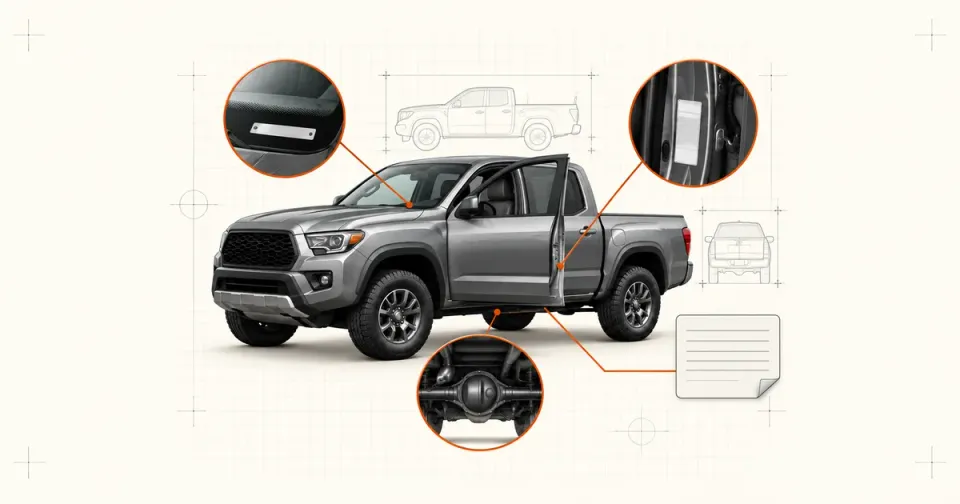
START WITH THE VIN—FINISH WITH THE ACTUAL TRUCK
Enter the 17-character VIN in Toyota's Vehicle Specification tool, then verify the VIN and installed equipment on the truck. Record model year, grade, cab, bed, powertrain, transmission, drivetrain, suspension and factory options. A VIN result identifies the built configuration; it does not prove that equipment remains installed or that an aftermarket SKU fits.
Where should you start?
Use Toyota's Vehicle Specification VIN tool as the primary record for a U.S.-market Tacoma. Toyota asks for the 17-character VIN and says the result can provide build year, color, technical specifications, optional equipment and more. Its result categories include basic vehicle information, additional vehicle information, port- or factory-installed equipment and standard equipment.
Toyota identifies four practical places to find the VIN:
- the driver-side dashboard near the windshield;
- the driver-side doorjamb label;
- the vehicle registration card; and
- the insurance identification card.
Compare at least one document with the VIN physically displayed on the truck. If they do not match, stop before ordering parts and resolve the vehicle identity.
Do not post the complete VIN in a public forum or marketplace question. A trusted Toyota dealer or manufacturer support team may need it, but a public fitment request can normally use the configuration fields you extract from it.
What should you record from the Toyota VIN result?
Build a short fitment profile. Use the manufacturer's exact terminology where available.
| Field | Why parts sellers ask for it | Commonly affected categories |
|---|---|---|
| Model year and generation | Establishes the platform and refresh boundary | Nearly every mounted part |
| Grade/trim | Narrows factory hardware and packages | Skids, bumpers, lighting, suspension, interior |
| Cab | Changes roof/body/frame-side geometry | Racks, steps, sliders, interior parts |
| Bed length | Changes rail span, floor length and wheelbase application | Covers, racks, mats, shells, cargo systems |
| Engine/powertrain | Changes powertrain-adjacent space and electronics | Intake, exhaust, skids, tuning, cooling |
| Transmission | Changes controls, mounts and underbody application | Driveline, shifters, skids, electronics |
| Drivetrain | Changes transfer-case/front-driveline hardware | Skids, suspension, gears, recovery and towing |
| Suspension/factory off-road hardware | Changes mounts, travel, sensors and clearance | Shocks, springs, skids, wheels/tires |
| Port/factory-installed equipment | Reveals option-specific interfaces and conflicts | Cameras, rails, covers, lamps, armor, towing |
Save the result or write these fields into a build record. Do not reduce the profile to “2024 TRD Off-Road” or another badge.
Why are year and trim not enough?
One model year and grade can still have multiple configurations. Toyota's 2024 Tacoma specification table is a clear example:
- Double Cab configurations can use a nominal 5- or 6-foot bed, while XtraCab uses the 6-foot bed in the documented launch lineup.
- i-FORCE gas and i-FORCE MAX hybrid powertrains occupy different applications.
- Toyota lists rear-wheel drive, part-time four-wheel drive and, on a named hybrid Limited configuration, full-time four-wheel drive.
- Rear suspension can be leaf spring or coil-spring multi-link depending on configuration.
- Stabilizer Disconnect Mechanism is available or standard only on named configurations.
Review Toyota's 2024 Tacoma configuration matrix. The table proves that configuration fields vary; it does not identify one truck without its VIN/build record.
For an older or newer Tacoma, use that model year's Toyota documentation. Do not apply the 2024 grade matrix to another year because packages and standard equipment can change.
How do you confirm cab and bed length?
Use the Toyota VIN record first, then visually and physically cross-check the truck.
- Cab: confirm the manufacturer description and door/seating layout. Toyota changed cab names and availability across generations.
- Bed: measure inside the closed bed from the front wall to the tailgate, then compare the measurement with Toyota's specification for that exact model year.
- Generation: establish the model year before relying on cab or bed terminology.
For third-generation trucks, Toyota documents nominal 5- and 6-foot beds with specific Access Cab and Double Cab combinations. Fourth-generation choices use XtraCab and Double Cab. Continue with the Tacoma cab and bed-length fitment guide when the part mounts to the roof, frame or bed.
A tape measure is a cross-check, not a substitute for an exact application. Sellers round bed lengths and may use “short,” “standard,” “long,” “5-foot” or “6-foot” differently.
How do you confirm gas/hybrid, transmission and drivetrain?
Read the Toyota record and compare it with the truck's controls and underbody. Record:
- engine or powertrain designation;
- i-FORCE gas or i-FORCE MAX hybrid on 2024+ applications;
- automatic or manual transmission;
- 2WD, part-time 4WD or full-time 4WD where applicable; and
- factory rear differential or off-road equipment when the product asks for it.
Do not infer drivetrain from ride height, tires, decals or a seller's description. For fourth-generation powertrain-adjacent parts, use the i-FORCE versus i-FORCE MAX fitment guide after identifying the truck.
What can the VIN record miss?
Toyota's record describes the built vehicle and listed equipment. It cannot be assumed to show every change made after production. Inspect for:
- dealer-installed accessories not reflected in the returned record;
- removed factory skids, steps, rails, covers or tow equipment;
- owner-installed suspension, bumpers, wiring, cameras or lighting;
- collision repairs and replacement body/front-end parts;
- swapped beds, axles, seats, wheels or drivetrain components; and
- existing aftermarket parts that share the new product's mounts.
This is why the workflow ends with the actual truck. A correct VIN does not make a removed crossmember reappear or prove that a previous owner preserved factory wiring.
Use the factory-options fitment checklist to inspect the specific mounting area.
Should you also use the NHTSA VIN decoder?
NHTSA's vPIC VIN Decoder is a useful independent cross-check for information encoded in the VIN. NHTSA says the tool identifies specific vehicle information encoded in that number.
Use vPIC to confirm broad identity fields when needed. Do not treat it as a Toyota build sheet or a complete list of port, dealer or optional equipment. For Toyota-specific configuration, prefer Toyota's vehicle record and current physical inspection.
How do you turn the information into a parts-fitment check?
Create one reusable vehicle line. For example:
> 2025 Tacoma TRD Off-Road Double Cab, 5-foot bed, i-FORCE MAX, automatic, part-time 4WD, coil rear suspension, SDM, factory TRD front skid and front camera.
Then compare that line with the exact manufacturer SKU—not a marketplace title or a category page.
Ask four questions:
- Does the application name the correct year or generation?
- Does it resolve every relevant field: cab/bed, powertrain, transmission, drivetrain, suspension and factory options?
- Do the installation instructions retain or remove existing equipment?
- Is your current truck still in the documented factory state at those mounts?
If a relevant field is absent, the honest verdict is unknown until the manufacturer confirms it.
Compatibility snapshot
| Identification source | What it can establish | Result | Required check |
|---|---|---|---|
| Toyota Vehicle Specification result for the exact VIN | Manufacturer build/specification and listed equipment | Primary starting record | Verify returned fields and current installed state |
| VIN on dashboard/doorjamb plus registration | Vehicle identifier consistency | Identity cross-check | Resolve any mismatch before ordering |
| NHTSA vPIC decode | VIN-encoded vehicle information | Independent cross-check | Do not treat it as a complete Toyota options list |
| Trim badge or seller description alone | Partial marketing identity | Insufficient | Obtain VIN record and inspect the vehicle |
| Exact part maker application matching the completed profile | Product-specific documented scope | Candidate fitment | Follow exclusions, companion parts and instructions |
Bottom line
The reliable sequence is Toyota VIN record → physical VIN/label check → cab, bed and equipment inspection → exact product application. VIN data establishes the built truck; inspection establishes what is there now. Keep both separate from the final aftermarket decision, because no decoder can approve an unnamed part or account for every modification.
If the model year is still unclear, begin with the Tacoma generation and parts-fitment guide.
Sources & notes
- Toyota Vehicle Specification VIN tool, accessed 2026-10-15. Toyota's VIN-specific starting point for build year, technical information and listed standard/optional/port or factory equipment; it does not approve aftermarket parts or reflect every later modification.
- Toyota 2024 Tacoma eBrochure and specification matrix, accessed 2026-10-15. Documents model-year-specific cab/bed, powertrain, drivetrain, suspension and SDM variation; it does not identify one truck without its VIN record.
- Toyota Genuine Tacoma parts catalog, accessed 2026-10-15. Toyota asks buyers to confirm year, trim and driveline or add a vehicle by VIN for exact OEM-parts browsing; it does not establish third-party fitment.
- NHTSA vPIC VIN Decoder, accessed 2026-10-15. Independent government decoder for information encoded in the VIN; not a complete Toyota build/options record.