
Toyota Tacoma Generations Explained: Which Years Fit Which Parts?
Verify fitment with the merchant before you buy.
Reviewed by DoesItFit Editorial · How we evaluate compatibility
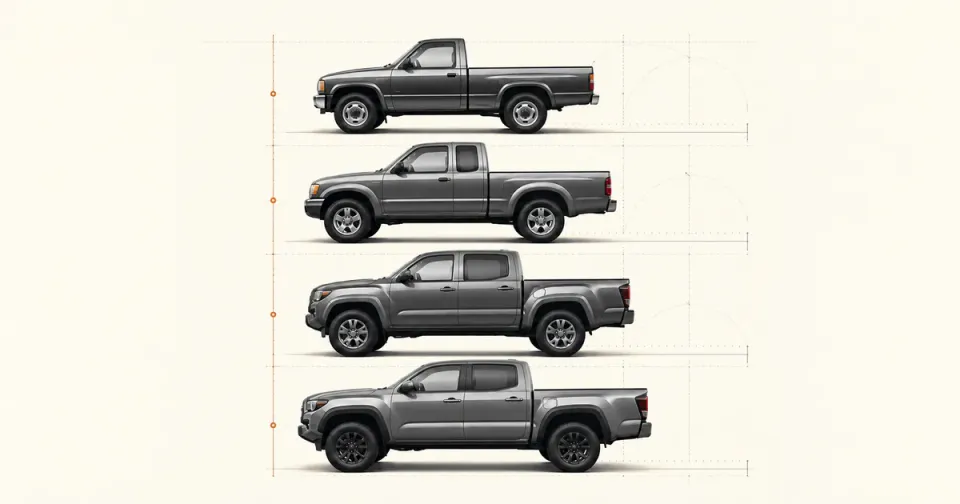
DEPENDS ON THE EXACT CONFIGURATION
U.S.-market Toyota Tacomas fall into four generations: 1995.5–2004, 2005–2015, 2016–2023 and 2024+. Start with that year range when shopping for parts, but do not stop there. Cab, bed length, trim, drivetrain, powertrain and factory equipment can split fitment within one generation.
Tacoma generation years at a glance
| Tacoma generation | U.S. model years | Fitment takeaway |
|---|---|---|
| First generation | 1995.5–2004 | Early trucks vary widely by cab, drivetrain and five- versus six-lug configuration. Do not shop by “first gen” alone. |
| Second generation | 2005–2015 | A new generation boundary, but 11 model years still contain body, trim and equipment changes. |
| Third generation | 2016–2023 | The 2016 redesign created a new body and powertrain boundary. The 2020 refresh can matter for lighting, grilles, cameras and sensors. |
| Fourth generation | 2024+ | A ground-up redesign on Toyota's TNGA-F platform. Treat 2016–2023 chassis, body, bed, suspension and powertrain parts as unverified unless the maker also names 2024+. |
Toyota's historic media archive identifies the 1995.5 Tacoma material as first generation and the 2005 model as second generation. Toyota introduced the rebuilt 2016 truck as all-new, then explicitly called the redesigned 2024 Tacoma fourth generation. See Toyota's first-generation archive, second-generation archive, 2016 launch information and 2024 launch information.
The “1995.5” label is useful when discussing the first Tacoma, but parts catalogs commonly present the range as 1995–2004. For any 1995 truck, use the VIN and build information rather than relying on the half-year shorthand.
Why generation matters—but does not prove fit
A generation change is a warning that the vehicle's geometry, mounting points or systems may have changed. It is not a promise that every part fits every truck inside that year range.
The fourth-generation change shows why. Toyota documents a new frame, body, turbocharged powertrains, electric power steering, four-wheel disc brakes and new roof attachment provisions for 2024. It also uses different rear suspension layouts by configuration: most grades could use a multi-link coil-spring rear suspension, while SR, SR5 XtraCab and TRD PreRunner retained leaf springs at launch. A listing that says only “2024+ Tacoma” can still be too broad for suspension, skid, exhaust or underbody hardware. Review Toyota's fourth-generation chassis and configuration details.
The six details to collect before shopping
1. Exact model year
Use the VIN label, registration or Toyota owner information—not appearance. A late purchase date does not change the truck's model year.
2. Cab configuration
Names and choices change by generation. Access Cab, Double Cab, Regular Cab and fourth-generation XtraCab parts can differ in length, mounting position and door clearance. Steps, sliders, roof racks and storage products are especially sensitive.
3. Bed length
“Short bed” and “long bed” are not precise enough for an order. Confirm the maker's named 5- or 6-foot application and measure when instructed. Toyota's published five-foot-bed dimensions also changed across the latest generation boundary: the 2021 sourcebook lists 60.5 inches inside length and 41.5 inches between the wheel wells, while the 2024 brochure lists 60.3 and 44.7 inches respectively. Those measurements do not decide a cover or rack by themselves; they show why a model-year application is necessary. Compare Toyota's 2021 sourcebook with the 2024 Tacoma specifications.
4. Trim and factory equipment
TRD Sport, TRD Off-Road, Limited, TRD Pro and Trailhunter can carry different suspension, armor, lighting, cameras, sensors or recovery hardware. A bumper that physically bolts on can still conflict with radar, parking sensors, a camera, a factory skid or a tow component.
5. Powertrain and drivetrain
Engine, transmission, two- or four-wheel drive, gas or hybrid, and axle configuration affect intakes, exhausts, skids, suspension and driveline parts. “Tacoma V6” is not enough if the listing spans more than one generation.
6. Exact part and mounting-kit number
Product-family names are reused. Record the complete SKU plus every bracket, rail, adapter or relocation kit. Manufacturer application data for that number should name your truck.
Parts that often split inside a generation
| Part family | Details that commonly change the application |
|---|---|
| Tonneau covers, caps and bed racks | Bed length, rail system, tailgate, cover track and cab clearance |
| Roof racks and lighting mounts | Cab style, roof attachment points, sunroof, antenna, light-bar cutout |
| Steps and rock sliders | Cab, bed/wheelbase, frame mount and factory rail conflicts |
| Bumpers, skids and recovery points | Frame/mounts, engine, drivetrain, factory armor, sensors and hitch |
| Wheels and tires | Bolt pattern, center bore, fasteners, offset, load rating, brake and body clearance |
| Suspension | Drivetrain, cab/bed, axle load, rear-suspension type, lift target and existing weight |
| Interior and electronics | Dash, connectors, audio package, airbags, cameras and driver-assistance systems |
This is why two manufacturers can use different year ranges without either being wrong. Prinsu, for example, lists one named Tacoma cab-rack product for 2005–2023, while BamBeds offers separate platform selections for 2005–2023 and 2024+. Those are product-specific application boundaries, not universal rules for all roof racks or bed platforms. See the Prinsu application and BamBeds Tacoma selections.
Mid-cycle refreshes can create smaller fitment boundaries
Do not assume every year inside a generation is identical. The third-generation range is commonly sold as 2016–2023, but parts involving the grille, headlights, cameras, radar or wiring may use narrower year ranges. The right rule is simple: use the generation to narrow the catalog, then let the exact manufacturer's application decide.
Cosmetic similarity is not evidence. Nor is a marketplace title that crams several years into one listing. Prefer the part maker's fitment table and installation instructions, then verify any configuration the documentation does not address.
Compatibility snapshot
| Product/application | Vehicle fitment | Result | Required check |
|---|---|---|---|
| Part explicitly listing the exact year, cab/bed and relevant equipment | Matching Tacoma | Documented application | Confirm SKU, exclusions and installation notes |
| Part listing only the correct generation | Same-generation Tacoma | Not enough information | Match configuration and factory-equipment exclusions |
| Generation-specific part from an earlier generation | Newer Tacoma | Unknown until explicitly approved | Require the maker to list both generations or a documented adapter |
| “Universal” accessory | Any Tacoma | Conditional | Verify mount, clearance, load, securement and system conflicts |
Before you buy
Send the seller or manufacturer one line with your complete combination:
> 2022 Tacoma TRD Off-Road Double Cab, 5-foot bed, 4WD, factory deck rails — does part ABC-123 fit without another mounting kit?
Ask for the exact application or installation document. If the answer is based only on the word “Tacoma,” keep looking.
Bottom line
Use 1995.5–2004, 2005–2015, 2016–2023 and 2024+ as the four Tacoma generation buckets. Then verify the details that actually control the part. Generation gets you into the right aisle; the exact year, configuration and SKU decide whether the part belongs on your truck.
For a cross-generation purchase, continue with Will third-gen Tacoma parts fit a fourth-gen Tacoma? or ask the Assistant to check your exact truck and part number.
Sources & notes
- Toyota: first-generation Tacoma historic media, accessed 2026-10-13. Establishes Toyota's first-generation label and early model-year context.
- Toyota: second-generation Tacoma historic media, accessed 2026-10-13. Establishes 2005 as the second-generation boundary.
- Toyota: all-new 2016 Tacoma, accessed 2026-10-13. Documents the 2016 redesign boundary and major powertrain/body changes.
- Toyota: 2024 Tacoma launch, accessed 2026-10-13. Documents the fourth-generation redesign, configurations and chassis/powertrain changes.
- Toyota: 2021 Tacoma SourceBook, accessed 2026-10-13. Scoped third-generation bed dimensions.
- Toyota: 2024 Tacoma eBrochure, accessed 2026-10-13. Scoped fourth-generation specifications and bed dimensions.
- Prinsu Pro Tacoma cab rack, 2005–2023, accessed 2026-10-13. Example of a manufacturer-defined product application.
- BamBeds Tacoma platform, accessed 2026-10-13. Example of separate 2005–2023 and 2024+ product selections; not evidence for another bed product.