
Which Cab and Bed Size Does Your Tacoma Have—and What Fits?
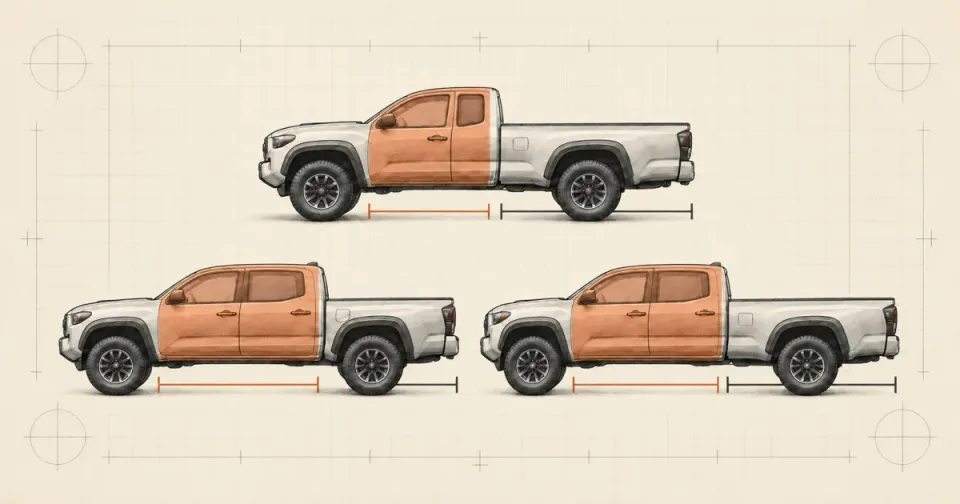
How Much Usable Room Is in a Fourth-Gen Tacoma Bed
Toyota lists 60.3 inches inside the fourth-gen Tacoma short bed and 73.5 inches inside the long bed in its 2024 U.S. brochure. Both list 44.7 inches between the wheel wells. The long bed adds 13.2 inches of published floor length. For a bulky item, compare its size with the narrowest point along the loading path.
Fit Assistant · For your setup
Identify the details that change fit
Tell us a little about your situation. Fit Assistant will help you apply this guide.
Identify the truck before interpreting a listing
Start with model year, then cab and inside-bed length. If you are unsure, use the VIN identification guide as a starting point and confirm any missing body detail from the truck or vehicle records. A decoder may not supply every option or bed detail.
Four doors and an unknown bed: “Double Cab” does not settle whether to order a short- or long-bed cover. Verify the inside length and the maker's application before choosing an option.
A seller describes a six-foot shell: record the shell's exact identity and destination generation too. Similar nominal length cannot approve the rail, seal or tailgate interfaces.
You are shopping sliders or a roof rack: identify whether the named part follows cab geometry alone or also the wheelbase/bed combination. Use the product's actual selector rather than assuming every accessory uses the same fields.
Do not confuse cargo measurements with part fitment
Inside floor length helps describe the bed. Width between wheel wells helps plan a bulky load. Rail shape and the maker's clamp system govern a cover or rack interface. These measurements answer different questions.
Use a short record when shopping: year / cab / bed / existing rail system / proposed exact part. If one item is unknown, identify which decision it affects. You can compare product types now while leaving final fitment unresolved.
Why “Double Cab” does not fully identify the truck
Toyota's 2023 model information shows two cab types: Access Cab and Double Cab. Access Cab configurations use the 6-foot bed. Depending on grade, Double Cab trucks use either a 5-foot or 6-foot bed. Toyota's specification table gives the nominal third-generation bed lengths as 60.5 inches and 73.7 inches. See Toyota's 2023 Tacoma model and specification tables.
That creates three common third-generation shopping descriptions:
- Access Cab with 6-foot bed;
- Double Cab with 5-foot bed; and
- Double Cab with 6-foot bed.
The bed names are nominal. Sellers may call them 5-foot/6-foot, short/long, or use rounded measurements. Match the manufacturer application rather than trying to reconcile a listing by rounding alone.
The configuration also changes by generation. Start with the Tacoma generation guide, then identify cab and bed within that generation. Do not apply the third-generation combination table to a 2005–2015 or 2024+ truck without checking its own model-year documentation.
2024+ Tacoma bed dimensions
Toyota's 2024 specification table lists these fourth-generation inside-bed dimensions:
| Measurement | 5-foot bed | 6-foot bed |
|---|---|---|
| Inside length | 60.3 in. | 73.5 in. |
| Width at tailgate | 53.0 in. | 53.0 in. |
| Width at accessory rail | 56.4 in. | 56.4 in. |
| Width between wheel wells | 44.7 in. | 44.7 in. |
| Bed depth | 20.2–21.2 in., depending on drivetrain | 20.2–21.2 in., depending on drivetrain |
For 2024, Toyota lists XtraCab with the 6-foot bed. Double Cab offerings include 5-foot and, on several grades, 6-foot configurations; Trailhunter is shown with both 5- and 6-foot bed dimensions; TRD Pro is shown with the 5-foot bed. Availability must still be checked for the exact model year and trim. Review Toyota's 2024 dimensions and configuration table.
The nominal labels are shopping categories, not interchangeable fitment. A 2024+ 5-foot cover, mat or shell does not become a documented 2016–2023 5-foot application because the names are similar.
Which parts follow cab type?
Parts attached to the cab, cab roof or frame alongside the passenger compartment commonly need a cab-specific application.
Roof racks
Cab roof length, door layout and documented mounting points determine the application. Prinsu's current Pro Tacoma rack is titled for the 2005–2023 Double Cab. That listing does not establish Access Cab fitment simply because the truck is within the same year range. Review the named Double Cab rack application.
Running boards, side steps and rock sliders
The part must reach the correct door area and use the documented frame or body mounts. Cali Raised LED's 2005–2023 Step Edition sliders require one of three selections: Access Cab, Double Cab Short Bed or Double Cab Long Bed. This named product shows that cab type is essential and, for some frame-mounted products, bed/wheelbase configuration remains part of the selector. See the configuration choices on the manufacturer page.
Do not assume a Double Cab short-bed step or slider fits a Double Cab long-bed truck. Use the exact manufacturer's option and supplied mounting hardware.
Cab storage and interior accessories
Rear-seat storage, seat covers, floor protection, consoles and cab wiring can differ with cab type, seat layout, trim and model year. “Fits Double Cab” still needs the correct generation and seating/equipment application.
Which parts follow bed length?
Anything that spans, seals to, sits inside or clamps to the bed needs the exact bed application.
Tonneau covers and camper shells
A cover or shell must match more than nominal length. Rail profile, front-wall shape, tailgate interface, clamp location and cab clearance also matter. LEER's product pages use vehicle-specific applications and instruct buyers to confirm model year, bed and configuration before ordering. See LEER's Tacoma-specific cap application example.
Never approve a used cap by tape measure alone. For cross-generation shells, use the second-gen to third-gen camper-shell transfer guide.
Bed mats, liners and cargo platforms
The part must match the floor length and any wheel-well, tie-down, drain, power-outlet or storage geometry it covers. A short-bed mat cannot become a documented long-bed application because its width appears correct. A long-bed part should not be trimmed unless its maker supplies that instruction for the exact application.
Bed racks and crossbars
Rack feet or rails must match the bed length, deck-rail or clamp system and any tonneau-cover interface. Bed length decides the available mounting span, but it does not by itself establish load capacity or cover compatibility. For that combination, use the Tacoma bed-rack and tonneau-cover compatibility guide.
Bed extenders and dividers
These can depend on bed-side mounting points, deck rails, tailgate operation and cover clearance. Confirm the exact model-year and bed application, then check every installed cover, rack, liner or bed-storage accessory that shares the same space.
Which parts need more than cab and bed length?
Cab and bed are important filters, not a complete vehicle identity.
- Bumpers, skid plates and recovery parts: check model year, drivetrain, engine/powertrain, sensors, factory armor and tow equipment.
- Suspension: check drivetrain, engine/load range, rear-suspension design, ride height and exact kit application.
- Wheels and tires: check wheel and tire specifications, brakes, suspension and body clearance—not cab/bed alone.
- Lighting and electronics: check model year, trim, connector, factory lamp type, camera and safety equipment.
- Exhaust and intake: check engine, transmission where specified, wheelbase/cab-bed application where the routing changes, and exact SKU.
The practical rule is to identify the mounting system. A part follows the cab, bed, frame, powertrain, electronics—or a combination of them.
How can you identify your cab and bed correctly?
- Start with the model year so you are using the correct generation's names and choices.
- Use the VIN/build information, original window sticker or Toyota vehicle record to identify the cab and grade.
- Count the door layout only as a visual cross-check; do not substitute appearance for the vehicle record.
- With the tailgate closed, measure the inside bed floor from the front wall to the tailgate and compare it with the correct model-year Toyota specification.
- Record the exact manufacturer's terminology—Access Cab, Double Cab Short Bed or Double Cab Long Bed, for example—before choosing a product option.
- Verify the product SKU and installation instructions for that same year/cab/bed application.
If a listing says only “fits Tacoma” or only “fits Double Cab,” it is incomplete whenever generation, bed length or factory equipment changes the mounting area.
Additional fitment checks
| Product/application | Vehicle fitment | Result | Required check |
|---|---|---|---|
| Prinsu Pro Tacoma Double Cab Roof Rack, 2005–2023 | Correct-year Double Cab within the listed range | Cab application documented | Confirm exact rack, instructions and vehicle roof-load limit |
| Cali Raised Step Edition sliders, 2005–2023 | Access Cab, Double Cab Short Bed or Double Cab Long Bed | Fits only when the selected variant matches | Choose the exact cab/bed option and supplied hardware |
| Bed cover, mat, shell or rack labeled only “Tacoma” | Any Tacoma bed | Unknown until exact application is confirmed | Match generation, bed length, rails, tailgate and shared accessories |
| Double Cab part with no bed-length field | Double Cab long- or short-bed truck | Depends on mounting area | Determine whether the part follows cab/body only or also frame/bed geometry |
Before you buy
Treat cab type and bed length as two separate fields. On a third-generation Tacoma, “Access Cab” points to the long bed, but “Double Cab” can mean short or long bed. Then identify where the part mounts and require a manufacturer application for the exact year, cab, bed and relevant equipment. That is more reliable than measuring one dimension or trusting a generic Tacoma label.
Use the narrowest point in the loading path
A rigid box 65 inches long and 42 inches wide would exceed the short bed’s published length by 4.7 inches with the gate closed. The long bed has 8.5 inches of nominal length left and 2.7 inches between the box sides and the wheel wells combined. Those are arithmetic results from Toyota’s bare-bed figures. A mat, thick liner, storage box, cap opening or track can reduce the space.
Turn three measurements into a purchase check
Measure the tailgate opening at the height where you lift the item in. Then measure the minimum width along the route, including the wheel wells or accessory rails. Finally close the gate or cover and measure usable length and height. Include handles, latches and any clearance you need to lift or slide the cargo out.
Compatibility snapshot
| Decision | Documented starting point | What to confirm |
|---|---|---|
| Choose fourth-gen bed length for rigid cargo | 60.3 in short or 73.5 in long in Toyota’s 2024 table | Measure the loaded item and closed gate clearance. Toyota 2024 Tacoma U.S. specifications |
| Load past the wheel wells | 44.7 in is the published between-wells width | Measure the narrowest section with your liner and accessories. Toyota 2024 Tacoma U.S. specifications |
| Buy a tonneau, mat or cap | Use nominal length to identify the order branch | Verify the exact cab, model year and mounting application. Toyota 2024 Tacoma U.S. specifications |
Browse Tacoma guides and cargo & overland.
Sources & notes
Last verified 8 November 2026.
- Toyota 2024 Tacoma U.S. specifications. 60.3- and 73.5-inch published bed lengths and 44.7 inches between wheel wells. Bare specification is the starting point for a worked cargo example.
- Toyota 2023 Tacoma eBrochure, verified 2026-10-15. Documents third-generation cab/bed availability and nominal 60.5-inch and 73.7-inch bed lengths; it does not establish aftermarket fitment.
- Prinsu Pro Tacoma Double Cab Roof Rack, 2005–2023, verified 2026-10-15. Supports only the named Double Cab rack application and its installation/load conditions.
- Cali Raised Step Edition Rock Sliders, 2005–2023, verified 2026-10-15. Documents separate Access Cab, Double Cab Short Bed and Double Cab Long Bed choices for this product.
- LEER 180 Tacoma truck-cap application, part 500695, verified 2026-10-15. Demonstrates vehicle-specific cap application; confirm exact bed and configuration through the manufacturer's fitment workflow.
- Toyota 2024 Tacoma eBrochure and specifications, verified 2026-10-26. Documents fourth-generation bed dimensions and the cited model-year cab/bed availability.
Editorial review 2026-11-06: practical setup/use scenarios and purchase checks updated. Original source-access dates remain visible where evidence was not independently re-established in this pass.