
Tacoma i-FORCE vs. i-FORCE MAX: Which Parts Differ?
Verify fitment with the merchant before you buy.
Reviewed by DoesItFit Editorial · How we evaluate compatibility
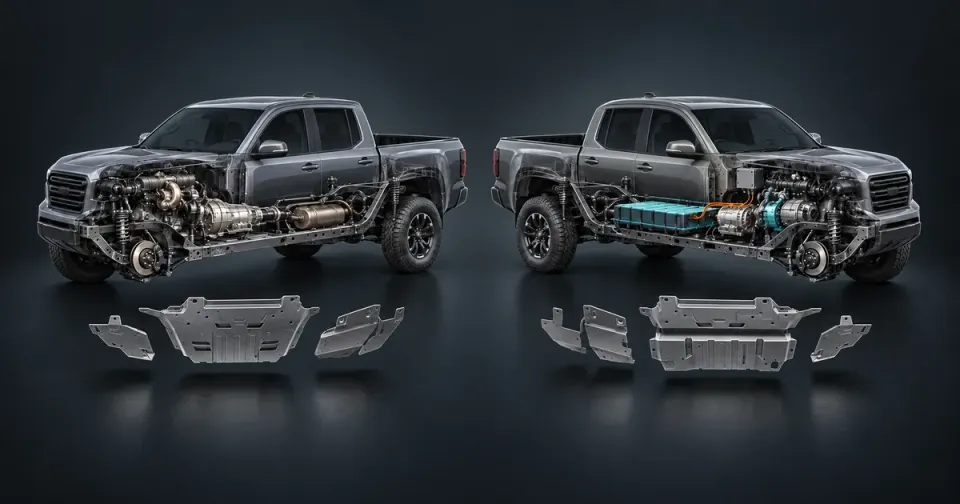
POWERTRAIN-ADJACENT PARTS NEED AN EXACT APPLICATION
i-FORCE and i-FORCE MAX Tacomas can require different skid plates, catalytic guards, powertrain parts and underbody hardware. The hybrid adds a motor integrated with the transmission and a traction battery, but not every body or bed accessory changes. Match the exact SKU by powertrain, then separately check grade, drivetrain and factory equipment.
What actually changes on i-FORCE MAX?
Both fourth-generation powertrains use a 2.4-liter turbocharged engine, but that shared description does not prove parts interchange.
Toyota says the i-FORCE MAX adds a 48-hp electric motor integrated into the eight-speed automatic transmission and a 1.87-kWh nickel-metal hydride battery. Toyota also documents grade-specific drivetrain and suspension differences within the hybrid lineup. For example, the launch-spec Limited used full-time four-wheel drive and adaptive variable suspension, while the TRD and Trailhunter hybrid grades used part-time four-wheel drive. Review Toyota's i-FORCE MAX engineering overview.
That means hybrid versus gas is one fitment field, not a complete configuration. A seller may also need the exact model year, grade, transmission, drivetrain, stabilizer-disconnect equipment or factory armor.
Which aftermarket parts are most likely to differ?
Skid plates and catalytic-converter guards
These parts occupy the same underbody area as the powertrain and exhaust, so a generic “2024+ Tacoma” label is not enough.
C4 Fabrication's 2024–2026 full-skid system, SKU 1224-50600, requires the buyer to choose i-FORCE turbo automatic or i-FORCE MAX hybrid automatic. It also separately requires a choice for trucks with or without the stabilizer disconnect. That is direct evidence that powertrain and factory suspension equipment independently change this named armor application. See C4's exact configuration choices.
RCI's named 2024+ transmission skid, part 24-TACO-T4R-TRANS-NH, is listed for non-hybrid trucks and explicitly says it does not fit hybrid models. RCI's matching catalytic guards require that transmission skid. A hybrid owner should therefore not buy that non-hybrid path unless RCI documents a different compatible application. Review the RCI transmission-skid application and its companion catalytic guards.
Also check what installation removes. C4 states that its full-skid system removes the OEM tow/recovery points. Fitment does not automatically mean every original function remains.
Intake, exhaust and powertrain electronics
Require the exact engine and powertrain application. A shared 2.4-liter displacement does not establish compatible plumbing, sensor locations, calibration, exhaust routing or service clearance.
For tuners, piggybacks, intake kits, exhaust components and powertrain wiring, the product maker should explicitly name i-FORCE or i-FORCE MAX, the model-year range and any transmission or drivetrain restrictions. If the listing names only “2.4L turbo” without resolving gas versus hybrid, treat fitment as unknown.
Do not use a physical connector match as proof that electronics are compatible. Calibration, current limits and vehicle diagnostics are separate requirements.
Transmission, driveline and service-access parts
The hybrid motor's integration with the automatic transmission makes the exact transmission application important for mounts, armor, service panels and adjacent components. Driveline parts can also follow two-wheel drive, part-time four-wheel drive or full-time four-wheel drive rather than the hybrid badge alone.
Verify oil-drain access, filter/service access, exhaust clearance and required companion parts after identifying the powertrain. A plate that bolts on but blocks required service is not a complete fitment result.
Suspension and load-carrying parts
Do not choose springs or shocks from “hybrid” alone. Powertrain weight can matter, but Toyota also changes suspension by grade and configuration. The product application should name the exact grade or axle/suspension setup and the intended added load.
For springs, coilovers and lift kits, record:
- grade and drivetrain;
- stabilizer disconnect or non-disconnect configuration;
- leaf- or coil-rear suspension where applicable;
- permanent front/rear accessory weight; and
- target ride height and wheel/tire combination.
Which parts may use the same application?
Body, cab and bed accessories can share an i-FORCE/i-FORCE MAX application when their maker documents both. They often follow a different interface.
- Tonneau covers, bed mats and many bed racks: usually follow model year, bed length, rail/clamp system, tailgate and nearby accessories. The hybrid badge by itself does not identify a cover SKU. Use the fourth-gen hybrid tonneau-cover guide.
- Cab storage and interior trim: often follow cab, seating, console, grade or installed electronics.
- Roof racks: follow cab/roof application, mounting system, moonroof clearance and load limits.
- Bumpers and exterior armor: may share a powertrain application, but still need exact sensor, camera, lighting, skid and recovery-equipment checks.
“May share” is not approval. It means the decision is controlled by the product's actual mounting area rather than automatically by the powertrain badge.
Does the hybrid's 2400W outlet change accessory fitment?
Toyota documents a 2400W AC supply to the cabin and bed on the i-FORCE MAX launch lineup. That factory capability does not authorize tapping hybrid wiring or prove compatibility with an auxiliary battery, inverter, charger or high-draw accessory.
For electrical additions, require a documented power source, fuse, conductor size, grounding path, load limit and mounting location. Keep the factory AC outlet specification separate from the 12-volt and high-voltage systems.
What should you check before ordering?
- Confirm the model year, grade and VIN/build information.
- Record i-FORCE gas or i-FORCE MAX hybrid; do not infer it from appearance alone.
- Record transmission, two-wheel/four-wheel-drive type, rear suspension and stabilizer-disconnect equipment.
- Photograph the mounting area, existing armor, crossmembers, exhaust and recovery points.
- Find the exact product SKU and every configuration selector—not just the page title.
- Read the instructions for parts removed, trimming, service access and required companion products.
- Ask the maker in writing if your powertrain is not explicitly named.
A useful question is: “Does SKU ___ fit a 2025 Tacoma ___ grade with i-FORCE MAX, part-time 4WD and stabilizer disconnect, while retaining the factory recovery points?”
Compatibility snapshot
| Product/application | Truck configuration | Verdict | Required condition |
|---|---|---|---|
| C4 full skid system, SKU 1224-50600 | Listed i-FORCE automatic | Documented application | Select gas and the correct stabilizer-disconnect option |
| C4 full skid system, SKU 1224-50600 | Listed i-FORCE MAX automatic | Documented application | Select hybrid and the correct stabilizer-disconnect option |
| RCI 24-TACO-T4R-TRANS-NH transmission skid | i-FORCE MAX hybrid | Does not fit per manufacturer | Use a separately documented hybrid application |
| RCI non-hybrid catalytic guards | Truck without the required RCI non-hybrid transmission skid | Not a complete application | Required companion skid and non-hybrid configuration must match |
| Any powertrain-adjacent part labeled only “2024+ Tacoma” | Gas or hybrid truck | Unknown | Maker must resolve powertrain and other stated configuration fields |
| Bed/cab accessory explicitly listing both powertrains | Matching year, cab, bed and equipment | Can share an application | Every non-powertrain fitment field must also match |
Bottom line
The i-FORCE MAX badge matters most when a part touches the engine, transmission, exhaust, underbody or electrical system. C4's separate gas/hybrid skid choices and RCI's non-hybrid-only transmission-skid path show why the exact application matters. For body, cab and bed accessories, use the mount's real fitment keys—but still require the manufacturer to document the complete truck configuration.
Start with the broader factory-options fitment checklist when the part also touches cameras, lighting, suspension, bed hardware or factory armor.
Sources & notes
- Toyota: 2024 Tacoma with i-FORCE MAX, accessed 2026-10-15. Establishes the hybrid motor, transmission, battery, grade/drivetrain examples and factory AC supply; it does not approve aftermarket parts.
- C4 Fabrication: 2024–2026 Tacoma full skid plates, SKU 1224-50600, accessed 2026-10-15. Documents separate gas/hybrid and stabilizer-disconnect choices for this exact system.
- RCI: fourth-gen Tacoma transmission skid, accessed 2026-10-15. Documents the named non-hybrid application and hybrid exclusion.
- RCI: non-hybrid catalytic guards, accessed 2026-10-15. Documents the required companion transmission skid and exact non-hybrid path.