
Tacoma Rooftop Tent: Roof Rack or Bed Rack—and What Happens to Payload?
Verify fitment with the merchant before you buy.
Reviewed by DoesItFit Editorial · How we evaluate compatibility
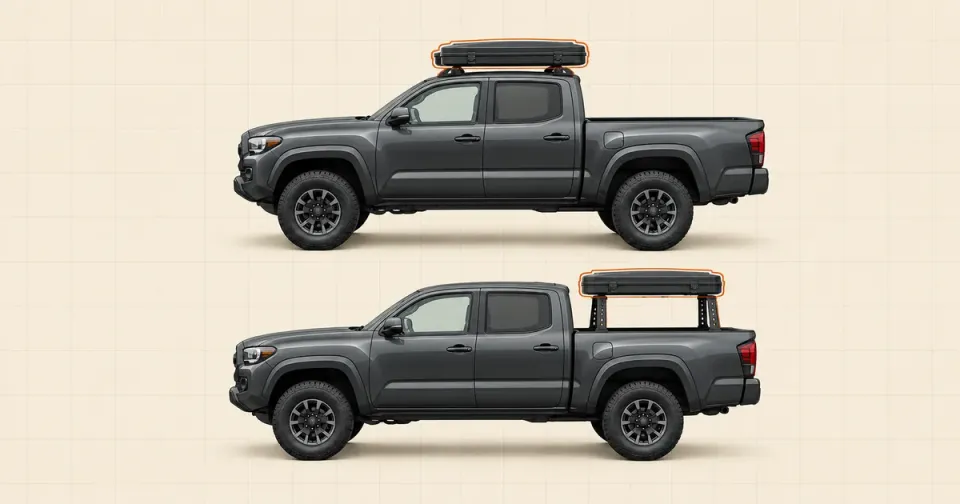
CHOOSE BY PACKAGING—THEN VERIFY THE COMPLETE SYSTEM
Use a Tacoma bed rack when lower tent placement is the priority; use a roof rack when keeping the bed unobstructed matters more. Both consume payload: count the complete rack, tent, mounts and travel contents regardless of location. Neither is automatically compatible or stronger; every vehicle, rack, tent, dynamic and parked limit must agree.
The short comparison
| Priority | Roof rack | Bed rack |
|---|---|---|
| Keep the pickup bed open | Best starting point | Rack structure and tent occupy bed-side/over-bed space |
| Place the closed tent lower | Usually not possible; tent sits above the cab | Low or mid-height racks can keep it nearer the cab roofline |
| Keep full-height bed access | Yes, if the bed has no other system | Tall rack helps; low/mid rack limits tall cargo |
| Keep a tonneau cover | Independent of the cab rack, but confirm any other conflicts | Requires a rack/cover combination explicitly designed to coexist |
| Simplify exact load approval | Still requires vehicle roof, rack and tent checks | Still requires bed, rack, tent and vehicle-payload checks |
The table is a packaging guide, not a rating. The exact products decide whether either option is usable.
Choose a bed rack when lower tent placement matters
A low- or mid-height bed rack places the closed tent below or near cab-roof height instead of above it. That can reduce the overall height compared with a cab-roof installation, subject to the exact rack and the tent's closed thickness. It also leaves the cab roof available for other approved uses.
The trade-off is bed geometry. Low and mid-height racks restrict tall cargo and can make reaching the center of the bed harder. A tall rack restores more vertical bed access but raises the tent and may affect camera sightlines on some trucks.
Cali Raised's current 2024+ Tacoma rack illustrates why the height choice is product-specific. It offers 7-inch low, 10-inch mid and 17.5-inch tall versions; the manufacturer recommends the mid height for many rooftop-tent setups and the tall height for more bed access. The same listing says the rack is not compatible with tonneau covers and warns that its tall version may affect named camera views. Those facts apply to that rack, not every bed rack. Review the exact 2024+ Tacoma bed-rack application.
Choose a roof rack when the bed must stay open
A cab roof rack keeps the pickup bed free for motorcycles, tall bins, loose materials or a separate cover system. It also avoids placing bed-rack feet or side structure along the bed rails.
The trade-off is height and a separate roof-load check. The tent sits above the cab, so measure total garage and trail clearance. Toyota documents integrated roof-rack attachment holes on the redesigned 2024 Tacoma, but attachment provisions alone do not prove that a particular rack-and-tent combination is approved. See Toyota's 2024 Tacoma launch details.
For any model year, use the exact vehicle documentation and rack instructions. Do not transfer a roof rating from another Tacoma generation, cab, rack or driving condition.
The complete load system has several separate limits
“The rack holds 600 pounds” is not enough information. Check all of these:
- Tent travel weight. Include the tent and anything the tent maker permits you to leave inside while driving.
- Vehicle and rack dynamic limit. This is the relevant limit while the truck is moving. Off-road limits may differ from on-road limits.
- Parked or static limit. This must cover the occupied tent as defined by the rack and tent makers. Do not use a parked rating while driving.
- Crossbar spacing and mounting envelope. The tent rails and clamps must land on approved support points and fit the bar shape.
- Tacoma payload and axle limits. Rack, tent, occupants, cargo and accessories remain vehicle load. A higher rack rating does not increase the truck's certified capacity.
Use the lowest applicable limit in the system. If one required rating is unpublished, treat the combination as unknown until the manufacturer confirms it.
Roof and bed mounting consume payload the same way
Moving the tent from the cab roof to the bed does not create payload. For either location, subtract the complete travel-ready system from the occupant-and-cargo allowance on the exact truck's door label:
RTT payload debit = rack + tent + mounting hardware + awning/ladder/accessories + anything carried inside while driving − documented factory parts removed
Then subtract occupants, other modifications, trip cargo and trailer tongue load. Toyota's 2026 load procedure starts with the exact vehicle placard—not a brochure maximum—and requires occupants and cargo to remain within the printed allowance. Review Toyota's vehicle-load calculation.
Rack and tent ratings answer a different question: whether those components support the system under their stated conditions. A 600-pound parked rating does not add 600 pounds to the Tacoma's payload, and it cannot be used as the moving rating.
Placement can change axle loading
The same total weight can load the axles differently when moved fore or aft. Do not estimate that distribution from appearance. Weigh the completed, trip-ready Tacoma by axle with normal occupants, fuel and cargo, then compare total weight with GVWR and the front and rear readings with their respective GAWR labels.
Use the full Tacoma remaining-payload worksheet when the build also has bumpers, sliders, drawers, a spare carrier or trailer tongue load. Springs or airbags may change ride height and motion control, but they do not rewrite the certified vehicle labels.
A tent maker's requirements can rule out either rack
iKamper's current guidance shows the checks a buyer should expect. Its named tents can mount to suitable crossbars, a roof rack or a bed rack, but the manufacturer gives model-specific dynamic requirements, minimum crossbar spacing and mounting-bracket dimensions. Most named models require at least 30 inches between bars; Skycamp Mini uses a different 22-inch minimum. Requirements vary by tent, so use the exact current manual rather than copying those numbers to another brand. Read iKamper's current mounting FAQ.
Before ordering, draw the rack's front and rear support centers and compare them with the tent's allowed rail spacing. Then compare bar width and height with the supplied clamps. A load rating cannot fix a clamp that does not physically fit.
What about tonneau covers and cameras?
A cab roof rack usually leaves the bed-cover decision separate. A bed rack often shares the bed rails with the cover, so compatibility must be explicit. “Tonneau compatible” should name the cover style, rail or adapter—not merely show a cover in a photo.
If keeping Toyota's factory tri-fold cover is the decisive constraint, use the narrower Tacoma bed-rack, rooftop-tent and factory tri-fold guide. Also check rear-camera and digital-mirror sightlines with the tent closed; a tall rack or wide tent can occupy those views even when the hardware bolts on.
Compatibility snapshot
| Product/application | Vehicle fitment | Result | Required check |
|---|---|---|---|
| Exact tent on an approved Tacoma cab roof rack | Exact year/cab application | Conditional | Vehicle roof limit, rack dynamic/static ratings, spacing and clamps |
| Exact tent on an approved Tacoma bed rack | Exact year/bed application | Conditional | Rack height, dynamic/static ratings, spacing, cameras and bed use |
| iKamper tent on roof or bed rack | Current named tent model | Manufacturer allows either rack type when requirements are met | Use that model's current weight, spacing and bracket envelope |
| Cali Raised Overland Bed Rack | Named 2024+ Tacoma bed/height selection | Manufacturer describes it as rooftop-tent ready | Confirm tent, bed length, height, no-tonneau constraint and total vehicle load |
Before you buy
Collect one line of facts before asking for approval: “2025 Tacoma Double Cab with 5-foot bed; rack SKU ABC-123; tent model XYZ at its complete travel weight; required bar spacing; tonneau and camera requirements; door-label allowance and trip-ready axle weights.”
Ask the rack maker to confirm the tent's dynamic and parked loads, bar spacing and clamp geometry on that exact Tacoma application. Then compare the full installed weight with the truck's tire-and-loading label and owner documentation.
Bottom line
A bed rack is the better starting point for lower tent placement. A roof rack is the better starting point for an unobstructed bed. Both rack and tent systems consume Tacoma payload, and placement can change axle loading. Approve the installation only when the exact Tacoma, rack, tent, mounts, door-label allowance and axle limits form one documented system.
Sources & notes
- Toyota: 2024 Tacoma launch information, accessed 2026-10-15. Documents integrated roof-rack attachment holes on the redesigned truck; it does not approve an arbitrary rooftop tent.
- iKamper: rooftop-tent and rack FAQ, accessed 2026-10-15. Documents current named-tent dynamic requirements, crossbar spacing, mounting-bracket envelope and use on suitable roof or bed racks. These numbers do not transfer to another tent brand.
- Cali Raised LED: Overland Bed Rack For 2024+ Toyota Tacoma, accessed 2026-10-15. Documents the named rack's Tacoma application, height choices, recommended 400-pound dynamic capacity, rooftop-tent use, tonneau exclusion and camera notes. Its ratings do not apply to another rack.
- 2026 Toyota Tacoma Owner's Manual, accessed 2026-10-15. Supplies Toyota's placard-based occupant/cargo calculation and vehicle-load-limit framework; exact limits come from the subject truck's labels.