
Should You Choose Tacoma Running Boards, Nerf Bars or Rock Sliders?
Verify fitment with the merchant before you buy.
Reviewed by DoesItFit Editorial · How we evaluate compatibility
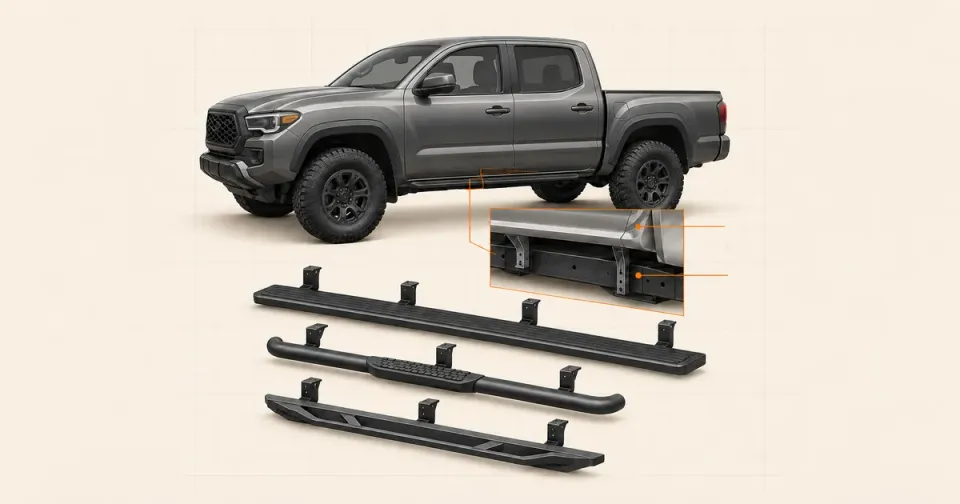
CHOOSE THE JOB, THEN VERIFY THE MOUNT
Choose running boards or nerf/tube steps for easier cab entry; choose a documented frame-mounted rock slider when rock-contact protection is the job. The product name and shape are not enough. Match the exact Tacoma year, Access Cab/XtraCab/Double Cab, bed where required, mounting location and manufacturer SKU.
What is the practical difference?
Sellers use “running board,” “nerf bar,” “tube step,” “step slider” and “rock slider” inconsistently. Start with the documented job and mounting system rather than the label.
| Product category | Primary job | Typical decision | Evidence to require |
|---|---|---|---|
| Running board | Broad, continuous footing for entry | Best for frequent passengers and everyday access | Exact year/cab application, usable width, brackets and load limits |
| Nerf bar or tube step | Narrower tube or bar with pads/drop steps for entry | Best when you want a less bulky access step | Exact year/cab SKU, mounting location and step position |
| Integrated-step rock slider | Trail protection plus a usable step | Compromise between access, clearance and weight | Frame mounting, stated structural role, exact cab/bed application |
| Clearance-focused rock slider | Protect the rocker area while minimizing hang-up points | Best for real rock contact | Frame mounting, structural design and maker-defined use limits |
Toyota describes its named Predator Drop Step and tube-step accessories as products that improve access to the cab. Cali Raised describes its Step Edition as a frame-mounted rock slider with a flat step and its Trail Edition as the slimmer clearance-oriented choice. Those are product-specific examples, not universal definitions.
When should you choose a running board?
Choose a running board when easy entry is the main job. A broad surface can be more comfortable for children, shorter passengers or anyone who wants predictable footing. Compare:
- the vertical drop from the door sill;
- usable width with the doors open;
- traction in rain, snow and mud;
- whether the board runs cab length or wheel to wheel;
- bracket position and ground clearance; and
- the maker's load and installation limits.
Do not assume a wide board is designed to support the truck against a rock. Access strength and structural trail protection are different claims.
Toyota's accessory catalog makes the configuration check visible: its 2024 accessory brochure labels the Predator Drop Step as Double Cab only, and Toyota's older PT767-35113 product title identifies a 5-inch tube step for Double Cab with the long bed. Review Toyota's Tacoma accessory brochure and the named long-bed tube step. Each exact part still needs a current vehicle/VIN fitment check.
Where do nerf bars fit?
Nerf bars and tube steps normally solve the same entry problem with a narrower tubular or rectangular profile. Some use full-length pads; others place one or more drop steps below the bar. The term does not establish the mount or protection level.
Westin's catalog shows why the exact SKU matters:
- R7 part 28-71125 is listed for 2005–2023 Tacoma Access Cab, uses a vehicle-specific mount kit and names the rocker panel as its mounting location.
- Westin lists separate R5 applications for 2005–2023 Access Cab, 2016–2023 Double Cab and 2024–2026 Double Cab.
- Westin's E-Series chart assigns separate parts to fourth-generation XtraCab and Double Cab applications.
Check Westin's R7 application and R5 Tacoma application chart. A matching length or similar bracket shape is not evidence that an Access Cab part fits a Double Cab or XtraCab.
Westin says the cited R7 can protect rocker panels from potential damage. Preserve that narrow manufacturer claim. It does not turn the part into a documented frame-mounted rock slider, jacking point or recovery point.
What makes a rock slider different?
For this decision, treat a product as a structural rock slider only when the manufacturer documents:
- a frame-mounted application for the exact truck;
- the mounting plates, brackets and hardware;
- the product's intended structural or rock-contact role; and
- any limits on jacking, impact or recovery use.
Cali Raised's Step Edition for 2005–2023 Tacoma supplies a useful exact-product example. The maker calls it frame mounted and bolt on, and requires the buyer to select Access Cab, Double Cab Short Bed or Double Cab Long Bed. Review the Step Edition application.
That documentation proves only the named Cali Raised product's application. It does not prove that every tubular side rail is a slider or that a second-/third-generation part fits a 2024+ truck.
Frame mount versus rocker or pinch-weld mount
The mounting interface is more reliable than the marketing name.
- Frame mounted: the product attaches to documented frame locations. This is the starting evidence for structural trail protection, but the maker must still define the product's use and limits.
- Rocker/body mounted: brackets use body-side or rocker-panel locations. This can be appropriate for an access step or light rocker shielding, but do not transfer a frame-slider claim to it.
- Pinch-weld involvement: some products use the pinch-weld area as a bracket or stabilizing interface. Do not assume every rocker-mounted step uses it, and do not assume pinch-weld contact alone establishes structural protection. Read the exact instructions.
If a listing does not show the mounting location or instructions, the protection verdict is unknown. Ask the manufacturer before using the product against rocks or as a lifting point.
How do cab and bed change fitment?
Side products follow the body and frame-side geometry, so cab length is almost always material. Bed and wheelbase can also matter when a product extends behind the cab.
For 2005–2023 Cali Raised Step Edition sliders, Access Cab, Double Cab Short Bed and Double Cab Long Bed are separate selections. For the cited Westin nerf bars, Access Cab and Double Cab use distinct applications. Fourth-generation XtraCab and Double Cab parts also carry different SKUs.
Record:
- exact model year and Tacoma generation;
- Access Cab, XtraCab or Double Cab;
- 5- or 6-foot bed when the seller asks;
- cab-length or wheel-to-wheel coverage;
- factory steps, rails or skid interfaces that must be removed; and
- exact left/right bars, brackets and hardware kit.
Use the Tacoma cab and bed-length guide when the listing's body description is unclear.
What if you need both access and protection?
An integrated-step slider can do both jobs, but the trade-offs remain:
- a flatter or lower step can reduce trail clearance;
- frame-mounted steel adds weight;
- an angled tube may protect better but offer less usable footing;
- step plates can collect mud or snow; and
- a wheel-to-wheel design can require a different bed/wheelbase application.
Decide which job cannot be compromised. If daily entry is mandatory, verify the actual step area and height. If rock contact is expected, do not replace structural documentation with a comfortable-looking step.
For installation planning after choosing a slider, continue with the Tacoma rock-slider installation checklist.
Compatibility snapshot
| Exact product/application | Documented role and mount | Result | Required check |
|---|---|---|---|
| Toyota Predator Drop Step, exact vehicle application | Cab access; cited brochure says Double Cab only | Access product | Confirm current Toyota part/VIN application |
| Westin R7 28-71125 | Access Cab, cab-length, rocker-panel-mounted nerf bar | Access/rocker-shielding application | Do not treat as a frame slider |
| Westin R5 Tacoma nerf bars | Separate Access Cab and Double Cab applications | Cab-specific | Match model year and exact SKU |
| Cali Raised 2005–2023 Step Edition slider | Frame-mounted; Access Cab/DCSB/DCLB selections | Documented slider application | Select the exact generation, cab and bed |
| Any step-shaped rail with no mount/use documentation | Any Tacoma | Unknown as protection | Obtain instructions and structural-use limits |
Bottom line
Running boards and nerf/tube steps are the normal choice for entry. A rock slider is the protection choice only when the exact manufacturer documents frame mounting and structural use. Whichever category you choose, match model year, generation, cab, bed where required and the complete product/mounting-kit SKU. Shape and marketing name cannot replace that application evidence.
Sources & notes
- Toyota 2024 Tacoma Accessory eBrochure, accessed 2026-10-15. Describes the Predator Drop Step as an access product and labels the pictured application Double Cab only; confirm the current exact part by vehicle/VIN.
- Toyota Genuine 5-inch Oval Tube Steps, PT767-35113, accessed 2026-10-15. Exact Double Cab/long-bed access-product example; not structural-slider evidence.
- Westin R7 Nerf Bars, 28-71125, accessed 2026-10-15. Names the 2005–2023 Access Cab application, vehicle-specific mount kit and rocker-panel mounting location.
- Westin R5 Nerf Bar application chart, accessed 2026-10-15. Documents separate Tacoma Access Cab and Double Cab applications across generation boundaries.
- Cali Raised Step Edition Rock Sliders, 2005–2023 Tacoma, accessed 2026-10-15. Product-specific frame-mount and Access Cab/Double Cab bed-configuration evidence; it does not establish another product's structure or fitment.