
How Do You Read a Tacoma Fitment Chart and Avoid Return Mistakes?
Verify fitment with the merchant before you buy.
Reviewed by DoesItFit Editorial · How we evaluate compatibility
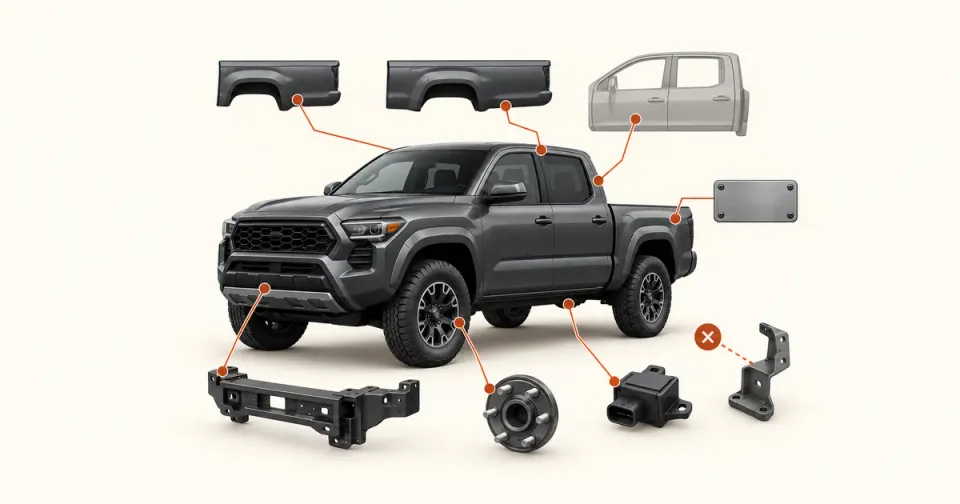
TREAT THE CHART AS A FILTER, NOT A GUARANTEE
Match the chart to your Tacoma's exact year/generation, cab, bed, drivetrain, powertrain and relevant factory options—then match the selected SKU and every exclusion. Confirm the current truck and installation area, save the manufacturer's application, and check return terms before mounting, cutting, coating or modifying anything. An unresolved field means fitment is unknown.
What does “fits 2016–2023 Tacoma” actually prove?
It proves only the scope written on that page. A broad year range can identify a generation, but it may not resolve a refresh, cab, bed, drivetrain, powertrain, factory option or product variant. Treat the headline as the first filter and continue until the exact truck and exact SKU meet in the same documented application.
Start with a vehicle line such as:
> 2021 Tacoma TRD Off-Road Double Cab, 5-foot bed, 3.5-liter V6, automatic, part-time 4WD, with factory bed rails and a front camera.
Build that line from Toyota's VIN record and physical inspection. The VIN record describes the truck as built; the inspection catches removed, replaced or aftermarket equipment. Use the exact Tacoma configuration workflow before reading a product chart.
Read the chart from left to right
Fitment tables vary, but the same sequence prevents most category errors.
| Chart field | What to match | Common mistake |
|---|---|---|
| Year/generation | Exact model year and any refresh boundary | Reading a generation-wide heading as every-year approval |
| Cab/body | Access Cab, Double Cab or XtraCab as named | Using door count or a seller photo instead of the maker's application |
| Bed/wheelbase | Exact bed length and required cab/bed combination | Treating “short bed” and “5-foot” as universal naming |
| Drivetrain/powertrain | 2WD/4WD, transmission, engine or gas/hybrid when listed | Assuming trim alone resolves underbody hardware |
| Factory equipment | Cameras, radar, sensors, rails, flares, skids, hitch or suspension | Treating optional equipment as standard on every trim |
| Product SKU/variant | Part number, side, size, material, finish and selected options | Checking the correct product family but adding the wrong variant to cart |
| Exclusions/notes | “Except,” “only,” required companion parts and modifications | Stopping at the green check mark or broad application title |
If a field is relevant to the mounting area but the chart does not address it, do not fill the gap with an assumption. Ask the manufacturer to confirm the exact combination in writing.
Why does the exact part number matter?
The same product name can hide multiple applications. Westin's Tacoma charts provide a concrete example: the manufacturer assigns different nerf-bar applications and part numbers to Access Cab, Double Cab and fourth-generation XtraCab/Double Cab configurations. Similar length or appearance does not merge those rows. Review Westin's R5 application chart.
Copy the SKU from the row that matches the truck, then verify that the cart, order confirmation and box label use that same SKU. Also preserve the selected material, finish, left/right position, bed length or bracket kit. A correct family with the wrong dropdown selection is still the wrong order.
What do exclusions and instructions reveal?
The exclusion line often contains the real fitment decision. Look for language such as:
- Double Cab only or excludes XtraCab/Access Cab;
- gas only, hybrid only, 4WD only or manual-transmission exclusions;
- not compatible with a factory skid, air dam, tonneau, deck rail, camera or sensor package;
- requires a separate bracket, relocation kit, reinforcement or light mount;
- cutting, drilling, trimming, wiring or calibration required; and
- stock vehicles only or no approval with another aftermarket component.
Open the current installation instructions before ordering. They can show reused mounting points, discarded factory pieces and conflicts that the shopping-page summary omits. A part can be correctly listed for the truck yet still not coexist with a rack, cover, skid, lift or bumper already installed.
Use the factory-options fitment checklist when the part touches cameras, sensors, lighting, rails, suspension or armor.
Which fitment source should you trust?
Use the product manufacturer first: exact product page, application chart and installation instructions. For Toyota accessories, use Toyota's VIN-aware catalog and the exact Toyota part record. A retailer selector can help locate candidates, but it should not override the manufacturer application.
Do not use a marketplace title, search snippet, product photo, forum report or “confirmed fit” badge as the final proof. Those sources may omit the exact SKU, configuration or exclusions. If the seller and manufacturer disagree, stop and obtain written clarification before ordering.
How do you avoid an expensive return?
Fitment verification and return eligibility are separate checks. A seller can accept a return only under conditions you have already lost by installing or modifying the part.
Before purchase:
- Save the dated product page, application row, selected SKU and exclusions.
- Download the installation instructions and compare them with photos of the actual mounting area.
- Ask one complete written question naming the truck, SKU, factory options and existing modifications.
- Read the seller's return window, RMA process, restocking fee, return-freight responsibility and non-returnable categories.
- Inspect freight damage before signing when the seller's policy requires it.
C4's current return policy illustrates the exposure: it requires a pre-authorized RMA, unused/resalable condition and original packaging, applies a 20% restocking fee, and generally places return shipping on the customer. Custom or made-to-order products may be non-returnable. Those are C4-specific terms, not a universal policy. Read C4's current returns and RMA policy.
After delivery, compare the box label and product to the order, inventory the hardware, and perform only the manufacturer's allowed non-destructive checks. Do not drill, cut, mount tires, coat bare metal or modify the product until its exact fit and contents are resolved. Keep the packaging until the decision is complete.
Compatibility snapshot
| Evidence/application | Result | Required check |
|---|---|---|
| Manufacturer application matches the full current vehicle profile and exact SKU | Candidate fitment | Resolve every exclusion and follow current instructions |
| Broad year range matches, but cab/bed/powertrain or factory-option field is absent | Unknown until confirmed | Obtain written manufacturer confirmation |
| Correct product family but cart contains another SKU or variant | Do not order | Select the exact documented application |
| Marketplace or retailer claim conflicts with manufacturer documentation | Stop | Resolve the conflict with the manufacturer and seller |
| Part has been cut, drilled, coated, installed or otherwise modified | Return eligibility at risk | Check the exact seller policy before any irreversible step |
Bottom line
The reliable sequence is exact truck → exact SKU → complete application and exclusions → current instructions → return terms → non-destructive inspection. A fitment chart narrows the candidates; it does not replace inspection or answer an omitted compatibility field. If one relevant field remains unresolved, wait for written confirmation rather than gambling on return freight and restocking fees.
Sources & notes
- Toyota Vehicle Specification VIN tool, accessed 2026-10-15. Manufacturer starting point for VIN-specific build and listed equipment; it does not approve aftermarket parts or reflect every later modification.
- Westin R5 Nerf Step Bars application chart, accessed 2026-10-15. Demonstrates separate Tacoma cab/application rows and part numbers; it does not establish another product family's fitment.
- C4 Fabrication returns and RMA policy, accessed 2026-10-15. Current C4-specific return window, condition, RMA, fee, freight and non-returnable boundaries; another seller's terms may differ.