
Power Running Boards vs Fixed Steps for a 2024+ Tacoma
Verify fitment with the merchant before you buy.
Reviewed by DoesItFit Editorial · How we evaluate compatibility
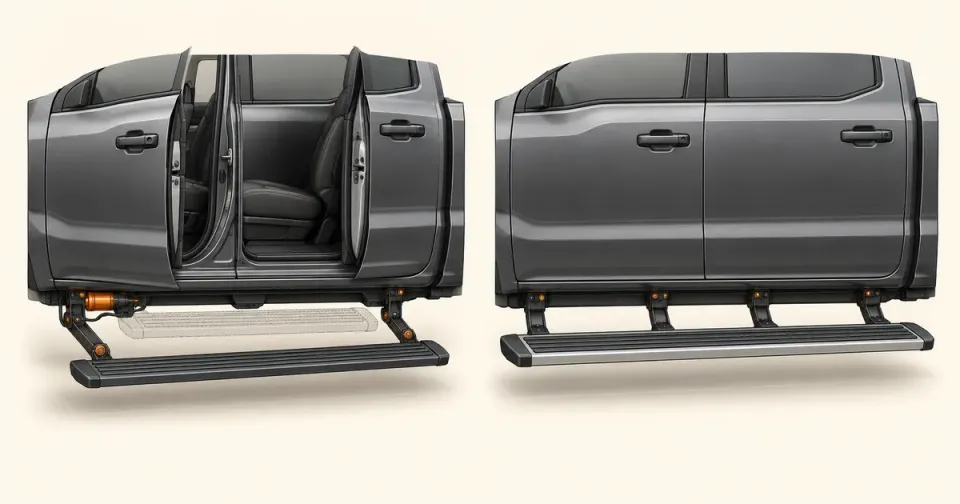
POWER BOARDS TRADE COMPLEXITY FOR STOWED CLEARANCE
Choose a power running board when you need a deployed access step but want it retracted near the rocker while driving. Choose a fixed step when simple, always-available footing and a mechanical bolt-on installation matter more than permanently reduced side clearance. Neither category is automatically a rock slider; verify the exact cab, mounting points and product SKU.
Exact-example comparison
| Example | Current application used here | Access and clearance | Installation boundary |
|---|---|---|---|
| AMP Research PowerStep 76362-01A | Product page/instructions list 2024–2026 Tacoma; confirm exact cab/grade with seller | Six-inch board deploys with door and retracts after closing | Motors, controller, battery harness, DSM/OBD connection; 3–5 hours; LED wiring requires drilling |
| Toyota cast aluminum board PT738-35240 | 2024+ Tacoma/Tacoma HV Double Cab | Fixed broad slip-resistant board, always available | Uses factory threaded positions with 16 specified bolts; no powered control system |
This comparison uses the two named systems to expose the architecture. It does not approve every powered or fixed step that looks similar.
Choose a power board for access without a permanently low step
A power running board moves down and out when a door opens, then retracts toward the rocker after the doors close. AMP describes 76362-01A as a six-inch aluminum cab-length board rated at up to 300 pounds per door. Its current application page and June 2026 instructions list 2024–2026 Tacoma.
The main advantage is packaging: the board can provide a useful step when entering while returning closer to the body during travel. Do not convert that into a universal clearance measurement. Actual stowed height, linkage position and trail exposure depend on the exact system and truck.
The exact AMP page does not visibly settle every cab and grade combination. Confirm 76362-01A against the exact Double Cab or XtraCab, factory power-step equipment and electrical configuration before ordering.
Choose a fixed board for simple, predictable footing
A fixed board is always in the same place. There is no wait for deployment, no controller or motor, and no powered mechanism to service. Toyota's PT738-35240 provides a current fourth-generation example: cast aluminum with a slip-resistant surface, and instructions scoped to 2024+ Tacoma and Tacoma HV Double Cab.
Those instructions use existing vehicle locations and specify 16 replacement bolts. That is a much narrower installation system than the AMP example. The tradeoff is equally direct: the board remains beneath the rocker while driving, so it continuously occupies side-clearance space.
PT738-35240 is a Double Cab application. A similar overall length or bracket count does not approve it for XtraCab. Use the exact current fit check.
Power installation is more than bolting on brackets
AMP's 76362-01A instructions estimate 3–5 hours and recommend professional installation. The procedure includes:
- two motor/linkage assemblies and running boards;
- a controller and fused battery connection;
- harness routing along the firewall and frame area;
- DSM wire connections and an OBD-II module;
- activation and door-by-door operation checks; and
- drilling 9/32-inch pinch-weld holes for the supplied LED lamp wiring.
That is not a reason to reject the system; it is the ownership price of automatic movement. If another device already occupies the OBD port, confirm the documented pass-through solution and compatibility rather than improvising a splitter.
Mud, snow and salt change the maintenance decision
AMP warns that mud, dirt and salt can become trapped in the mechanism and cause unwanted noise. Its instructions prescribe deploying the boards for cleaning, avoiding direct motor spray and lubricating hinge pivot pins as directed.
The evidence does not provide a universal winter failure rate, so this guide does not claim powered boards always fail in cold climates. It does establish that a moving, exposed mechanism needs maintenance that a fixed board does not. Buyers who regularly encounter salted slush or packed mud should include cleaning access in the decision.
Factory power boards are a separate system
Toyota documents power-extending running boards on equipped fourth-generation trucks, including the 2024 Limited application, and its quick-reference guide explains their door-linked and manual-switch operation. That factory equipment does not prove a practical retrofit path for a truck built without it.
Before adding an aftermarket system to a truck with factory power boards—or replacing the factory system—confirm removal, wiring, switches, body control logic, warning messages and warranty implications with the relevant manufacturers.
Neither access step is automatically a rock slider
Both products in this comparison are access systems. A fixed board may look substantial, and a powered board may retract for clearance, but neither fact establishes structural rock-contact or jacking use.
If rocker protection is the primary job, use the running boards, nerf bars and rock sliders guide and require explicit frame mounting and structural-use documentation. If the truck is an XtraCab, also use the fourth-generation XtraCab step-fitment guide.
Before you buy
- Record model year, Double Cab or XtraCab, grade and gas/hybrid powertrain.
- Check whether factory power boards or other side hardware are already present.
- Match the exact SKU and current installation guide—not only the product-family name.
- Measure the step position needed by regular passengers and the fixed-board clearance you can accept.
- For a powered system, confirm wiring, OBD/DSM interface, drilling, installer skill and maintenance access.
- For a fixed system, confirm every bracket, bolt and cab-specific mounting point.
- Require separate structural documentation if rock-contact protection is expected.
Bottom line
Power running boards are the better starting point when low deployed access and a cleaner stowed profile justify a more involved electrical/mechanical system. Fixed steps are the better starting point when simple installation, predictable footing and fewer moving parts matter more than maximum side clearance. On a 2024–2026 Tacoma, the final answer still belongs to the exact cab, grade, existing equipment and SKU.
Sources & notes
- RealTruck: AMP Research PowerStep 76362-01A, accessed 2026-10-15. Documents the current 2024–2026 Tacoma listing, operation, board construction, mount and published capacity; confirm exact cab/grade before purchase.
- RealTruck: 76362-01A installation instructions, revision 2026-06-30, accessed 2026-10-15. Documents installation time, wiring/control interfaces, drilling, activation, operation and adverse-condition maintenance.
- Toyota: PT738-35240 installation instructions, accessed 2026-10-15. Documents the 2024+ Tacoma/Tacoma HV Double Cab scope, components, factory mounting locations and specified hardware.
- Toyota: 2024 Tacoma accessory brochure, accessed 2026-10-15. Describes the fixed Double Cab cast-aluminum board as an access product.
- Toyota: 2024 Tacoma quick-reference guide, accessed 2026-10-15. Documents operation of factory power running boards when equipped; it does not establish retrofit compatibility.
- Refresh plan: recheck applications, cab/grade notes, electrical interfaces and instructions quarterly. The hero is an original generic illustration, not exact-product or clearance evidence.