
Bed Tent vs Rooftop Tent for Tacoma Camping
Verify fitment with the merchant before you buy.
Reviewed by DoesItFit Editorial · How we evaluate compatibility
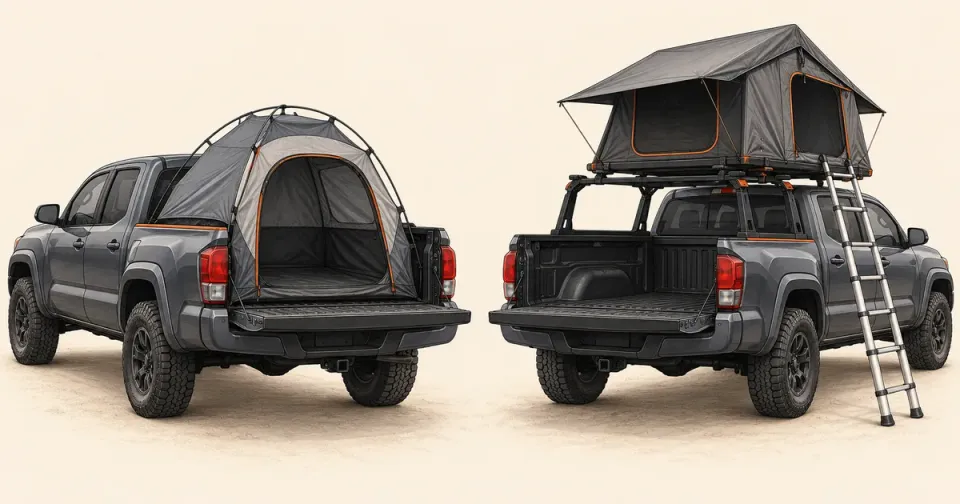
CHOOSE THE BED TENT FOR A LIGHTER REMOVABLE SYSTEM; THE RTT FOR REPEAT-USE CARGO SEPARATION
Choose a bed tent when occasional camping, low installed weight and removing the entire system between trips matter most. Choose a rack-mounted rooftop tent when you want an integrated mattress and need to keep cargo in the Tacoma's bed. A bed tent needs the measured bed and accessory interfaces to fit; an RTT needs the exact vehicle, rack, tent, spacing and load limits to agree.
The practical comparison
| Decision | Bed tent | Rack-mounted rooftop tent |
|---|---|---|
| Bed while sleeping | Tent occupies it; tailgate normally stays down | Bed can remain available below the rack |
| Permanent truck hardware | Usually none after packing the tent | Compatible rack/crossbars remain installed |
| Travel weight and height | Tent is packed as cargo; no roof/bed-rack requirement | Tent plus rack consume payload and raise the travel envelope |
| Fitment key | Measured bed length and accessory clearance | Exact vehicle/rack approval, tent weight, bar spacing and clamps |
| Setup pattern | Pitch and remove at camp | Unfold/open the mounted tent and deploy ladder |
| Best starting point | Occasional use, simpler storage and lower system commitment | Frequent use, integrated sleep system and bed/cargo separation |
This is an architecture decision. Product quality, weather performance and setup speed still depend on the exact model and correct installation.
Choose a bed tent when simplicity and removability matter
A truck-bed tent attaches to the pickup bed while parked. It uses the bed floor as the sleeping platform, so it does not need a load-rated rooftop-tent rack. When packed away, it leaves no tent or rack above the truck.
Napier's current Tacoma short-bed collection explains the key fit rule: bed length, rather than cab size, selects its truck tent. Its Backroadz 19 Series lists compact short-bed model 19066 for beds from 5 feet to 5 feet 2 inches and compact regular-bed 19044 for beds from 6 feet to 6 feet 3 inches. Those ranges are Napier-specific; they do not approve another brand.
The tradeoff is bed use. Cargo must be moved before the tent is pitched, the tailgate remains open, and the tent cannot stay erected while driving. Napier estimates 10–20 minutes after the user becomes familiar with setup. Treat that as its own product guidance, not a universal contest against every rooftop tent.
Choose a rooftop tent when the bed must keep working
A rooftop tent is carried on an approved rack or crossbar system. On a Tacoma, that rack may be above the cab or above the bed. Either location can leave the bed floor available for bins, drawers or other cargo while the tent is open.
The convenience comes with a larger installed system. Yakima's current SkyRise HD 8007534 weighs 131.5 pounds before counting the rack and anything the maker permits inside during travel. Its product page lists a 26- to 40-inch crossbar spread; its current instructions further distinguish side and rear deployment and require at least 165 pounds of vehicle/rack carrying capacity.
Those instructions also say not to use that tent with factory crossbars because Yakima considers them too flexible for this application. That is a rule for this named tent—not proof about every rooftop tent or every factory rack. Use the exact tent maker's fit list and instructions.
If an RTT is the choice, continue with the Tacoma rooftop-tent roof-rack versus bed-rack guide to choose its location.
A bed tent still has real compatibility checks
“Fits midsize trucks” is not enough. Before buying a bed tent:
- measure the usable bed length with the tailgate closed, then match the tent maker's method;
- confirm the bed height/profile and tailgate-open layout;
- ask whether a tonneau, toolbox, bed rack, sport bar or camper shell blocks the straps or fabric;
- remove debris that could abrade the tent or paint and use the maker's strap protection; and
- verify the sleeping pad or mattress fits between the wheel wells and does not cover unsafe heat or power equipment.
Napier says some tonneaus, toolboxes and bed racks may work while others interfere, and specifically rules out use with a camper shell. That is an accessory-by-accessory check—not a universal “remove everything” rule.
An RTT is a complete load system, not just a tent
For a rack-mounted tent, verify all of these together:
- the vehicle and rack are approved for the tent while driving;
- rack dynamic capacity covers the tent and allowed travel contents;
- the parked/static system covers occupants and permitted gear;
- crossbar spacing falls inside the exact tent's allowed range;
- clamps fit the bar width, height and support location;
- the opened tent and ladder clear the truck and reach stable ground; and
- rack, tent, occupants and cargo stay within Tacoma payload and axle limits.
Use the lowest applicable limit. A tent's occupied capacity does not increase the rack rating, and a rack's parked rating does not increase Tacoma payload. Use the remaining-payload worksheet before buying a heavy permanent system.
Consider the entire campsite workflow
Both choices tie the sleeping area to the truck. A grocery or trail run means packing the tent before moving the Tacoma. A separate ground tent is the better comparison if leaving shelter erected while the vehicle departs is essential.
For either truck-mounted design, park on stable level ground, follow the wind/weather limits, keep flames and cooking outside the tent, and dry fabric before storage. Do not drive with a bed tent installed or an RTT open.
Before you buy
- Record Tacoma model year, cab and measured bed length.
- List the tonneau, toolbox, rack, sport bar, shell, drawer and bed-mat interfaces.
- For a bed tent, match the maker's exact bed range and strap path.
- For an RTT, record tent travel weight, rack SKU, dynamic/static limits, bar spacing and clamp envelope.
- Calculate remaining payload with occupants and normal trip cargo.
- Measure closed travel height and opened ladder/deployment clearance.
- Confirm how cargo will be moved or accessed at camp.
Bottom line
A bed tent is the more removable, lower-commitment Tacoma camping system, but it consumes the bed and requires cargo/accessory clearance every time it is pitched. A rack-mounted rooftop tent preserves bed-floor space and can streamline repeat trips, but it adds permanent hardware, weight, height and a stricter rack/load verification problem. Choose the architecture first, then approve the exact bed or rack/tent interface.
Sources & notes
- Napier: Tacoma mid-size short-bed tents and FAQ, accessed 2026-10-15. Documents bed-length selection, accessory conflicts, parked-only use, open-tailgate use and estimated setup. Confirm the exact tent variant and measured bed.
- Napier: Backroadz Truck Tent, 19 Series, accessed 2026-10-15. Documents current 19066 and 19044 compact-bed size ranges; those ranges do not transfer to another brand.
- Yakima: SkyRise HD 8007534 and current instructions, accessed 2026-10-15. Document weight, crossbar spacing, load/interface requirements and named restrictions for this exact tent.
- iKamper: Skycamp installation requirements, accessed 2026-10-15. Corroborates the model-specific dynamic-load, spacing and bracket checks expected for a rack-mounted tent.
- Refresh plan: recheck exact variants, bed ranges, tent weight, rack approval, spacing and instructions quarterly. The hero is an original generic illustration, not fitment or load evidence.