
What Should You Check Before Installing a Bed Rack on a Tacoma?
Verify fitment with the merchant before you buy.
Reviewed by DoesItFit Editorial · How we evaluate compatibility
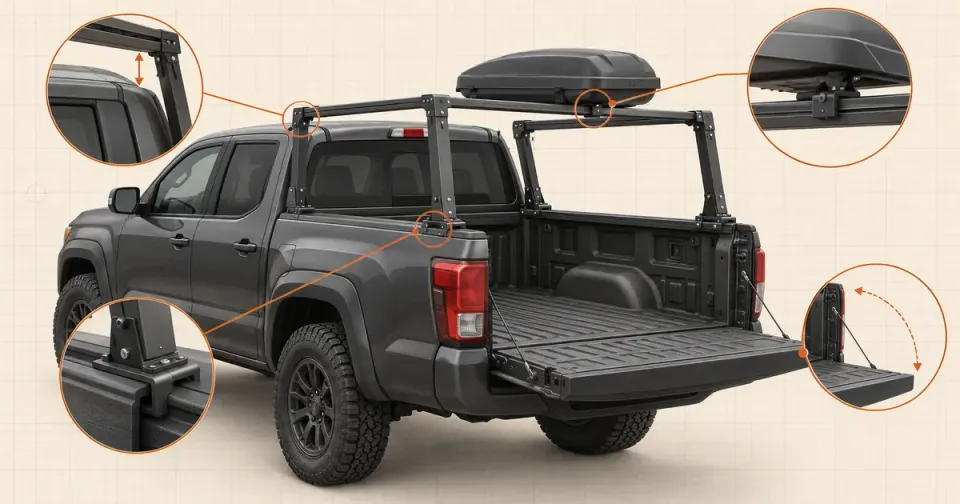
VERIFY THE WHOLE RACK SYSTEM BEFORE ASSEMBLY
Install only after the rack and mounting kit match your Tacoma's year, bed length and rail system; all legs, crossbars, plates and hardware are present; and the selected height clears the cab, tailgate, cameras, cover and cargo. Use the exact instructions for leg position, torque and load limits—none of those values is universal.
Installation-readiness snapshot
| Check | Ready when | Stop when |
|---|---|---|
| Application | Tacoma year, bed length, rail system and exact rack/mount kit agree | Listing says only “Tacoma,” or an adapter/application is assumed |
| Parts | Every leg, crossbar, side rail, plate, clamp and fastener matches the current instructions | Hardware is missing, damaged or mixed between kits |
| Shared space | Rack height and feet clear the cab, tailgate, cover, toolbox, cameras and bed accessories | Two separately compatible products occupy the same rail or movement envelope |
| Load system | Cargo/tent, mounts, rack and vehicle limits are known for driving and parked use | A static rating is being used as a driving allowance |
| Final installation | Rack is square, torqued in sequence, secured and rechecked as directed | Legs rock, crossbars bind, clamps bottom out or the instructions do not match the truck |
1. Match the rack to the exact Tacoma
Record the model year, generation, bed length and factory bed-rail system. Then match those facts to the rack's exact SKU, height and mounting kit—not merely to a photo of a Tacoma.
The current Cali Raised 2024+ Tacoma Overland Bed Rack shows why each field matters. Its listing separates five- and six-foot beds, offers 7-, 10- and 17.5-inch heights, and mounts its named system to the factory bed rails. The maker directs 2005–2023 trucks to a different listing. Review the current 2024+ application.
Do not assume that “universal truck rack” means one-box Tacoma fitment. Yakima's OverHaul HD, for example, requires the towers plus separate crossbars and says tracked beds need an additional Track Kit. The exact current vehicle fit data decides which parts are required. Review the OverHaul HD system.
If you are still choosing a rack, first resolve whether it must share the bed rails with a cover in the bed-rack and tonneau compatibility guide.
2. Inventory the complete system
Lay out every component in instruction order before removing factory parts. Identify:
- all four legs or towers and their left/right or front/rear orientation;
- crossbars, side rails, braces and end caps;
- vehicle-specific track plates, adapters, clamps and rubber isolators;
- every bolt, washer, nut, T-nut, spacer and locking part;
- accessory mounts that must be installed before a crossbar end is closed; and
- the exact tools, sealants and torque tools named in the instructions.
Compare the physical hardware with the current manufacturer manual, not an unboxing video for an older revision. Stop for a bent rail, damaged thread, missing plate or unexplained extra hardware. Do not replace a graded or corrosion-resistant fastener with a convenient hardware-store bolt unless the manufacturer approves it.
3. Map every shared interface
Rack feet consume space on or beside the bed rails. Before tightening anything, list the cover, toolbox, inner-bed panels, cleats, bed extender, camper, tie-downs, lighting and wiring that must remain.
“Fits a Tacoma” plus “fits a Tacoma” does not prove the pair fits together. The cited Cali Raised rack explicitly excludes tonneau covers, including named retractable styles. Yakima says its OverHaul system can work with select tonneaus only through a separate Tonneau Kit. Those opposite examples make the rule clear: require written compatibility for the exact rack, cover and adapter combination.
Also cycle the tailgate and any cover, drawer, hatch or toolbox lid through its full travel. Preserve access to bed lights, outlets, storage compartments and tie-downs if the product documentation says they remain usable.
4. Choose rack height from the load and clearance envelope
Height is functional. A lower rack can keep a closed rooftop tent nearer the cab roofline, while a taller rack can improve bed access or allow long cargo to clear the cab. Either choice can create a new conflict.
Dry-check:
- cab roof and rear-window clearance under chassis flex and loaded conditions;
- rooftop-tent shell, hinges and mounting brackets;
- rear hatch, tailgate, toolbox and cooler-lid travel;
- digital rearview-mirror and bed-camera sightlines;
- antenna, roof rack, awning and light interference; and
- the cargo's front, rear and side overhang.
Cali Raised warns that its tall 17.5-inch version may affect named camera views, while its low and mid versions are not expected to. That is a product-specific warning, not proof that every similarly sized rack behaves the same way.
5. Build the load calculation before mounting cargo
Keep at least four limits separate:
- the rack's driving or dynamic rating;
- any lower off-road rating;
- the parked or static rating; and
- the Tacoma's payload, gross vehicle weight and axle limits.
Yakima publishes 500 pounds on road and 300 pounds off road for the named OverHaul HD system. Leitner publishes separate on-road, off-road and parked ratings for its named Tacoma ACS FORGED. Cali Raised publishes dynamic and static recommendations for its named rack. These numbers are not interchangeable because the products and manufacturers differ.
Count the complete installed system: rack, adapters, tent or cargo, accessory panels, awning, fuel/water containers, recovery equipment and the contents carried in or on them. The lowest applicable component or vehicle limit controls. A high parked rating does not authorize that load while driving, and a rack rating does not add payload to the Tacoma.
For a full vehicle calculation, use the payload-after-accessories guide. For tent placement, use the roof-rack versus bed-rack guide.
6. Dry-fit, square and tighten in the documented order
Clean the bed rails and inspect for cracks, deformation, old sealant, liner buildup or accessories that prevent flat contact. Protect painted surfaces exactly as the maker directs.
Assemble the rack loosely enough to position it. Set leg locations and crossbar spacing from the current instructions and the cargo maker's mounting envelope. Measure diagonals or use the manufacturer's squaring method before final torque. Tighten in the documented sequence and to the documented values with a suitable torque wrench.
Stop if a clamp bottoms out before securing the foot, a plate does not sit flat, a crossbar must be forced into alignment, or drilling appears necessary when the instructions describe a no-drill application. Do not slot holes or add improvised spacers to make an incorrect kit fit.
7. Complete the post-install inspection
Before loading, confirm that every fastener is accounted for, all locking features are engaged, the rack does not rock, and the bed/tailgate/accessories still operate. Secure each load to approved points and verify the cargo cannot shift into the cab, glass or tailgate.
Follow the maker's re-torque and inspection schedule. At minimum, recheck after the initial driving period, after rough-road use and whenever the load or accessory layout changes—using the intervals in the exact instructions rather than inventing a universal mileage.
Compatibility snapshot
| Exact system | Documented interface | Result | Required check |
|---|---|---|---|
| Cali Raised Overland Bed Rack for 2024+ Tacoma | Five- or six-foot bed; factory rails; selected height | Documented named application | Exact bed/height, no-tonneau condition, cameras and current ratings |
| Yakima OverHaul HD | Towers plus selected HD crossbars; extra kits for tracked beds/select tonneaus | Conditional system | Current vehicle fit, every required kit and on-/off-road ratings |
| Leitner ACS FORGED Toyota application | Named Tacoma application | Conditional named application | Exact year/bed selection and separate driving/parked limits |
| Any rack plus an unlisted cover or camper | Shared bed-rail and movement envelope | Unknown together | Written exact-SKU compatibility before modifying parts |
Before you install
Write one approval line: “[Year] Tacoma, [bed length], [rail system], rack [brand/model/SKU], height [value], mount kit [SKU], retained bed accessories [list], intended load [weight/use], current instructions [revision/date].”
Resolve every blank before drilling, trimming, applying sealant, loading a tent or discarding packaging.
Bottom line
A Tacoma bed-rack installation is ready only when the exact truck, bed, rail interface, rack, height and adapter kit match; the complete hardware is present; all covers, cameras and cargo clear; and the rack, mounts, load and Tacoma limits form one documented system. Assemble, torque and recheck it using the exact current instructions.
Sources & notes
- Cali Raised LED: Overland Bed Rack for 2024+ Toyota Tacoma, accessed 2026-10-15. Documents the named rack's bed and height selections, factory-rail mounting, load recommendations, tonneau exclusion and camera notes; those facts do not transfer to another rack.
- Yakima: OverHaul HD System, accessed 2026-10-15. Documents the named modular system, separately required crossbars/adapters, selected-tonneau condition and distinct on-/off-road ratings; vehicle fit still depends on Yakima's current fit data.
- Yakima: OverHaul HD installation instructions, accessed 2026-10-15. Supports parts inventory, cleaning, loose positioning and product-specific torque/sequence checks; its torque values apply only where that manual specifies them.
- Leitner Designs: ACS FORGED — Toyota, accessed 2026-10-15. Provides a second example of separate on-road, off-road and parked rack limits for a named Tacoma application.