


Should You Buy a Maverick Hybrid or EcoBoost for Daily Driving?
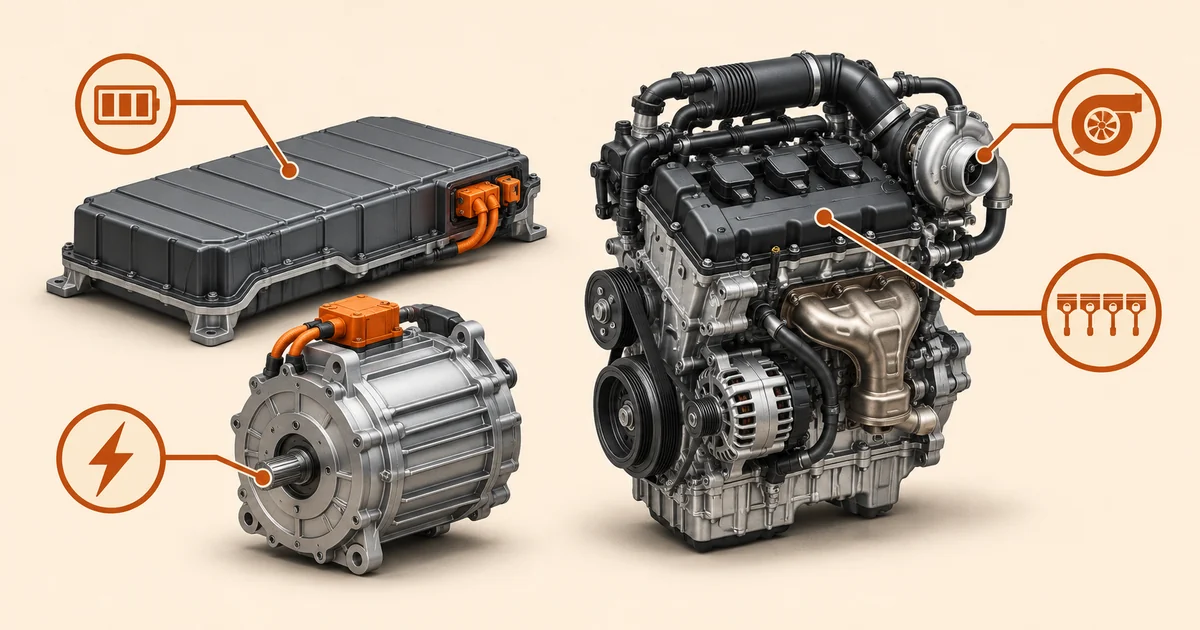
MATCH THE POWERTRAIN TO YOUR NORMAL DRIVING
Start with a Maverick Hybrid if fuel cost is the deciding factor. The EPA lists 37 MPG combined for the ordinary 2026 Hybrid AWD and 25 for the comparable EcoBoost AWD. The Lariat Hybrid AWD has its own 36-MPG entry. Verify model year and drivetrain before comparing actual asking prices, equipment and your commute.
Fit Assistant · For your setup
Apply this to your powertrain choice
Tell us a little about your situation. Fit Assistant will help you apply this guide.
First remove the wrong model-year assumptions
A used listing and a new-truck comparison may involve different choices. Ford’s 2025 specifications document Hybrid FWD, optional Hybrid AWD and EcoBoost AWD. Ford’s 2026 update says EcoBoost FWD was reintroduced.
| Purchase situation | Useful starting point | Avoid this shortcut |
|---|---|---|
| Earlier used Hybrid | Check that exact year’s drivetrain choices | Assuming a later Hybrid AWD specification applies |
| 2025 Hybrid versus EcoBoost | Compare the actual FWD/AWD candidates | Treating every Hybrid as FWD |
| 2026 ordinary daily driver | Compare both powertrain and driven wheels | Assuming every EcoBoost is AWD |
| Tremor, Lobo or a specific Lariat | Use the exact trim’s data | Borrowing the most efficient model’s MPG |
For an individual used candidate, follow the used Maverick buying checklist as well. Lower expected fuel cost does not resolve its service history or condition.
Compare EPA figures on the same basis
These are the EPA’s 2026 combined estimates, not our road-test results.
| 2026 configuration | Combined MPG | Hypothetical annual fuel cost |
|---|---|---|
| Hybrid FWD | 38 | About $1,105 |
| Hybrid AWD | 37 | About $1,135 |
| Lariat Hybrid AWD | 36 | About $1,167 |
| EcoBoost FWD | 26 | About $1,615 |
| EcoBoost AWD | 25 | About $1,680 |
| Tremor AWD | 23 | About $1,826 |
| Lobo AWD | 24 | About $1,750 |
Cost assumptions: 12,000 miles per year and $3.50 per gallon, rounded to the nearest dollar. Calculation: annual miles ÷ MPG × price per gallon. Actual consumption depends on your use; fuel prices change. The table is a consistent comparison, not an ownership-cost quote.
A regular Hybrid AWD and a Lariat Hybrid AWD have different listed combined estimates. Keep the exact candidate in the calculation rather than giving every AWD Hybrid the 37-MPG figure.
How much does the Hybrid price premium matter?
At the example assumptions, Hybrid AWD versus EcoBoost AWD saves approximately $545 a year in fuel. If the otherwise-comparable Hybrid costs $3,000 more, simple fuel-only payback is about 5.5 years.
That calculation excludes financing, insurance, maintenance, repair risk, resale and differences in equipment. A higher trim is not a pure engine-price premium. Use written prices for similarly equipped trucks before calling the difference a Hybrid premium.
Annual mileage changes the result. At half the miles, the same MPG difference produces roughly half the annual savings. At more expensive fuel, the savings grow. This is why two readers can rationally choose different powertrains even when the published MPG advantage is clear.
Match the choice to the driving you actually do
Frequent urban driving: investigate the Hybrid first if fuel cost is a major concern. Compare the city figure and your actual route rather than promising that every short trip will match the combined estimate.
Mostly highway miles: use the highway estimates for the exact candidates, then rerun the cost calculation. Combined MPG is useful for a first comparison, but it is not a prediction for a highway-only commute.
Low annual mileage: the purchase-price difference may outweigh a small annual fuel bill difference. A well-priced candidate that suits the job deserves comparison even if it is less efficient.
Winter commute or steep access road: decide whether AWD is a requirement separately from engine choice. Also plan appropriate tires. AWD availability is not proof of winter stopping performance, and a more capable drivetrain does not fix an unsuitable tire choice.
Maverick Hybrid FWD or AWD for winter driving?
Start with Hybrid FWD if your regular winter route is plowed and you rarely struggle to get moving. Shortlist Hybrid AWD if your route regularly requires pulling away on a slick grade or in loose snow. In both cases, budget separately for tires suitable for the conditions. Ford added Hybrid AWD for 2025, so confirm the model year and drivetrain of a used truck before comparing prices.
| Winter use | Compare first | What to verify |
|---|---|---|
| Plowed city commute with occasional snow | Hybrid FWD and a tire plan for local conditions | Stock tire size, winter parking, and the fitted tires on the actual truck |
| Recurring steep or unplowed access | Hybrid AWD with the same winter-tire budget | Actual route, tread and a tire package that fits the exact trim |
| Ice or predictable stopping difficulty | Tire choice, driving conditions and route first | Ford's tire requirements and the tire maker's winter guidance |
| Used Hybrid listing described as AWD | Model year and original equipment record | The exact truck's drivetrain rather than the headline |
AWD can help the truck get moving when traction is limited. Tire grip and driving conditions still govern braking and cornering. Compare quotes with the same winter setup, including the wheels and seasonal storage if needed. For the tire decision, see how tire size affects Maverick snow traction.
Ford 2025 Maverick order guide · Ford Maverick owner's manual · U.S. Tire Manufacturers Association winter guidance filed with NHTSA
Do not let occasional towing disappear from the decision
If your trailer exceeds the chosen truck’s documented rating, fuel savings cannot make that combination suitable. Conversely, a reader with light towing should not assume EcoBoost is required solely because an old review said Hybrid AWD did not exist.
Use Ford’s year-specific towing documents and the actual equipment record. The frequent-towing comparison handles the loaded-trailer decision in more detail. This guide’s purpose is the everyday purchase trade-off, not a second towing chart.
Two worked buying situations
12,000-mile commuter, wants AWD, ordinary 2026 trims: use 37 versus 25 MPG for the displayed Hybrid AWD/EcoBoost AWD comparison. At $3.50 a gallon, the difference is about $545 annually. Then compare the actual purchase prices, features and insurance quotes.
Same commute, Hybrid candidate is a Lariat: use 36 MPG, not 37. Example fuel savings versus 25 MPG become about $513 annually. That is still useful, but the comparison must include the Lariat’s equipment and price rather than claiming an engine-only saving.
Older used truck with 5,000 annual miles: an unusually high Hybrid asking-price premium may take a long time to recover through fuel. Inspect both candidates; this arithmetic cannot supply a reliability ranking.
Before you buy
Write down the exact two configurations, purchase prices, annual miles, driving mix and fuel assumption. Calculate the difference, then ask whether either truck fails a passenger, AWD or towing requirement. The decision is complete when the cost trade-off and the real capability requirement are both clear.
Compatibility snapshot
| Setup | Verdict | Required check and source |
|---|---|---|
| 2026 Maverick Hybrid FWD | 38 MPG combined EPA estimate | Compare the exact FWD candidate and the equipment you need. 2026 EPA and DOE Maverick listings |
| 2026 Maverick Hybrid AWD, ordinary entry | 37 MPG combined EPA estimate | Check that the candidate matches this entry rather than the Lariat. 2026 EPA and DOE Maverick listings |
| 2026 Maverick Lariat Hybrid AWD | 36 MPG combined EPA estimate | Use 36 MPG in a fuel-cost or break-even calculation. 2026 EPA and DOE Maverick listings |
| 2026 Maverick EcoBoost AWD, ordinary entry | 25 MPG combined EPA estimate | Check the separate Tremor or Lobo entry if that is the actual truck. 2026 EPA and DOE Maverick listings |
Sources & notes
Last verified 8 November 2026.
Reviewed 7 November 2026. 2026 EPA entries, Ford’s 2025 specifications, and Ford’s 2026 update support the dated comparison. Cost examples are hypothetical arithmetic; no guaranteed savings, payback, resale value or reliability advantage is established. See our methodology.