
Buying a Used Ford Maverick: Which Checks Matter Most?
CHECK THE TRUCK YOU ARE ACTUALLY BUYING
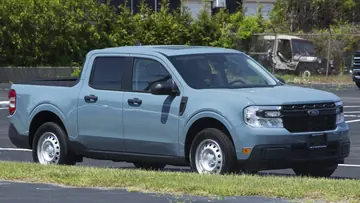
Buy a used Maverick by its actual year, powertrain, equipment and condition—not the reputation of one owner’s truck. Start with the VIN, service and repair records, an independent inspection, and the job you need it to do. A hitch does not prove 4K towing, and a clean recall lookup does not prove mechanical health.
Fit Assistant · For your setup
Apply this to your used-truck choice
Tell us a little about your situation. Fit Assistant will help you apply this guide.
Which Maverick are you actually buying?
Put these details on one page before comparing asking prices. You can leave a field unknown initially; it becomes a question for the seller rather than a reason to guess.
| Candidate detail | What to collect | Why it changes the purchase |
|---|---|---|
| Identity | VIN, model year, mileage, engine and drivetrain | A review of a different powertrain is an imperfect comparison |
| Factory equipment | Original window sticker or build record | A hitch, badge or seller description may omit important package details |
| History | Maintenance invoices, repair orders and vehicle-history report | You need dates and work performed, not just “well maintained” |
| Present condition | Independent inspection findings and written repair estimate | Past paperwork cannot show every current problem |
| Intended use | Passengers, cargo, commute and loaded trailer | A bargain that cannot do your regular job is the wrong candidate |
A VIN is the vehicle’s identification number. Match the number on the truck to the paperwork. For an unfamiliar seller’s abbreviation such as “AWD tow,” ask for the actual equipment record rather than treating the description as a specification.
Separate three different checks
A recall lookup answers whether an identified vehicle has an outstanding safety recall in the lookup system. Use NHTSA’s VIN search and confirm the current result with Ford when necessary. NHTSA explains that its search omits completed recalls and non-safety campaigns, and some newly announced VINs may take time to appear.
A vehicle-history report helps you investigate the recorded past. It does not establish that a repair was good or that an unreported problem is absent.
An independent inspection examines the candidate now. The FTC’s used-car guidance recommends an independent inspection even when a dealer has inspected a vehicle. Give your inspector the history and your planned use so the findings answer your purchase decision.
Keep those outputs together. “No open recalls” and “no accident shown” are useful results, but neither substitutes for the inspection.
Check the job before choosing the price
An early Maverick review can be useful for cabin access, controls and daily-driving impressions. Its specifications belong to that year and powertrain.
For example, Ford’s 2024 towing guide lists the Hybrid FWD at 2,000 pounds. The properly equipped EcoBoost AWD can reach 4,000 pounds with the required package; the Tremor has a separate 2,000-pound entry. Adding a receiver does not change those applications.
Later choices differ. The 2026 guide includes a properly equipped Hybrid AWD 4K configuration. Do not use “hybrids cannot tow 4,000 pounds” as an all-year buying rule.
If towing is your main purchase task, use the Hybrid versus EcoBoost towing comparison. This checklist focuses on evaluating the individual used truck.
Give the inspector a focused brief
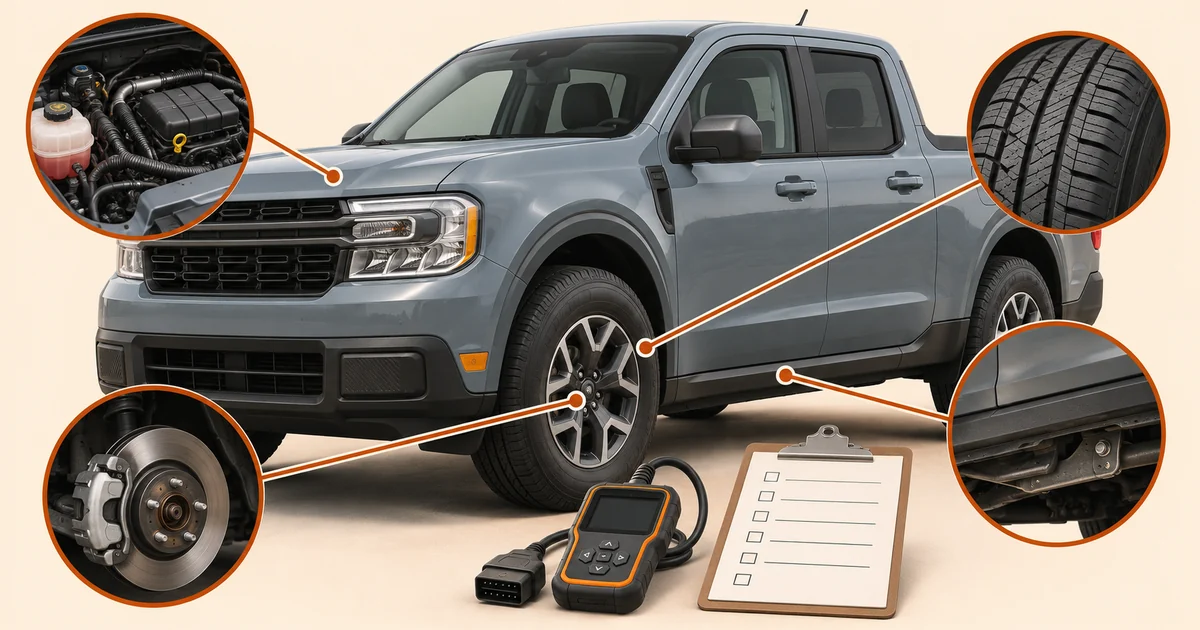
Ask for a condition report that separates observed faults from work due soon. It should cover the truck’s structure, brakes, tires, steering, suspension, leaks, electronic warnings and operation of its fitted equipment. Have the inspector explain any finding that needs a specialist or further diagnosis.
Ask specifically about modifications. Obtain the parts and installation records for changed wheels, suspension, wiring, tuning or trailer equipment. An unknown modification can complicate repair pricing and may affect the intended use. A clean-looking accessory installation is not proof that the original system remains intact.
For a Hybrid candidate, identify who can assess that powertrain locally. For any candidate with a warning light, unusual noise or intermittent fault, ask for the diagnostic finding and repair quote before deciding whether the price compensates you. This guide cannot diagnose a truck from the advertisement.
Compare the cost of owning this candidate
Use a small first-year worksheet instead of subtracting a vague “used-truck discount” from a new price.
| Cost line | Candidate A | Candidate B |
|---|---|---|
| Agreed purchase price and transaction charges | Written amount | Written amount |
| Inspection and immediate repairs | Quoted work | Quoted work |
| Known maintenance due soon | Records plus estimate | Records plus estimate |
| Required equipment for your actual use | Complete installed package | Complete installed package |
| Insurance and expected fuel | Your quote and driving assumptions | Same comparison basis |
Illustration only: a $24,000 truck with $1,800 of identified work starts at $25,800 before other charges. A $25,000 candidate with $400 of identified work starts at $25,400 on that same limited basis. That does not prove the second truck is better; it shows why the inspection changes the price comparison.
For a dealer purchase, read the Buyers Guide and the written warranty terms. Do not assume a verbal repair promise is part of the agreement. For a private sale, confirm the paperwork and transfer requirements that apply where you buy.
Two purchase decisions
2024 Hybrid with a receiver; 3,000-pound loaded camper: this is a use mismatch before debating reliability. The hitch does not turn that configuration into a 4K truck. Investigate a documented suitable configuration instead.
Commute and light household loads; incomplete service history: the unknown history does not establish a failure. It does justify requesting records, arranging inspection and pricing due work before committing. Compare the remaining uncertainty with another candidate on the same basis.
Compatibility snapshot
| Candidate or claim | Scope | Result | Decisive check |
|---|---|---|---|
| 2024 Hybrid FWD with a receiver | 3,000-pound loaded trailer | Does not meet the documented tow rating | Different suitable configuration · Ford’s 2024 towing guide |
| Eligible 2026 Hybrid AWD with 4K equipment | Towing purchase | Documented route to investigate | Exact build, loaded weights and limits · 2026 Ford Maverick Towing Information |
| Clean VIN recall result | Individual used vehicle | Limited recall information | Inspection and complete records remain separate · NHTSA’s VIN search · FTC’s used-car guidance |
| Modified used Maverick | Actual fitted parts | Unknown until assessed | Installation records and condition report · FTC’s used-car guidance |
Before you buy
Finish with an identified truck, a resolved use case, inspection findings, and written costs or remaining unknowns. You do not need to predict every future repair. You need enough evidence to decide whether this candidate makes sense at its price.
Sources & notes
Reviewed 7 November 2026. NHTSA, FTC, and Ford’s 2024 and 2026 towing guides support the scoped distinctions. This is a purchase checklist, not our ownership test, failure-rate study or inspection of your vehicle. See our methodology.