
Should You Buy Highway, All-Weather or All-Terrain Maverick Tires?
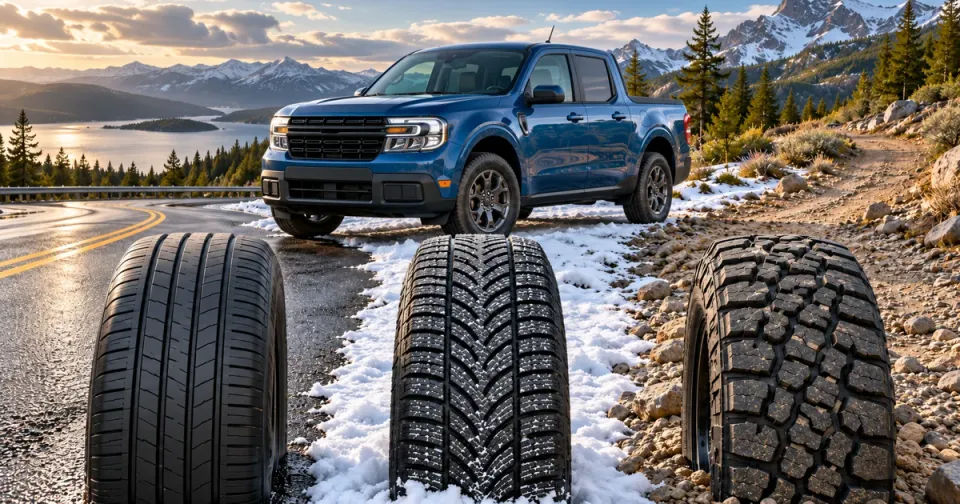
CHOOSE TIRES FOR THE ROADS YOU USE MOST
Start with a road-focused touring tire for mainly paved driving, a 3PMSF all-weather option for mixed pavement and occasional snow, or an all-terrain when rough roads are routine. Michelin Defender2, CrossClimate2 and Falken WildPeak A/T Trail illustrate the three choices. Check exact size, service description and your winter needs before ordering.
Fit Assistant · For your setup
Choose a tire type for your driving
Tell us a little about your situation. Fit Assistant will help you apply this guide.
Which tire type matches your week?
| Your regular driving | Start by comparing | The trade-off to explore |
|---|---|---|
| Commutes, errands and mostly mild-weather pavement | Highway/touring all-season | Wet-road behavior, comfort and efficiency in the exact product |
| Year-round paved driving with occasional snow | 3PMSF road-focused all-weather | Winter capability alongside your year-round priorities |
| Repeated gravel, dirt access or rough work roads | An all-terrain suited to the vehicle | Whether its construction and tread are useful enough to accept any comfort or efficiency cost |
| Frequent snowy or icy winter roads | A dedicated winter set compared with year-round alternatives | Your real winter exposure, storage and seasonal changeover |
For example, a Hybrid owner who commutes on pavement and visits a gravel campsite twice a year has a different job from someone using rough access roads each week. Choose around the normal driving and the difficult conditions you actually face, rather than an occasional trip's appearance.
NHTSA describes tire choice as dependent on location and typical weather, and distinguishes all-season, winter and all-terrain uses. Read the TireWise buying guidance.
All-season and all-weather are not interchangeable promises
Look for the Three-Peak Mountain Snowflake, often shortened to 3PMSF, when comparing severe-snow capability. It is a specific marking, not another name for M+S or for an aggressive-looking tread. It does not establish an ice-performance ranking between two products.
The names on product pages can be confusing. Michelin markets CrossClimate2 as an all-season tire with 3PMSF certification; buyers often describe that road-focused, snow-certified category as all-weather. Michelin also advises considering winter tires for frequent snow-covered and icy roads. Check the CrossClimate2 classification and winter-use explanation.
That means the useful question is which certification and documented use the exact tire has, rather than whether its product title contains your preferred category word.
Which named tires are useful comparison starting points?
| Product or route | What the manufacturer establishes | What it does not establish |
|---|---|---|
| Michelin Defender2 | A road-focused all-season product family emphasizing comfort and tread life | That it is the best tire for every Maverick or a snow-certified substitute |
| Michelin CrossClimate2 | On-road all-season family with 3PMSF certification | That it replaces a winter tire for every climate or fits every factory wheel |
| An all-terrain in the exact approved size/specification | A route worth exploring when terrain is part of regular use | A universal MPG penalty, puncture-proof construction or a no-rub upsizing allowance |
These are product-family examples, not a tested ranking or final fitment recommendation. Confirm availability in your required size and specification through the manufacturer. Defender2 product information.
If an all-terrain is the right route, the existing Falken, Toyo and BFGoodrich comparison takes that narrower buying decision further.
What matters for Hybrid MPG and road comfort?
Compare the exact tire's specification and intended use; do not infer weight or rolling resistance from the category alone. NHTSA identifies low-rolling-resistance replacement tires as a way to support vehicle efficiency, including for hybrids. It does not supply an MPG forecast for a particular Maverick and tire combination. See NHTSA's fuel-efficiency guidance.
Ask what you are willing to trade for the change you want. If quiet commuting matters most, demand relevant road-use information before choosing an aggressive tread. If rough access is routine, compare the exact construction and available evidence. This guide does not establish comparative noise, wear or fuel-economy test results.
Keep tire category separate from tire size
Choosing an all-terrain does not mean you must upsize. Start with the tire and loading label and the requirements for the exact Maverick configuration. Check size, load index, speed rating, approved wheel range and the manufacturer's application before ordering. Use the recommended cold pressure for the vehicle and selected supported setup, not the sidewall maximum as a default.
If you are buying a separate seasonal set, the Maverick winter tire-size guide handles wheel and sizing questions separately. A tire test in an LT size on another vehicle is useful only within its test conditions; it does not prove how a different size or construction will fit or perform on your truck.
How should you compare wet braking in a stock Maverick size?
Start with the size, load and speed requirements on the actual truck. Then compare the same tire models in one wet test. In Tire Rack's 2024 premium CUV comparison, the Continental CrossContact LX25 led the wet-braking comparison on its 235/55R19 Alfa Romeo Stelvio setup. The same test included Michelin CrossClimate2. The test is useful for shortlisting those models, with no measured Maverick stopping distance.
| What you want to decide | Evidence to use |
|---|---|
| Primarily a rainy paved commute | Comparable wet braking and wet handling tests for the exact tire model |
| Rain and frequent winter conditions | Evaluate wet testing and winter evidence separately, then compare exact available variants |
| Choosing a size and service description | The truck placard, Ford guidance and exact tire listing |
| One result uses a different size or test vehicle | Treat it as a shortlist clue and keep the size and vehicle visible |
Compare the total installed price and the exact tire on your quote after you shortlist. A survey score measures a different thing from a controlled stopping test. Avoid comparing figures across different test sizes and conditions as though they came from the same experiment.
Tire Rack 2024 premium CUV same-test comparison · Ford 2026 Maverick owner's manual, Tire Care
Before you buy
- Describe pavement, rough-road and winter use honestly.
- Record the factory size and truck configuration from the label.
- Confirm the exact tire's required load and speed specifications.
- Compare current mounted-set cost, installation and seasonal-storage needs.
- Have the tire maker or a qualified installer confirm the final selection.
Browse Maverick Guides and the tires and wheels topic for the next specific question.
Bottom line
Start with your roads and climate. Touring, snow-certified all-weather, all-terrain and dedicated winter tires solve different jobs. Fit Assistant can help weigh those jobs for your routine; the final product still needs the correct vehicle application and tire specification.
Compatibility snapshot
| Setup | Verdict | Required check and source |
|---|---|---|
| Mostly paved Maverick driving | Compare a road-focused touring tire such as Defender2 | Match the exact fitment and service description. Michelin Defender2 NHTSA TireWise |
| Pavement with occasional snow | Compare 3PMSF all-weather CrossClimate2 | Check the exact size and whether your winter use warrants a dedicated winter tire. Michelin CrossClimate2 |
| Regular gravel or rough roads | Compare an all-terrain such as WildPeak A/T Trail | Compare exact size, load and trade-offs. Tire Rack WildPeak A/T Trail specification table |
Sources & notes
Last verified 8 November 2026.
- Michelin CrossClimate2
- Tire Rack WildPeak A/T Trail specification table
- NHTSA TireWise
- Michelin Defender2
- Product families are examples, not a hands-on test or an exhaustive shortlist. Recheck specifications, available sizes and manufacturer applications before purchase.