
Tacoma Tire & Wheel Change Calculator: Speed, Clearance and Offset
Verify fitment with the merchant before you buy.
Reviewed by DoesItFit Editorial · How we evaluate compatibility
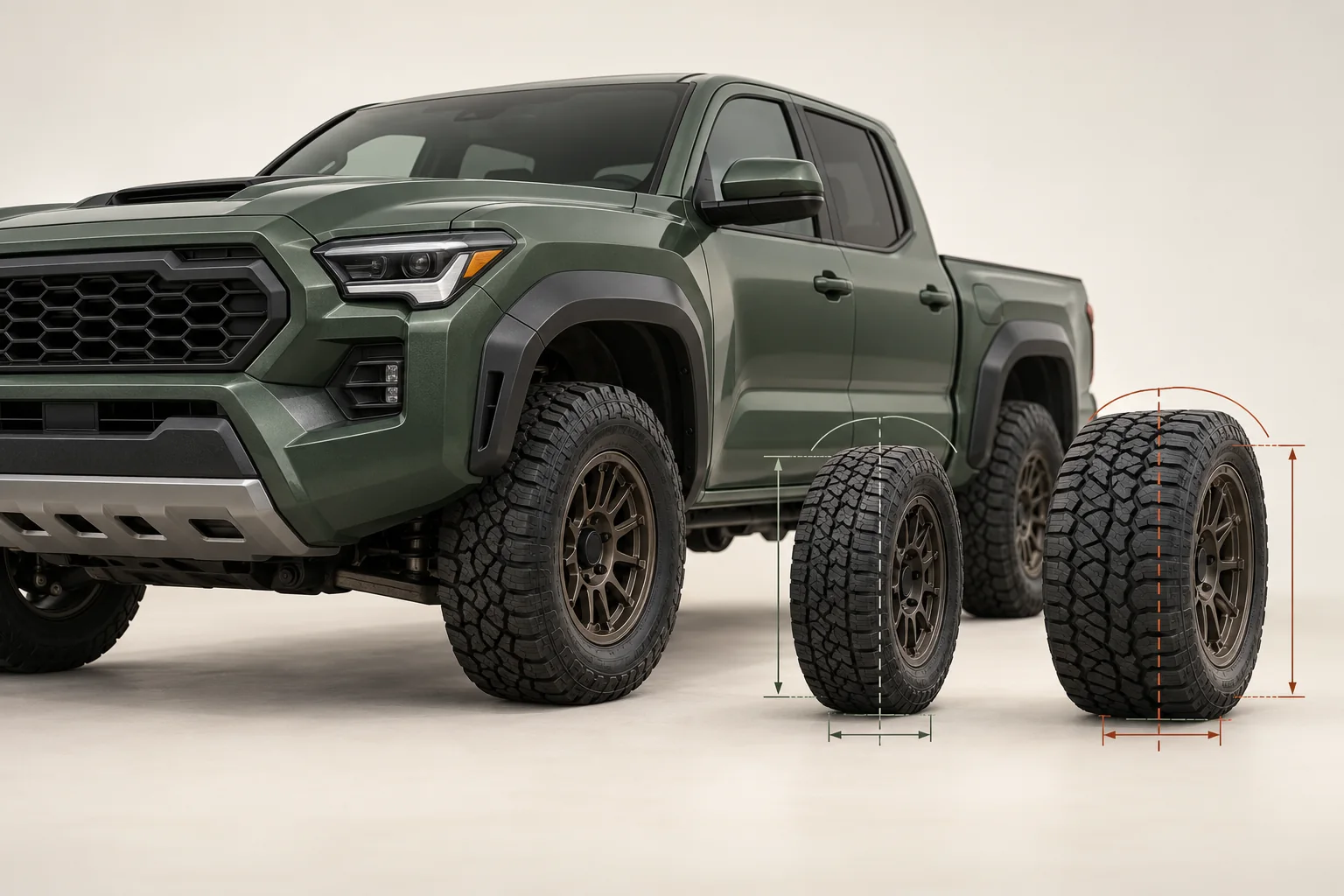
CALCULATES THE CHANGE — NOT A FIT GUARANTEE
Use this calculator to quantify what changes when a Tacoma moves to a different metric tire size or wheel width and offset. It estimates nominal diameter, speedometer and odometer difference, ground-clearance change, effective gearing, outer poke and inner wheel clearance. It cannot see the exact tire casing, wheel profile, brakes, suspension, body clearance or load rating.
Tacoma tire & wheel calculator
See what changes before you buy
Compare your current and proposed tire-and-wheel setup. See changes in diameter, speedometer reading, gearing, wheel poke and suspension-side clearance.
Geometry estimateUses exact tire and wheel specsPhysical clearance check still required
Calculated change
Noticeable diameter change
Original
Proposed
Wheel position
More calculationsClearance, gearing and distance
Speedometer reference20–80 mph
| Indicated | Estimated actual |
|---|
This calculator compares geometry; it cannot confirm fitment. Verify the exact tire's published dimensions and check clearance at full steering lock and through suspension compression.
The short answer
A tire-size calculator answers how much the geometry changes. It does not answer whether the complete package fits a specific Tacoma. Two tires with the same sidewall label can have different published overall diameters and section widths. A wheel's spoke and barrel profile can also contact a brake caliper even when diameter, width and offset look acceptable.
Use the result to decide what needs verification. A larger nominal diameter changes the distance traveled per wheel revolution. A wider wheel or lower offset changes where the assembly sits. Neither calculation knows the truck's liner, body mount, upper control arm, brake package, alignment, suspension travel or the tire's real loaded shape.
Find the tire size on your Tacoma
Tacomas from the same model year can have different tire sizes. Use the exact size printed on your tire or the driver’s-door label—not a size chosen from the year alone.
| Tire size | Nominal calculated diameter | Where you may see it |
|---|---|---|
| 245/70R17 | 30.50 in. | Common 17-inch size on newer Tacomas |
| 265/70R17 | 31.61 in. | Seen on newer PreRunner and TRD Off-Road trucks |
| 265/65R18 | 31.56 in. | An 18-inch size close in height to 265/70R17 |
| 265/70R18 | 32.61 in. | A taller 18-inch size on newer Tacomas |
| 245/75R16 | 30.47 in. | Seen on some 2016–2023 Tacomas |
| 265/70R16 | 30.61 in. | Seen on some 2005–2023 Tacomas |
| 265/65R17 | 30.56 in. | Seen on some 2005–2015 Tacomas |
Confirm the original size on the driver's-door Tire and Loading Information label. NHTSA recommends using the vehicle's original tire size or another size recommended by the vehicle manufacturer. Check NHTSA's tire-size guidance.
What each calculation means
Nominal tire diameter
For a metric size such as 265/70R17:
- Sidewall height is section width multiplied by aspect ratio: 265 mm × 0.70.
- Convert the sidewall to inches by dividing by 25.4.
- Double the sidewall and add the 17-inch rim diameter.
That produces a nominal diameter of about 31.61 inches. NHTSA defines the first number as nominal width in millimeters, the second as the height-to-width ratio, and the final number as the rim-diameter code. See NHTSA's tire-label explanation.
The result is geometric, not a substitute for the tire maker's specification sheet. Tread design, casing, load range and measuring-rim width can change the published dimensions of a specific tire SKU.
Speedometer and odometer difference
If the truck remains calibrated for the original tire, a taller tire travels farther per revolution. The calculator multiplies indicated speed by the ratio of new nominal diameter to original nominal diameter.
For example, changing from 245/70R17 to 265/70R17 increases nominal diameter by about 3.6%. When the speedometer shows 60 mph, the geometry estimate is about 62.2 mph. An indicated 100 miles corresponds to about 103.6 actual miles.
This is an estimate, not a calibration certificate. Verify actual speed safely with an appropriate diagnostic or GPS method and ask a qualified shop whether recalibration is available for the exact Tacoma.
Ground-clearance change
Only half of a tire's diameter increase appears below the axle centerline. A 1.10-inch diameter increase therefore adds about 0.55 inch of theoretical axle clearance.
It does not add that amount beneath every part of the truck, and it does not describe fender clearance. Suspension, skid plates, differential housings and body components have different low points.
Effective gearing and engine speed
A taller tire acts like numerically lower gearing because each wheel revolution covers more ground. The calculator estimates an equivalent axle ratio by multiplying the original ratio by original diameter divided by new diameter.
That number is not a new physical gear ratio. Transmission choice, torque-converter behavior, hybrid controls, shift logic, vehicle load and terrain decide actual engine speed and drivability. Use it to understand direction and magnitude before discussing calibration or regearing with a qualified shop.
Wheel poke and inner clearance
Offset alone is incomplete. Wheel width determines where both wheel edges sit relative to the mounting pad.
- Outer position change estimates how much farther the new wheel's outer edge moves toward the fender. Positive means more poke.
- Inner clearance change estimates how much space changes between the inner wheel edge and the vehicle. Negative means the wheel edge moves closer to suspension or chassis components.
For the setup shown—moving from a 17×7.5 +30 wheel to a 17×8.5 0 wheel—the outer wheel edge moves roughly 42.7 mm outward and the inner edge gains roughly 17.3 mm of space. That is a large stance change even though the wheel is only one inch wider. Review Tire Rack's definition of wheel offset.
These values describe wheel lips, not the tire's widest point. Tire section width, rim-width effect and sidewall shape must be added using the exact tire specifications.
Why calculated revolutions per mile are labeled theoretical
Circumference math can estimate unloaded revolutions per mile, but a tire deforms under vehicle load. Tire Rack explains that the loaded radius, continuous deflection and tread slip keep real revolutions per mile from being a simple diameter calculation. Read Tire Rack's revolutions-per-mile explanation.
When a tire manufacturer publishes revolutions per mile for an exact SKU, use that value for calibration and drivetrain discussions. The calculator's value is best used for an initial comparison.
Worked Tacoma comparisons
| Original → new tire | Nominal diameter change | Actual speed at 60 indicated | Theoretical axle-clearance change |
|---|---|---|---|
| 245/70R17 → 265/70R17 | +3.6% | 62.2 mph | +0.55 in. |
| 265/70R17 → 265/65R18 | −0.1% | 59.9 mph | −0.02 in. |
| 265/70R17 → 285/70R17 | +3.5% | 62.1 mph | +0.55 in. |
| 245/75R16 → 265/75R16 | +3.9% | 62.3 mph | +0.59 in. |
The near match between 265/70R17 and 265/65R18 shows why rim diameter alone is not tire diameter. The 285-size comparison also shows why a modest diameter change can arrive with a meaningful width increase and an entirely different clearance envelope.
What this calculator cannot tell you
It cannot responsibly return “fits” or “no rubbing.” Before buying, verify:
- exact Tacoma year, trim, drivetrain, brake and suspension package;
- original tire and wheel from the truck—not a forum assumption;
- exact replacement tire SKU, load index/range, speed rating, published diameter, section width, approved rim-width range and revolutions per mile;
- exact wheel SKU, bolt pattern, center bore, hub seating, lug-seat type, hardware and load rating;
- brake-caliper clearance from the wheel's barrel and spoke profile;
- upper-control-arm, suspension, liner, mud-flap, body-mount and fender clearance;
- full steering lock in both directions, forward and reverse;
- compression and articulation required for the way the truck will be used;
- spare-tire storage and whether a mismatched spare is acceptable for the drivetrain;
- TPMS sensor compatibility and registration; and
- whether speedometer, odometer or driver-assistance calibration is required.
Toyota warns that different tires can affect ABS, traction control, stability control and Trailer Sway Control, and advises contacting a Toyota dealer when replacing tires or wheels. Read the 2024 Tacoma driving-assist warning.
A calculator result worth sharing with a shop or forum
Use Copy setup link after entering the setup. The URL retains the inputs, so a shop or another Tacoma owner can reproduce the comparison rather than guessing which baseline you used.
When asking for help, include the share link plus the exact tire and wheel product pages, Tacoma configuration, suspension changes, alignment/caster information and the clearance standard you require. “Street driving without rubbing” and “full articulation without trimming” are different questions.
Before you buy
- Photograph the door placard and record the wheel markings from the truck.
- Save the exact tire and wheel specification pages—not only retailer titles.
- Run the calculator with the actual original and proposed specifications.
- Flag every meaningful diameter, width, offset and inner/outer-position change.
- Ask the wheel maker to approve the exact Tacoma application and brake package.
- Ask the tire maker or installer to approve the tire for the selected rim width and required load.
- Test-fit the wheel before mounting tires when the seller or manufacturer has not confirmed the exact application.
- Verify physical clearance through steering and suspension motion after installation.
- Follow Toyota and the wheel maker's hardware, torque, re-torque and TPMS procedures.
Bottom line
The useful question is not “Is this tire under 3%?” It is: what changed, where did the wheel-and-tire envelope move, and which interfaces now need proof? Use the calculator to make those changes explicit. Use manufacturer data and a physical fitment check to decide whether the setup belongs on the truck.
Sources & notes
- 2024 Toyota Tacoma brochure, accessed 2026-10-18. Lists several original wheel-and-tire sizes; it does not approve an aftermarket change.
- Toyota Tacoma tire sizes by generation, with Toyota's 2021 source book and 2026 brochure also reviewed 2026-10-18. Used only to provide starting tire sizes.
- NHTSA tire-size and safety guidance, accessed 2026-10-18. Supports using the placard/owner's manual and retaining appropriate size and load capability.
- NHTSA tire-label explanation, accessed 2026-10-18. Defines nominal width, aspect ratio and rim-diameter code.
- Tire Rack wheel-offset guide, accessed 2026-10-18. Defines offset and explains why width and clearance must be evaluated together.
- Tire Rack revolutions-per-mile guide, accessed 2026-10-18. Explains why real loaded revs/mile differs from simple circumference math.
- 2024 Tacoma owner's manual: driving-assist systems, accessed 2026-10-18. Warns that different tires can affect vehicle-control systems.