
What Should You Check Before Your First Maverick Towing Trip?
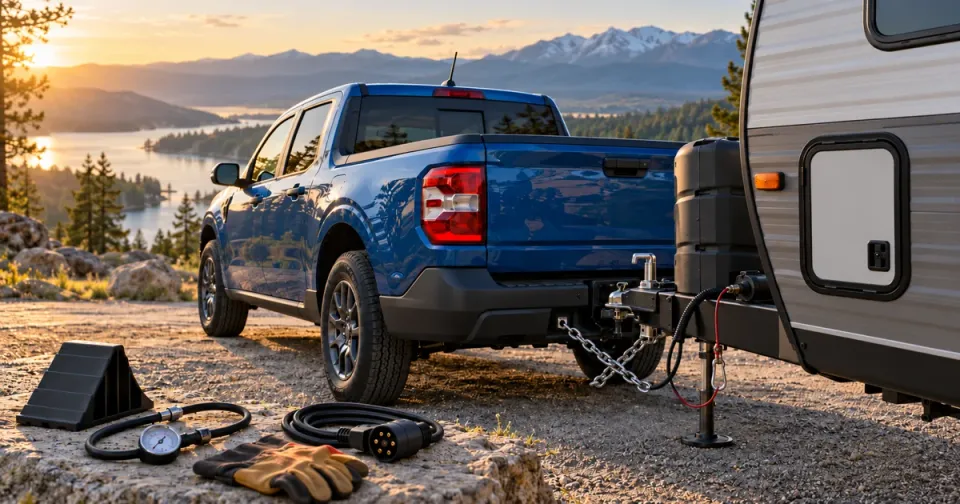
VERIFY THE COMPLETE LOADED SYSTEM BEFORE MOVING, THEN RECHECK IT AFTER 50 MILES
Before your first Maverick towing trip, confirm your truck’s tow package and the trailer’s actual loaded weight and tongue weight. Then check the coupler, crossed safety chains, trailer lights and brake operation. Ford’s Maverick towing guide sets the truck limits, and your truck and trailer labels supply the limits for the actual setup.
Ford rates properly equipped Mavericks for either the base towing class or up to 4,000 pounds with the required 4K Tow Package. The truck, package, trailer and load all have to remain inside their own limits.
Do a slow brake test in a safe area. The trailer should track straight without pushing, pulling or locking wheels. Mirrors must provide a usable view; route the electrical cable and chains so they have turning clearance without dragging.
Ford’s current towing guidance calls for a first-trip check and another inspection after roughly 50 miles. Look for a warm bearing, loosened coupler, shifted cargo, changed chain clearance, wiring contact or pressure loss. Follow the hitch, ball, rack and trailer makers’ torque instructions—do not invent generic values.
On the road, increase following distance, slow earlier for turns and descents, and avoid using speed to correct sway. Stop if the combination feels different from the low-speed test.
What happens to coupler and jack clearance on an uneven driveway?
Start with a level loaded trailer and the approved ball mount. Then check the driveway separately. A low coupler, a long shank or an extended jack can have enough clearance on level ground and still be close to contact where the slope changes.
| Position | Check before committing |
|---|---|
| Straight on level ground | Loaded trailer level, correct ball and coupler, and secured jack |
| Turn on a grade | Clearance around coupler, bumper and jack through the expected turn |
| Crest or driveway dip | Space between the lowest hardware and the ground |
| Route remains too tight | Compare a different approach or get the loaded setup checked |
Ask an installer to verify the lowest points with the actual truck and trailer loaded. Check the maker’s restrictions on mount orientation and articulation. A taller ball mount changes trailer angle as well as ground clearance, so evaluate both before changing parts.
CURT hitch height and ball-mount guidance · Ford Maverick owner’s manual
Bottom line
The first trip is a systems test, not just a tow-rating check. A correctly loaded trailer with verified connections, brakes, lights and an early reinspection is safer than a lighter trailer attached with guessed hardware.
If the truck is new, also confirm the Maverick towing break-in period.
Compatibility snapshot
| Setup | Verdict | Required check and source |
|---|---|---|
| Truck and loaded trailer | Package and ratings match | Verify actual trailer and tongue weight, remaining payload and axle limits. 2026 Ford Maverick Towing Information 2026 Ford Maverick Owner’s Manual |
| Hitch and safety equipment | Complete mechanical connection | Match ball and coupler, latch it, cross the chains and check the equipped breakaway separately. CURT installation and towing safety guidance 2026 Ford Maverick Owner’s Manual |
| Lights and trailer brakes | All intended functions work | Verify lights and brake operation before road use. Recheck the load and connection after you start the trip. 2026 Ford Maverick Towing Information 2026 Ford Maverick Owner’s Manual |
Sources & notes
Last verified 8 November 2026.
- 2026 Ford Maverick Towing Information
- 2026 Ford Maverick Owner’s Manual
- CURT installation and towing safety guidance
- 2026 Ford RV and Trailer Towing Guide, accessed 2026-10-27. Loading, braking and handling guidance.