
Should Your Maverick Use 17-, 18- or 19-Inch Wheels?
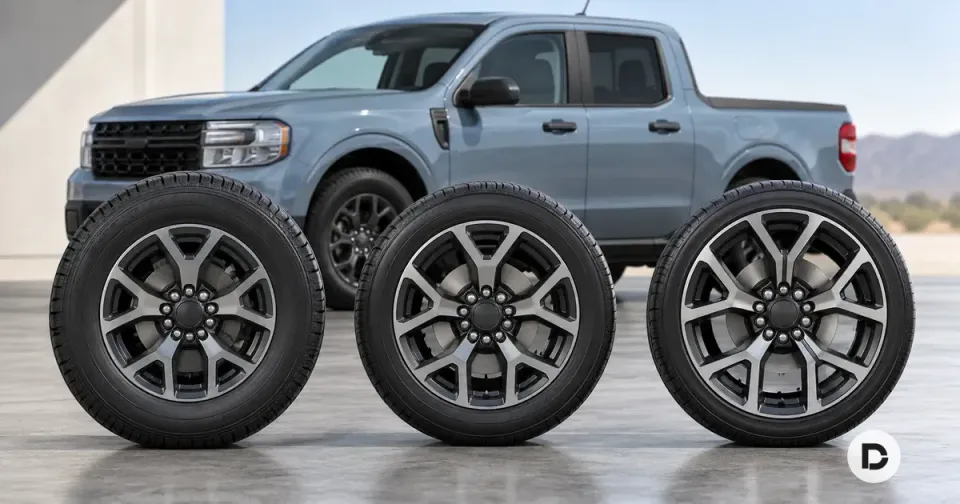
CHOOSE THE COMPLETE WHEEL-AND-TIRE PACKAGE
Choose 17-, 18- or 19-inch Maverick wheels by the complete tire package and your driving priorities. With the same outside tire diameter, a smaller rim leaves more sidewall height, but diameter alone does not establish comfort, weight, cost or MPG. Confirm exact year/trim, brake clearance, wheel dimensions and tire ratings before changing size.
Fit Assistant · For your setup
Compare wheel sizes for your driving
Tell us a little about your situation. Fit Assistant will help you apply this guide.
Wheel diameter alone does not change vehicle height. Tire outer diameter does. Moving from a 17-inch wheel to a 19-inch wheel while preserving the same outer diameter requires a shorter sidewall.
Compare packages, not wheel diameters
A 17-inch setup with a stiff, heavy tire can feel different from another 17-inch setup. Tread, construction, pressure, outside diameter and the truck's suspension also change the experience. Do not treat a comparison between different trucks or trims as a controlled test of wheel diameter.
| Your priority | Useful comparison |
|---|---|
| Rough-road daily driving | Sidewall height, suitable construction and correct pressure for each complete package |
| Appearance | The look you want versus sidewall and exact clearance |
| Winter set | Tires available in the correct size, sensors, mounting and storage cost |
| Efficiency | Full mounted weight and tire design; no MPG prediction from rim diameter |
At a hypothetical 28.5-inch outside diameter, a 17-inch rim leaves 5.75 inches of nominal sidewall height per side, an 18-inch rim 5.25 and a 19-inch rim 4.75. This is geometry to explain the trade-off, not a recommended Maverick tire size. Actual tire dimensions and approved fit still control.
Get a price for the same complete job
Price four correctly rated tires with each wheel choice, then include sensors, suitable fasteners, mounting, balancing and any spare change. Check current availability for the exact tire models you would actually buy. Neither “17 inches is always cheapest” nor “19 inches is always heavier” follows from diameter alone.
If you already like your factory package, keeping it is a valid result. Change size when the proposed package offers something you value enough to justify its cost and constraints. Ford's 2025 technical specifications document 17- and 19-inch factory examples; that does not approve an aftermarket wheel or transfer a brake-clearance result to another trim.
Compatibility snapshot
| Check | Requirement |
|---|---|
| Hub | 5×10⁸ pattern, correct center bore or approved hub-centric ring |
| Wheel | Width and offset keep inner/outer clearance |
| Brakes | Barrel and spoke shape clear caliper and weights |
| Tire | Overall diameter, load index and speed rating are suitable |
| Electronics | TPMS sensors are compatible and relearned |
| Fasteners | Correct lug-seat type and torque procedure |
Bottom line
Compare suitable complete packages against the job you need them to do. More sidewall may be a useful priority for rough roads; appearance may justify a different choice. Neither preference overrides exact fit, brake clearance or load requirements.
For the dimensions behind fitment, see Maverick wheel specs: bolt pattern, bore, width and offset.
Sources & notes
- Exact wheel fit requires dimensional verification; nominal diameter by itself does not prove compatibility.
- Michelin: changing tire size or specification, reviewed 2026-11-06. Size changes need application-specific assessment; this is not a larger-size approval.
- Ford 2025 Maverick and Lobo technical specifications, reviewed 2026-11-06. Dated factory examples; not a current 2027 lineup or universal wheel interchange record.
Editorial review 2026-11-06: decision examples and setup checks updated from competitor-gap research. This is source-based guidance, not our own product road test. Original source dates remain where evidence was not independently re-established.