
Which Wheel Specs Must Match Your Ford Maverick?
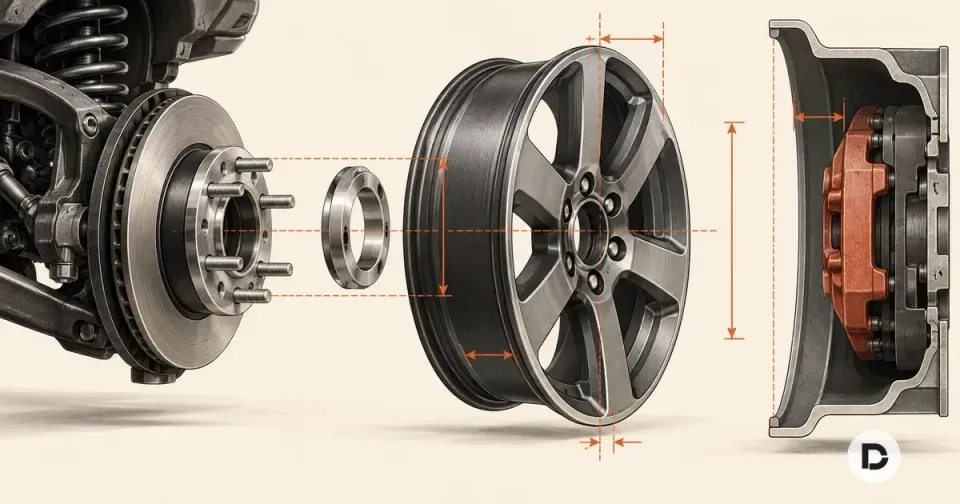
MATCH THE COMPLETE WHEEL, NOT JUST THE BOLT PATTERN
The Maverick's reference bolt pattern is 5×108 mm, with a 63.4 mm hub diameter and M14×1.5 studs in the cited chart. A replacement still needs the right width, offset, fastening hardware, load rating and brake clearance. Use those numbers to screen a candidate—not to approve every wheel from another vehicle with the same bolt pattern.
Fit Assistant · For your setup
Understand a wheel option for your Maverick
Tell us a little about your situation. Fit Assistant will help you apply this guide.
What are the Maverick wheel reference numbers?
| Item | Reference | What it tells you |
|---|---|---|
| Bolt pattern | 5×108 mm | Five studs on a 108 mm bolt circle |
| Hub diameter | 63.4 mm | The wheel's center opening must have the correct supported fit |
| Stud thread | M14×1.5 | Thread size/pitch; it does not establish the correct nut seat |
| Width and offset | Specific to the wheel and application | Do not apply one factory or accessory wheel's value to every Maverick |
US Wheel Adapters lists those first three references in its Maverick 2022+ chart row. This is a manufacturer reference chart, not a recommendation to install adapters. Check the chart's Maverick row.
Ford's 2025 owner's manual also identifies M14×1.5 in its wheel-nut section. Use the current manual and the wheel maker's instructions for the actual fastening procedure and supported hardware. Find Ford's 2025 wheel-nut guidance.
Can you use wheels from an Escape, Bronco Sport or another 5×10⁸ vehicle?
Possibly, but the donor name and bolt pattern do not settle the purchase. Ask for the actual wheel's part number and markings. Different trims, years and accessory packages can use different wheels, even within one vehicle family.
Check the center opening, width/offset, fastening seat, load rating and clearance around your brakes. A wheel that bolts to the hub can still interfere with a caliper or place the tire differently. The Escape-wheel example covers that narrower donor question.
Avoid buying a used set on “same bolt pattern” alone. If the seller cannot provide the wheel number or readable markings, you do not yet have enough information to compare the application.
How do wheel width and offset work together?
Width describes the rim's nominal width. Offset is the distance between its mounting face and centerline, in millimeters. With width unchanged, a lower positive offset moves the wheel farther outward. With offset unchanged, a wider rim grows inward and outward.
Here are geometry examples, not stock Maverick specifications or fit recommendations:
| Change | Approximate wheel-edge movement | Limit of the calculation |
|---|---|---|
| Same 8-inch width, +40 to +30 mm offset | 10 mm farther outward | Does not prove tire/fender clearance |
| 7-inch to 8-inch width, offset unchanged | 12.7 mm more width on each side | Does not model spokes, brakes or actual tire shape |
Tire Rack explains wheel-offset geometry. Use a wheel-position calculation to compare known inputs, then confirm the exact physical wheel and tire. A geometry calculation is not a brake-clearance or full-travel fit test.
Why should you check the exact year and wheel package?
Ford's bronze M1007KM208B accessory listing is a useful counterexample to assuming every Maverick wheel has one offset: it specifies 20×8 inches and +47.5 mm, with a particular pressure-monitor package. That is an accessory-kit specification, not the factory specification for every trim. Review Ford's exact bronze wheel kit.
The reviewed page has an application mismatch: its heading says 2025–2026, while the details say 2025–2027. Ask Ford to resolve the exact truck application before relying on the broader range. Do not extend it to a 2022–2024 truck or assume its included 433 MHz sensors suit an unlisted configuration.
Ford's 2025 Maverick and Lobo technical specifications also separate factory equipment by configuration. Select your actual trim and brakes rather than borrowing a wheel-diameter recommendation from a different version.
What should you ask a used-wheel seller?
Request clear pictures of the back of each wheel and its stamped or cast markings. Ask for:
- The manufacturer and part number, not just the donor vehicle.
- Diameter, width, offset, bolt pattern and center-bore information.
- The wheel maker's application/load documentation and correct fastening hardware.
- Any known damage, cracks, repairs or distortion to be assessed by a wheel professional.
- The included pressure-monitor sensors, if any, and their identification.
For example, an advertisement saying “17-inch Ford wheels” is a discovery lead. A readable part number and complete specifications turn it into a candidate you can actually compare. Buying tires for the set should wait until its application and condition are resolved.
Does a matching wheel make the tires fit too?
No. The tire's size, actual dimensions and approved rim-width range are separate. Changing width or offset can change suspension-side and fender-side room. Steering and suspension movement also matter; a parked photo does not show the full range.
If the tire is still undecided, use the Maverick tire-category guide to choose around road use before buying the full package. Include mounting, balancing, supported pressure-monitor hardware and any required setup in the quote.
Compatibility snapshot
| Candidate | What is established | Result / required check |
|---|---|---|
| Wheel listed by its maker for the exact Maverick | A documented application route | Confirm trim, tires, load, brakes and complete hardware |
| Donor wheel advertised only as 5×10⁸ | Bolt pattern alone | Unknown until the other interfaces and condition are checked |
| Ford M1007KM208B | Named 20×8, +47.5 mm accessory package | Resolve the heading/detail year mismatch and exact sensor application |
| Wider/different-offset wheel based only on a calculator | Approximate wheel-edge movement | No approval of brake, tire or full-travel clearance |
Before you buy
Confirm the exact wheel number, vehicle application and condition first. Then check tire compatibility, load, brakes, fastening seats and pressure-monitor hardware with the seller or installer. Obtain the correct installation and follow-up instructions for that combination. Do not improvise drilling, fastening or spacing to make an unsupported wheel fit.
Browse Maverick Guides and tires and wheels for related setup choices.
Bottom line
The Maverick's bolt-pattern reference narrows the search; it does not finish it. A complete wheel identity and exact application save more wasted purchases than a long donor-vehicle list. Use the specifications to ask better questions, then confirm the complete wheel/tire/hardware package before ordering.
Sources & notes
- US Wheel Adapters bolt-pattern/hub chart, checked 2026-11-05, Maverick 2022+ row. Reference pattern, hub and thread dimensions; no adapter or donor-wheel recommendation.
- Ford 2025 Maverick owner's manual, wheel-nut entry reviewed 2026-11-05. Vehicle-specific fastening reference; use the manual for the actual truck.
- Ford M1007KM208B bronze wheel kit, checked 2026-11-05. Named dimensions, offset and sensor package. Conflicting heading/detail year ranges are explicitly unresolved here.
- Ford 2025 Maverick/Lobo technical specifications, original review 2026-10-27 retained. Configuration-specific factory equipment, not universal aftermarket fitment.
- Tire Rack wheel-offset explanation, reviewed 2026-11-05. General geometry; the worked changes above are mathematical examples, not tested setups.
- Original technical wheel illustration; no pictured clearance or installation establishes fitment.