
Ford Maverick Payload After a Cover, Rack, Cap or Carrier
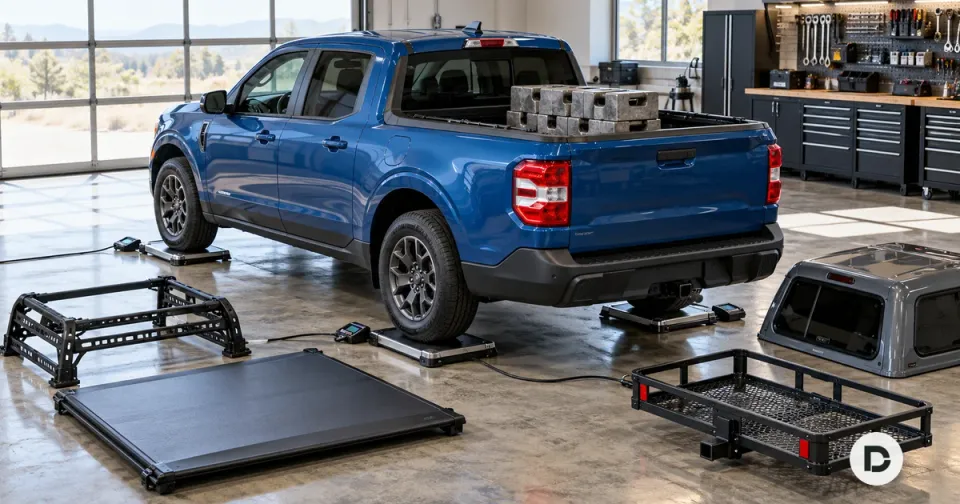
SUBTRACT EVERY INSTALLED ACCESSORY, PERSON, CARGO ITEM AND TRAILER TONGUE LOAD
Start with the payload allowance on the specific truck’s tire-and-loading label—not a brochure maximum. Subtract the actual weight of the cover, rack, cap, tent, carrier, passengers, cargo and trailer tongue load. The remainder is the usable payload, subject to axle and component limits.
Ford Maverick load planner
Estimate remaining payload
Start with the occupant-and-cargo allowance on the exact truck's door label. Add real installed weights, people, cargo and tongue load.
Compare the loaded truck by axle with GVWR and GAWR before travel.
Planning estimate only. This arithmetic cannot verify axle load, tire capacity, hitch limits, weight distribution or the actual installed weight. A helper spring does not increase certified payload.
A Maverick advertised with “up to” 1,500 pounds of payload does not mean every configuration has that allowance. Factory options consume curb-weight headroom, and aftermarket equipment consumes more.
Payload calculation
`remaining payload = door-label occupant/cargo allowance − people − installed accessories − cargo − trailer tongue load`
| Weight added to the truck | Count it? | Placement concern |
|---|---|---|
| Tonneau, bed rack or cap | Yes | Mostly rear axle |
| Rooftop tent and crossbars | Yes | High center of gravity |
| Hitch basket or motorcycle carrier | Yes | Leverage behind rear axle |
| Trailer tongue load | Yes | Rear axle plus hitch limit |
| Driver and passengers | Yes | Distributed by seating position |
| Fuel | Follow label/manual basis | Do not improvise a brochure calculation |
Use published accessory weights only for early planning. Hardware, adapters, stored tools and add-ons can change the installed total. A public vehicle scale gives a better finished-truck number: weigh the loaded truck by axle and compare it with the GVWR and front/rear GAWR on the certification label.
A helper spring can reduce visible sag but cannot add payload, GVWR, GAWR, hitch or tire capacity. The same is true of a higher-rated rack: it does not increase what the truck may carry.
For a hitch carrier, count the carrier and cargo as payload, then verify receiver and tongue limits. Because the load sits behind the rear axle, rear-axle effect can be greater than its scale weight alone. For towing, use measured loaded tongue weight rather than the trailer’s empty brochure number.
Bottom line
The correct Maverick payload number lives on the truck. Subtract the complete real-world load and let the lowest vehicle, axle, tire, hitch or accessory rating control.
For towing-specific limits, read payload vs tow and hitch ratings.
Sources & notes
- 2026 Ford RV and Trailer Towing Guide, accessed 2026-10-27. Vehicle loading and towing limits.
- 2026 Ford Maverick towing information, accessed 2026-10-27. Maverick equipment and towing boundaries.
- 2026 Ford Maverick models, accessed 2026-10-27. Current maximum payload context.