
What Should You Check Before Installing a Tonneau Cover on a Tacoma?
Verify fitment with the merchant before you buy.
Reviewed by DoesItFit Editorial · How we evaluate compatibility
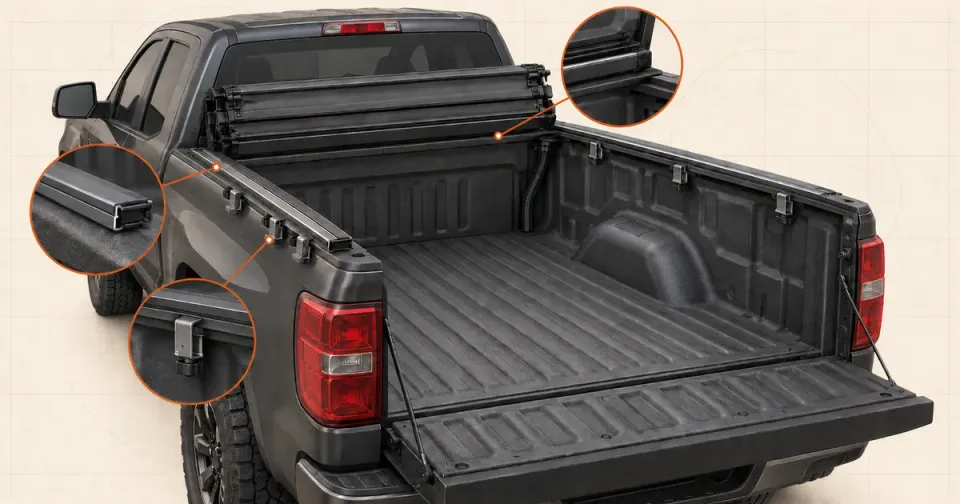
VERIFY THE APPLICATION, PARTS AND BED INTERFACES FIRST
Install only after the exact cover matches your Tacoma's year, bed length and rail system; every listed rail, adapter, clamp, seal, drain and latch part is present; and the liner and bed accessories leave the mounting and operating envelope clear. Use the current SKU-specific instructions because drilling, hardware and adjustment are not universal.
Installation-readiness snapshot
| Check | Ready when | Stop when |
|---|---|---|
| Truck and cover application | Year, bed length, rail system and exact SKU all match | Listing says only “Tacoma” or the bed/rail application differs |
| Kit inventory | Every instruction-listed rail, adapter, clamp, seal, drain, bumper and fastener is identified | Parts are missing, damaged or mixed from another kit |
| Bed interfaces | Mounting surfaces are clean and the liner/accessories leave documented clearance | A rack, toolbox, panel, cleat or liner occupies the clamp/seal/drain path |
| Operation | Rails are level/aligned and latches, tailgate and folded/rolled/canister positions clear | Binding, uneven latch load, cab contact or blocked tailgate operation remains |
| Water management | Seals contact as designed and drains reach approved outlets without kinks | Generic foam or an improvised drain route is needed to hide a fit problem |
1. Confirm the exact Tacoma and cover application
Record the Tacoma's model year, generation, bed length and factory Deck/Cargo Rail System. Then match all four to the cover maker's exact SKU and current instructions. A five-foot and six-foot bed do not share one cover application, and the presence or absence of factory cargo rails can change the adapter and clamp system.
The 2024+ Tacoma BAK Revolver X2/X4s sheet makes that interface explicit: the manufacturer says the truck must have cargo rails for the named product. That requirement belongs to this cover, but it shows why model year and bed width alone are incomplete. Review the Tacoma-specific Revolver instructions.
If the cover has not been chosen yet, start with the hard-folding, retractable and load-bearing comparison. If the question is fourth-gen tri-fold fitment to factory rails, use the 2024–2026 Deck Rail guide.
2. Inventory the exact kit before disassembly
Lay out the parts in instruction order without mixing left/right rails or hardware bags. The current 2024+ Tacoma BAKFlip MX4 TS sheet lists the hard-fold cover, driver/passenger cover rails, driver/passenger adapter rails, retainer clamps, six clamps, T-nut kits, bulkhead gaskets, cab bumpers, drain tubes and a bulkhead seal. Review the current Tacoma MX4 TS installation sheet.
Do not substitute a similar clamp or seal from another cover. Stop and obtain the correct part if a rail is bent, a latch is damaged or the current instructions show hardware not in the box.
Also record the exact tools and consumables. The cited Tacoma MX4 TS sheet includes a drill and 5/8-inch bit for its documented procedure. That does not mean every tonneau requires drilling; it means a generic “no-drill cover” summary must never override the exact Tacoma instruction sheet.
3. Inspect the bed, liner and accessory conflicts
Clean and inspect the bulkhead, rail caps, factory rails and intended clamp locations. Look for damage, old adhesive, bedliner overspray, deformed caps or aftermarket fasteners that keep a rail from sitting level.
List every item that shares the bed perimeter or opening envelope:
- spray-in or drop-in liner and bed-rail caps;
- rack feet, rack adapter rails or crossbars;
- toolbox, inner-bed MOLLE panels or cargo boxes;
- movable cleats and tie-downs;
- cargo divider or bed extender;
- cab guard, spare carrier or camper hardware; and
- power-tailgate or accessory wiring near the latch path.
“Both fit the Tacoma” does not prove that two products fit together. Obtain written compatibility for the two exact SKUs before trimming, drilling or discarding packaging.
4. Dry-fit and align the mounting system
Before final tightening, place the adapter and cover rails exactly as the instructions show. Confirm left/right orientation, front position, level rail contact and even width. Install clamps only at the documented locations and use the maker's sequence and torque values.
Do not use latch force to pull misaligned rails into position. A cover can close while loading one latch, leaving an uneven seal or shifting during use. Correct rail position and squareness first, then verify the cover lands evenly at the cab and tailgate ends.
If the procedure calls for drilling or enlarging a drain outlet, protect nearby wiring and bed structure and follow only the exact template/location. Stop if the truck differs from the instruction drawing.
5. Install seals and drains as a water-management system
Clean and dry adhesive surfaces using the product instructions. Position the bulkhead seal and corner gaskets without stretching them or stacking extra foam to compensate for a misaligned rail.
Route drain tubes without kinks, uphill loops, pinching or discharge onto wiring and sensitive components. Toyota describes its PT954-35240 hard cover as using an advanced seal-and-channel system with cab-end drain hoses. That is water management—not a promise of a waterproof bed. Review Toyota's hard-cover description.
After installation, perform a controlled hose test and trace the exact entry path. Use the Tacoma tri-fold water-entry guide before adding generic weatherstrip.
6. Verify every operating position
With the truck stationary, cycle the complete system:
- Close and open the tailgate in the order required by the cover maker.
- Latch both sides and confirm even engagement without slamming.
- Fold, roll or retract the cover through every supported position.
- Install required straps, prop rods or retainers for travel positions.
- Check cab/rear-window contact and install the documented cab bumpers.
- Confirm drain tubes, wiring and clamps do not move or pinch.
- Verify movable cleats and retained accessories still have safe travel.
Never drive with a folded or rolled cover in a position the manufacturer does not approve and secure. A closed tailgate does not prove the cover is latched.
7. Finish with adjustment, inspection and a short recheck
Complete the maker's latch adjustment and fastener checks. Confirm the cover cannot lift at the corners, the rails remain level and the tailgate does not support or force the cover unless the design explicitly requires that interface.
After the first drives and after a hot/cold cycle, reinspect the items the manufacturer identifies: clamps, latches, seals, drains, straps/props and rail position. Keep the instructions and removed factory parts with the vehicle record.
Compatibility snapshot
| Exact application | Tacoma interface | Result | Required check |
|---|---|---|---|
| BAKFlip MX4 TS, current 2024+ Tacoma instructions | Adapter rails, clamps, seals, bumpers and drains | Documented Tacoma-specific installation system | Exact SKU/bed, complete parts, current drill/drain procedure and alignment |
| BAK Revolver X2/X4s, 2024+ Tacoma | Factory cargo rails required by cited sheet | Conditional fit | Confirm cargo rails, bed/SKU and every adapter/clamp part |
| Toyota PT954-35240 hard cover | Toyota standard-bed application with seal/channel and drains | Verify exact vehicle fitment | Toyota application check, complete mounting and drain parts |
| Any cover plus an unverified rack/toolbox/panel | Shared bed-rail or opening envelope | Unknown together | Written compatibility for both exact SKUs |
Before you install
Build one line of facts: “[Year] Tacoma, [bed length], [factory rail system], cover [brand/model/SKU], liner [type], retained accessories [list], current instructions [revision/date], all parts checked.”
If any field is unknown, resolve it before drilling, trimming, applying adhesive or discarding packaging. Those actions can make a wrong application harder to return and harder to correct.
Bottom line
A Tacoma tonneau installation is ready when the exact truck, bed, rails and cover SKU match; the complete vehicle-specific hardware is present; the liner and accessories leave the mounting envelope clear; and the rails, seals, drains, latches, tailgate and every travel position pass inspection. Follow the exact current instructions—never a generic “Tacoma tonneau” video—for drilling, torque and adjustment.
Sources & notes
- RealTruck BAK: 2024+ Tacoma MX4 TS installation sheet, accessed 2026-10-15. Tacoma-specific parts, tools, mounting, sealing and drain procedure for the named cover; its drill size, hardware and sequence do not transfer to another product.
- RealTruck BAK: Revolver X2/X4s 2024+ Tacoma installation sheet, accessed 2026-10-15. States the named product requires cargo rails and documents its own adapter/clamp system; not a rule for every tonneau.
- Toyota: PT954-35240 hard tonneau cover, accessed 2026-10-15. Describes the standard-bed product's seal/channel, cab-end drain hoses and bed-rail access; exact vehicle fitment remains subject to Toyota's application check.