
Will Third-Gen Tacoma OEM Wheels Fit a Fourth-Gen Tacoma?
Verify fitment with the merchant before you buy.
Reviewed by DoesItFit Editorial · How we evaluate compatibility
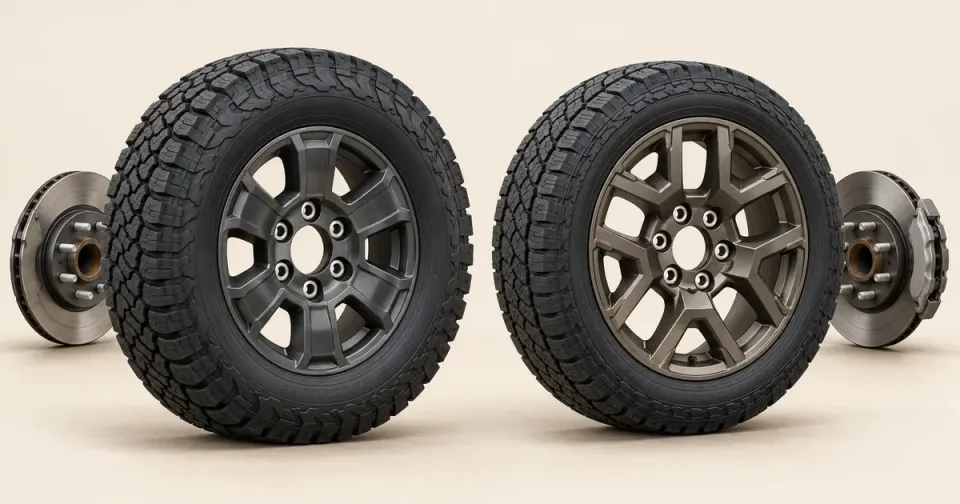
SIX LUGS DO NOT MAKE IT PLUG-AND-PLAY
Do not treat a third-generation Tacoma OEM wheel as plug-and-play on a 2024+ Tacoma. Toyota's catalogues use separate applications, and the fourth-generation manual requires wheel-specific nuts and torque. A shared six-lug pattern does not confirm hub centering, stud/nut seat, brake clearance, offset, load, tire or TPMS compatibility. Use the exact wheel part number and written application—or treat the swap as unverified.
Toyota documents the generations with different wheel applications
A real third-generation example shows why the exact part number matters. Toyota describes PT758-35170-02 as a 16-by-7-inch gloss-black alloy wheel with 13 mm offset, and its 2017 Tacoma accessory catalogue lists that part. See Toyota's PT758-35170-02 product record and 2017 Tacoma catalogue.
Toyota's 2024 Tacoma performance-wheel catalogue lists different fourth-generation accessories, including PTR56-35240-2F and PTR56-35240-5F. It does not list PT758-35170-02 in that 2024 selection. Check Toyota's 2024 Tacoma wheel catalogue.
That separation does not prove PT758-35170-02—or every third-gen wheel—is physically impossible to mount. It proves the reviewed Toyota catalogue does not supply the required fourth-gen application. Without that application, “OEM” and “six lug” are not approval.
Why the bolt pattern is only one interface
A wheel can share the number and spacing of lugs yet fail another safety-critical check.
| Interface | What must match | Why a visual match is insufficient |
|---|---|---|
| Toyota application | Exact wheel part number to destination VIN/configuration | Similar wheels may have different specifications or approvals |
| Hub centering | Wheel center bore and hub interface | Lug holes alone do not establish correct centering |
| Stud and wheel nut | Thread, seat shape, shank/washer design and engagement | The wrong nut can appear tight without clamping the wheel correctly |
| Brake clearance | Caliper, rotor, barrel and spoke clearance | Diameter alone does not describe the inner shape |
| Offset and width | Position relative to suspension, body and bearings | A mounted wheel can still rub or change load paths |
| Wheel load | Rating sufficient for the truck and use | “OEM Toyota” does not make every wheel rating interchangeable |
| Tire package | Approved size, load/speed rating and inflation basis | Wheel fit does not prove tire fit or vehicle-rating compliance |
| TPMS | Compatible sensor, valve and registration path | A sensor may require different hardware or programming |
Do not fill these fields from forum recollection. In particular, this guide intentionally does not claim an uncited hub-bore size or stud thread for either generation. Read the exact wheel markings, Toyota parts data and destination-truck service information.
Fourth-generation wheel hardware is not generic
Toyota's 2024 Tacoma manual says to use wheel nuts specifically designed for the wheels and gives separate tightening values for steel and aluminum wheels. It also tells owners to clean the wheel contact surface, inspect the bolt screws, nut threads and bolt holes, and retighten the wheel nuts within 100 miles after installation. Read Toyota's 2024 Tacoma wheel-installation procedure.
Those instructions defeat the shortcut “the old lug nuts thread on, so it fits.” Thread engagement is only one part of the joint. The wheel's seat geometry, specified nut, contact surface and tightening procedure must work as a system. Use the exact gas or hybrid manual for the destination truck; the linked page is the 2024 hybrid manual and is evidence of Toyota's fourth-generation wheel-specific procedure, not a universal torque table for every Tacoma.
A defensible verification process
1. Identify the source wheel
Remove assumptions such as “TRD wheel” or “came from a 2022.” Record the cast or stamped Toyota part number, size/offset markings and condition from the wheel itself. Check for cracks, bends, elongated holes, damaged seats, corrosion at the mounting face or repairs.
2. Check the destination by VIN
Give a Toyota parts department the fourth-generation Tacoma VIN and the exact wheel part number. Ask for a current application record plus the required wheel nuts, tire specification, center cap and TPMS hardware. A retailer's “fits Tacoma” filter is weaker than an exact Toyota application.
3. Resolve every interface before driving
If Toyota does not document the transfer, have a qualified wheel-and-tire installer verify the hub-centering method, fastener seat and engagement, brake and suspension clearance, wheel load rating, offset/width effect, tire and TPMS combination. The check should include full steering travel and applicable suspension travel—not merely whether the wheel hangs on the studs in the air.
4. Install and recheck only to authoritative specifications
Use the destination manual and wheel-specific hardware instructions. Do not copy a third-generation torque value or assume an impact wrench has produced the specified clamp load. Follow Toyota's post-installation recheck interval for the exact truck.
If any required specification remains unknown, stop. The correct verdict is unverified, even if someone else reports driving the same-looking combination.
Compatibility snapshot
| Evidence available | Verdict | Next action |
|---|---|---|
| Same six-lug pattern only | Insufficient | Identify the wheel part number and all interfaces |
| Third-gen Toyota catalogue lists the wheel | Source application only | Does not establish a 2024+ destination application |
| Fourth-gen catalogue omits that old part | Documentation gap | Do not convert absence into “physically impossible” |
| Toyota confirms exact wheel and VIN application | Potentially supported | Use specified nuts, tire, TPMS and installation procedure |
| No Toyota application, but complete engineering data and professional verification exist | Non-OEM-supported decision | Preserve written specs and validate all clearances/load limits |
| One interface or rating remains unknown | Unverified—do not drive | Choose a documented fourth-gen wheel or resolve the gap |
For non-OEM options, use the complete Tacoma aftermarket-wheel offset and interface checklist. For other cross-generation parts, the third-gen parts on fourth-gen Tacoma guide explains why part families need separate evidence rather than one blanket answer.
Bottom line
Some exact wheel combinations may prove workable, but “third-gen Tacoma OEM wheel” is not enough information to say yes. Toyota's reviewed catalogues separate the example third-generation and fourth-generation applications, while the 2024 manual makes wheel-specific nuts and procedures part of the installation. Start with the part number and VIN; if the application and every interface cannot be documented, treat the swap as unverified.
Sources & notes
- Toyota PT758-35170-02 16-inch wheel product record, accessed 2026-10-16. Primary source for one exact third-generation-era wheel's published size and offset.
- Toyota 2017 Tacoma TRD/GR catalogue, accessed 2026-10-16. Primary source tying the example part to Toyota's 2017 Tacoma accessory selection.
- Toyota 2024 Tacoma performance-wheel catalogue, accessed 2026-10-16. Primary source showing different fourth-generation wheel applications; omission is treated as a documentation gap, not proof of physical impossibility.
- Toyota 2024 Tacoma HV Owner's Manual, flat-tire/wheel installation, accessed 2026-10-16. Primary source for wheel-specific nuts, contact-surface/thread inspection, separate wheel-type torque values and post-installation recheck; exact destination manual controls.
- The hero is an original centered generic comparison illustration, not Toyota product artwork and not fitment evidence.