
How Should You Clean and Maintain a Tacoma Tonneau Cover?
Verify fitment with the merchant before you buy.
Reviewed by DoesItFit Editorial · How we evaluate compatibility
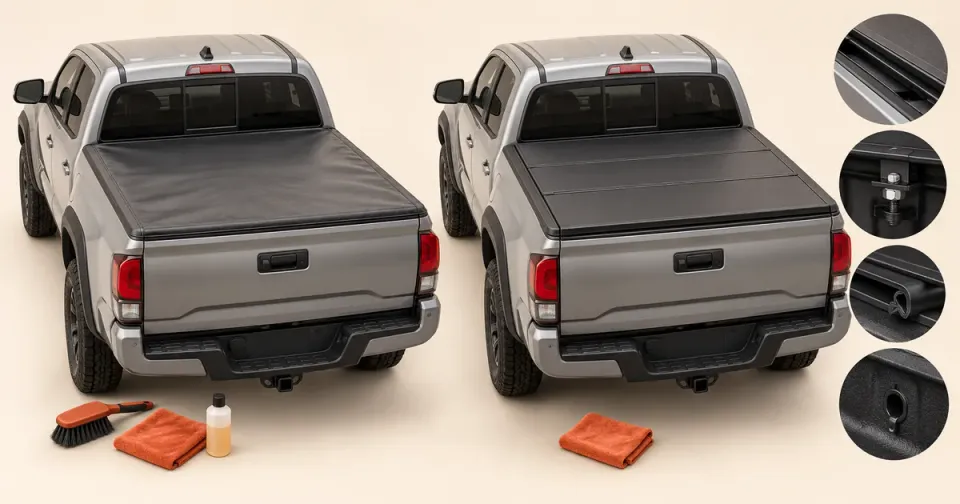
THE EXACT COVER MANUAL OVERRIDES GENERIC CLEANING ADVICE
Hand-wash a Tacoma tonneau with a soft tool and the cleaner approved for its material. Keep wax, harsh chemicals and silicone dressings off soft covers, matte finishes and seals unless the manual allows them. Inspect clamps, latches, drains and weather seals regularly. Never lubricate tracks automatically: some retractable-cover warranties explicitly prohibit lubricating rails and sealed bearings.
Match the cleaning method to the cover
| Cover area or material | Safe starting point | Avoid until the manual approves it | Maintenance check |
|---|---|---|---|
| Soft vinyl or canvas | Hand wash, soft brush or cloth, approved mild cleaner | Harsh detergent, wax, polish, silicone dressing, stiff brush | Seams, tension, hook-and-loop, latches |
| Painted or gloss hard panel | Automotive soap, clean mitt or microfiber, frequent rinse | Abrasive media and unapproved chemicals | Hinges, latches, panel alignment |
| Matte hard panel or vinyl-overlay hard cover | Mild soap and water | Wax or coating that can stain/change sheen | Surface wear, seals, secure travel position |
| Retractable rails and canister | Remove debris; follow exact manual | Automatic lubrication | Tracks, drains, latch, clamps, snow/ice |
There is no universal tonneau cleaner or lubricant. Product construction and warranty language decide what is safe.
Hand washing is the lowest-risk default
Rinse loose grit first, then wash with a clean microfiber mitt, cloth or soft-bristled brush and the mild product allowed by the cover maker. Work gently around stitching, hinges and seals, rinse thoroughly, and dry with clean microfiber to reduce water spots.
RealTruck's current care guide recommends hand washing over automatic brushes. Rotating brushes can abrade a soft surface and can gradually shift rails or clamps. If an exact manual permits an automatic wash, a touch-free wash is the safer type—but skip spray wax unless the cover maker approves it for every exposed material.
Do not pressure-wash directly into seals, hinges, drain joints or the front bulkhead. A tonneau is generally weather-resistant rather than waterproof, and forcing water into interfaces is not a useful leak test.
Clean soft vinyl or canvas without drying it out
Soft covers are more sensitive to cleaners and dressings than painted truck panels. Start with the cover maker's own approved cleaner. If the manual allows mild soap, use a dilute pH-neutral product with a soft brush or microfiber; do not assume the same wash-and-wax product used on the cab is safe.
Avoid generic tire shine, silicone dressing, polish and wax unless the product manual explicitly approves them. RealTruck warns that harsh chemicals and waxes can dry vinyl or discolor canvas. BAK's Revolver care instructions specifically recommend automotive soap and water with a soft sponge or cloth and warn that vinyl conditioners can shrink the vinyl.
TruXedo Pro-Tex is one documented product-specific example: its page describes a water-based, silicone-free cleaner and protectant for soft automotive materials. That does not make it approved for every cover; the cover manual still wins.
Clean hard panels according to the finish
Many fiberglass, polymer, ABS and aluminum hard covers can be washed much like automotive bodywork: clean wash media, automotive-grade soap, frequent rinsing and gentle drying. The finish changes the last step.
A painted or gloss panel may allow an automotive wax or coating. A matte surface can stain or develop uneven shine from the same product, while rubber seals can discolor. Keep protectants off matte areas and seals unless the exact instructions approve them.
Before washing a folding cover, close and latch it in the manual's approved position. Afterward, open it and dry trapped water around hinges, panel joints and seals.
Do not assume retractable rails need lubricant
This is the most important exception to generic maintenance advice. Some general guides suggest a dry automotive lubricant for dirty mechanical parts—but only when the manufacturer permits it.
Retrax's current care language for the cited retractable cover says to use mild automotive soap and water only and states that lubricating the rails or sealed ball bearings will void the warranty. The correct sequence is therefore:
- remove leaves, grit, ice and other foreign material;
- clear the drain channels and tubes;
- clean the rails as directed; and
- lubricate only the locations and products named in the exact manual.
“Maintenance-free bearing” does not mean the whole cover can be ignored. It means you should not add an unapproved lubricant to that bearing system.
Inspect the mounting and water-management system
Cleaning is a good time to inspect:
- rail clamps and mounting fasteners for movement or looseness;
- latches and release cables for full engagement;
- folding straps, buckles or prop rods for damage;
- weather seals for lifting, cuts or trapped grit;
- drain channels, canister outlets and tubes for blockage;
- soft-cover tension and hook-and-loop engagement; and
- contact between the cover and tailgate, bed accessories or cargo.
Retrax instructs owners to check clamps and retention mechanisms after a week of driving following installation or reinstallation and periodically thereafter. RealTruck's general guide suggests another check around 500 miles and at oil changes. Use the exact manual if it specifies a different schedule or torque procedure.
Do not blindly retighten hardware. Use the correct torque or adjustment method; overtightening can deform rails, clamps or a composite bed interface.
Remove snow, ice and cargo before operating the cover
Clear foreign material before rolling, folding or retracting the cover. Retrax explicitly includes snow and ice in this rule. A frozen seal or packed track can resist motion even when the handle moves.
Follow the exact cover's load limit and travel positions. BAKFlip instructions, for example, require the cover either fully closed and latched or fully folded and secured for driving; they do not approve driving with it partly folded. A different cover may have different allowed positions.
Never stand on a cover unless the manufacturer explicitly documents that use, and do not turn an evenly distributed load rating into approval for a point load.
A practical maintenance schedule
- After installation or reinstallation: verify alignment, latch engagement, clamps and drains after the manual's break-in interval.
- At normal washes: remove grit, clean the correct material, inspect seals and clear visible drains.
- At oil changes: inspect mounting hardware, latches, straps and mechanisms; follow manual-specific torque and lubrication instructions.
- After dusty trails, road salt, heavy rain or snow: rinse contaminants, clear tracks/drains and remove ice before operation.
- Before a long trip: confirm the cover is secured in an approved travel position and cargo is independently tied down.
Use the tonneau-cover installation checklist if the cover has shifted, stopped latching evenly or begun leaking after hardware movement.
Compatibility snapshot
| Product/material example | Documented care | Result | Required check |
|---|---|---|---|
| Soft vinyl/canvas cover | Approved mild cleaner; soft brush/cloth | Material-specific care | Confirm cleaner and dressing in exact manual |
| BAK Revolver vinyl overlay | Automotive soap/water; no generic vinyl conditioner | Follow BAK instructions | Preserve matte finish and vinyl condition |
| Retrax retractable rail/bearing system | Mild automotive soap/water; no rail or sealed-bearing lubrication | Do not add lubricant | Clear debris and drains; follow exact warranty terms |
| Unknown cover or finish | No universal chemical or lubricant approval | Unknown until confirmed | Identify brand, model and manual first |
Bottom line
Safe tonneau maintenance starts by identifying the cover and reading its manual. Hand-wash with material-safe products, avoid automatic brushes and unapproved waxes, inspect the complete mounting and drainage system, and treat lubrication as a product-specific instruction—not a routine assumption.
Sources & notes
- RealTruck: Cleaning and Maintaining Your Tonneau Cover, updated 2026-05-07 and accessed 2026-10-15. General soft/hard-cover washing, automatic-wash, hardware and maintenance guidance; exact manufacturer instructions take precedence.
- TruXedo Pro-Tex cleaner, accessed 2026-10-15. Product-specific water-based, silicone-free soft-material cleaner example; not universal approval.
- Retrax IX care and warranty conditions, accessed 2026-10-15. Mild-soap rule, lubrication prohibition, hardware inspection and debris/snow/ice requirements used as a retractable-cover example.
- BAK Revolver care guide and BAKFlip operating instructions, accessed 2026-10-15. Product-specific vinyl care and secured travel-position examples.
- The hero is an original centered generic illustration, not product-specific care, warranty or fitment evidence. Always use the manual supplied with the exact cover.