
Tacoma Roof Load: Static vs Dynamic Ratings for a Rooftop Tent
Verify fitment with the merchant before you buy.
Reviewed by DoesItFit Editorial · How we evaluate compatibility
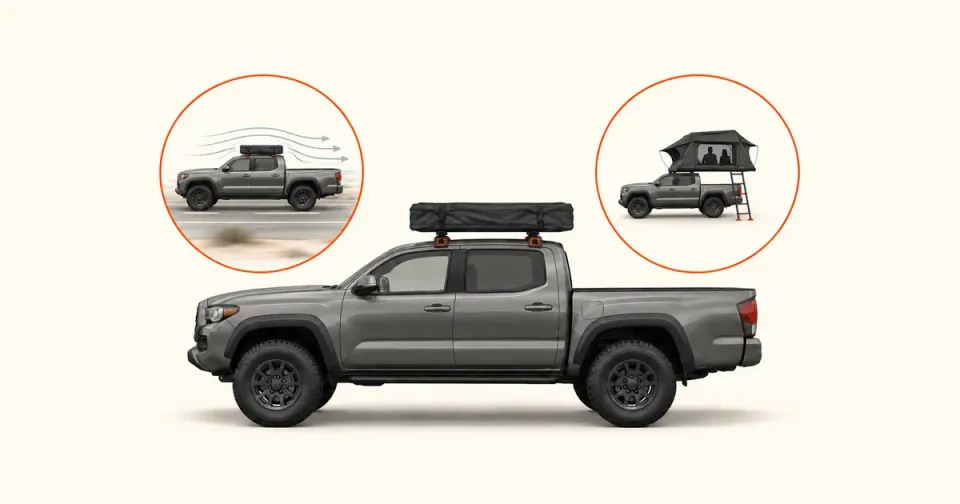
TWO LOAD CALCULATIONS—AND THE LOWER DOCUMENTED LIMIT WINS
Dynamic load is the rack, closed tent and attached cargo carried while driving. Static load is the rack, deployed tent, occupants and in-tent gear while parked. Compare each total with every applicable Toyota, rack, mount and tent limit; the lowest documented ceiling controls. Do not multiply a Toyota driving limit to manufacture a parked rating unless Toyota explicitly authorizes that method for your exact roof system.
The short version
A rooftop tent creates two different loading conditions:
| Condition | Include in the total | Approval needed |
|---|---|---|
| Driving, or dynamic | Rack/feet/crossbars + closed tent + awning, traction boards and every attached item | Exact vehicle roof limit plus every rack, mount and tent driving limit |
| Parked and occupied, or static | Rack + deployed tent + occupants + bedding and gear inside | Explicit parked-use/static support for the complete system |
The larger rack number is not automatically the usable Tacoma number. A rack can be stronger than the vehicle roof or mounting interface. A tent can also impose bar-size, spacing, mounting-foot or vehicle restrictions below the rack's headline rating.
Start with Toyota's exact equipment label
Toyota's 2024 Tacoma manual lists two roof-cargo limits: 154 lb (70 kg) for vehicles with cross bars and 104 lb (47 kg) for vehicles with a roof rack. Those are Toyota's labels, not interchangeable descriptions for every aftermarket system.
Use them as a warning against the phrase “a Tacoma is rated for X.” Before applying either number, confirm:
- the exact model year and cab;
- what Toyota calls the installed factory equipment;
- whether the system is Toyota equipment or an aftermarket rack using factory mounting points; and
- the current manual/instructions for every installed component.
If your truck, rack or tent instructions do not clearly authorize the combination, ask the manufacturer in writing. Do not select whichever Toyota number is more convenient.
How to calculate dynamic load
Dynamic load is the complete roof system moving down the road. Add:
Driving total = rack + feet/mounts + closed tent + attached accessories + cargo on/in those accessories.
For example, a 45-pound rack and a 120-pound tent already total 165 pounds before an awning, mounts or gear. That arithmetic does not prove the combination is approved; it only shows the number to compare with the applicable limits.
Check the result against:
- Toyota's exact vehicle/equipment limit;
- the rack, feet and crossbar limits;
- the tent's vehicle and rack requirements;
- any accessory-mount limits; and
- payload and axle/loading limits for the complete truck.
The first lower limit stops the build. A high rack rating cannot raise a lower vehicle limit.
Why rack ratings can mislead
Current fourth-generation Tacoma rack examples vary substantially. Prinsu publishes 600 lb dynamic / 1,000 lb static for its current 2024–2027 rack; Sherpa publishes 300 lb dynamic / 700 lb static for its 2024–2026 Double Cab Rainier.
Those figures describe the manufacturers' rack products under their conditions. They do not certify the Tacoma roof to the same numbers, make their test methods identical, or prove compatibility with a particular tent. Even if the rack is the strongest component, Toyota's vehicle limit, a mounting foot, the tent instructions or another interface can control.
Use our Prinsu vs Cali Raised vs Sherpa comparison to compare those racks, but keep product selection separate from the whole-system load calculation.
How to calculate static load
Static load is the complete system only after the truck is parked on appropriate ground and the tent is deployed according to its instructions. Add:
Parked total = rack + tent + occupants + bedding + gear in the tent.
This number is normally much higher than the driving total because people are now part of the system. But a published rack static rating alone is not complete approval. The vehicle roof, mounting system and tent application must support occupied use.
Thule's rooftop-tent guidance distinguishes moving and parked conditions and tells users to observe the lowest capacity in the roof/rack/tent chain. Some rack systems and component arrangements are excluded even when a headline weight seems sufficient.
A tent ladder can carry part of the occupied load when installed as instructed. It does not create permission to exceed a roof, rack, mounting or tent limit.
Do not apply a universal “three-times” rule
Some rack guidance uses a multiple of dynamic capacity as a parked-load rule of thumb. That can be useful only inside the system and conditions for which the manufacturer provides it.
It does not turn Toyota's 154-pound or 104-pound manual language into an automatically approved 462-pound or 312-pound rooftop-tent rating. Toyota would need to authorize that interpretation for the exact roof equipment. If it does not, the multiplication is an assumption—not evidence.
Roof load still consumes payload
Anything installed on the roof is still carried by the truck. Include the rack, tent, mounts and roof cargo when calculating remaining payload, then include passengers, cabin/bed cargo, armor, steps, recovery gear and trailer tongue weight where applicable.
Use the truck's certification label and manual rather than a trim-level marketing maximum. Our Tacoma payload-after-modifications guide shows the full accounting sequence.
Roof weight also raises the center of gravity and changes wind response. Staying below a weight number is not a promise of unchanged handling, braking, rollover resistance or fuel use.
The purchase checklist
Before buying a tent or rack, save written answers to these questions:
- Does Toyota authorize this roof equipment and use case on the exact VIN/model year?
- What is the complete rack/mount dynamic rating on this vehicle?
- Does the tent maker approve the rack type, bar profile, bar spacing and vehicle?
- What is the combined rack, tent and attached-accessory weight while driving?
- What is the combined rack, tent, occupants and gear weight while parked?
- Is occupied/static use explicitly supported for the complete combination?
- How much payload and axle capacity remains after installation?
If the roof calculation fails, a compatible bed-rack system may move the tent off the cab roof, but it still consumes payload and must be approved for the exact bed, tonneau and tent. Compare that route in our roof rack vs bed rack RTT guide.
Bottom line
Treat dynamic and static roof loads as separate calculations. While driving, count the complete closed roof system. While parked, add occupants and in-tent gear. In both cases, the lowest documented limit in the vehicle/rack/mount/tent chain wins—and no aftermarket rack number overrides Toyota's limit for the exact truck.
Sources & notes
- Toyota: 2024 Tacoma Owner's Manual and manuals landing page, accessed 2026-10-15. Current source for Toyota's exact cross-bar and roof-rack labels and limits; recheck the exact model-year manual.
- Prinsu: 2024–2027 Tacoma roof rack and Sherpa: Rainier, accessed 2026-10-15. Product-specific rack weight/rating examples; they do not override vehicle or tent limits.
- Thule: rooftop-tent guidelines, accessed 2026-10-15. Dynamic/static definitions, lowest-capacity rule and system-compatibility constraints.
- Refresh plan: verify the exact Toyota manual and every rack/tent instruction before purchase, and recheck product pages quarterly. Hero is an original centered generic illustration, not exact-product or load evidence.