
How Should a 2019 Manual Tacoma With a 3-Inch Lift Be Corrected Before Towing?
Verify fitment with the merchant before you buy.
Reviewed by DoesItFit Editorial · How we evaluate compatibility
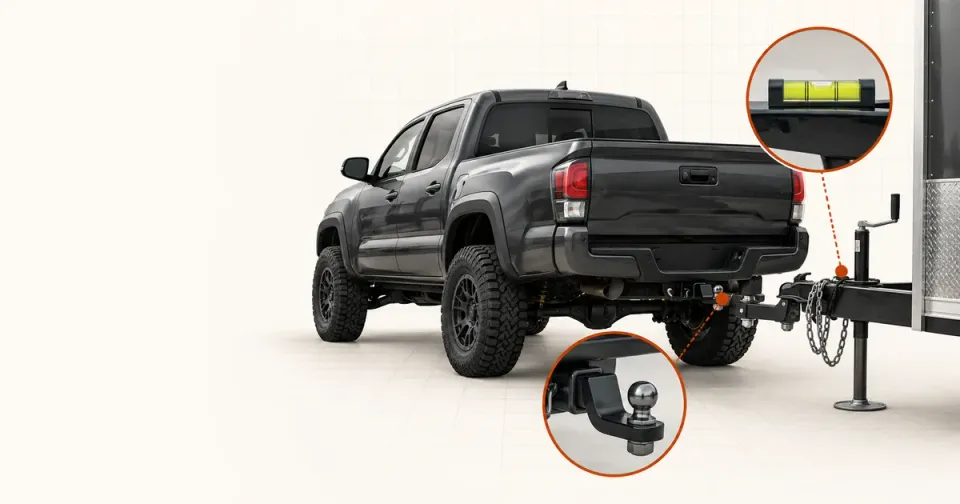
CORRECT THE LOADED TOWING SETUP FIRST
A 3-inch lift does not increase a 2019 Tacoma's towing or payload rating. Before towing, make the loaded trailer level, measure tongue weight, and correct rear sag or hitch height with compatible equipment. Alignment and tire condition matter, but neither fixes an overloaded or nose-up trailer.
Correction snapshot
| Observed issue | Correct decision path | What does not solve it |
|---|---|---|
| Trailer is nose-up or nose-down | Measure coupled height and select a correctly rated rise/drop mount | More suspension lift by itself |
| Rear sag under measured tongue/cargo load | Verify load, payload and compatible rear support | An unloaded visual level |
| Truck exceeds payload, axle or towing limits | Reduce/reconfigure the load | Stiffer springs or a level stance |
| Alignment, tire or brake condition is unknown | Inspect and correct before towing | Hitch-height adjustment alone |
A lift changes height, not the vehicle's ratings
Toyota's 2019 Tacoma manual treats trailer stability, braking, hitch setup, tire inflation, cargo security, and tongue weight as the towing system. It warns not to drive with a trailer that is not level, and names improper tongue weight, overloading, and worn suspension among the possible causes. A lift may change the hitch's relationship to the coupler, but it does not add payload or tow capacity. Read Toyota's 2019 towing guidance.
Correct the loaded geometry before buying more lift parts
Load the truck as it will travel: passengers, cargo, fuel, hitch equipment, and the trailer. Then check trailer level and actual tongue weight on scales. If the rear sags excessively or the trailer is not level, solve that measured problem with a correctly rated hitch and, where appropriate, a suspension or weight-distribution solution recommended for the vehicle and trailer. Do not use an arbitrary rear spacer merely to make an unloaded truck look level.
The hitch decision also follows the loaded measurement, not the lift number. CURT's ball-mount guidance requires a level vehicle/trailer combination and a mount rated for both gross trailer weight and tongue weight; it also points buyers back to the vehicle manufacturer's tow rating. That supports choosing the required rise or drop only after measuring the coupled setup. Review CURT's hitch-height and rating guidance.
Alignment and tires are required checks, not substitutes
Any altered suspension needs an alignment after installation and a towing inspection of tire condition, pressure, brakes, hitch fasteners, and trailer lighting. Toyota directs owners to confirm vehicle and trailer tire inflation, lights, ball height, a level trailer, secure cargo, and appropriate mirrors before towing. Those checks remain necessary whether the truck is stock or lifted.
Bottom line
For a lifted manual 2019 Tacoma, begin with real loaded weights and a level trailer. Correct the measured issue—hitch height, tongue weight, rear-load support, alignment, or worn components—while staying inside the truck's published limits. The 2020 four-cylinder camper example shows how trailer weight, tongue weight and payload must remain separate checks.
Sources & notes
- Toyota 2019 Tacoma owner's manual, accessed 2026-09-05. Establishes Toyota's pre-tow checks, level-trailer requirement, and the effects of towing on handling, braking, durability, and fuel use.
- CURT ball-mount selection guide, accessed 2026-09-05. Documents hitch-height measurement, level-towing setup, and component gross/tongue-weight ratings; Toyota's vehicle rating remains the limit.