
Tacoma First Towing Trip Checklist: What to Verify Before You Leave
Verify fitment with the merchant before you buy.
Reviewed by DoesItFit Editorial · How we evaluate compatibility
VERIFY THE RATINGS, CONNECTIONS AND SYSTEMS—THEN RECHECK
Before a first Tacoma towing trip, do not leave until the loaded truck and trailer are within the exact manual and label limits; the ball, coupler, pin, chains, breakaway cable and electrical plug are secured; tires, lights and brakes work; and the trailer is level with secured cargo. Drive a short low-speed test, stop safely, and recheck. Model-year requirements—not a generic checklist—control.
The checklist begins with numbers, not the hitch ball
A clean connection does not make an overloaded combination safe. Use the exact Tacoma model year, model code, certification labels and owner's manual to identify the applicable trailer-weight, combined-weight, vehicle-weight and axle limits. Then compare them with the truck and trailer as actually loaded: passengers, fuel, cargo, accessories, weight-distributing equipment and tongue load included.
Toyota's current towing guidance requires the gross trailer weight, gross combined weight rating (GCWR), gross vehicle weight rating (GVWR), gross axle weight ratings (GAWR) and tongue weight to remain within their respective limits. The specific numbers and equipment rules vary by Tacoma configuration, so a search-result tow rating or another owner's truck is not your answer. Use Toyota's manual for the exact truck.
If a scale result, label or manual limit is missing, the decision is not ready. Do not use spring helpers, a brake controller or a weight-distributing hitch as permission to exceed a vehicle rating.
48 hours before departure
Resolve problems while there is still time to get parts or service.
- Confirm the loaded weights. Record the actual truck, trailer, axle and tongue loads using a suitable scale procedure. Keep every applicable rating in the exact manual and on the labels.
- Verify the hitch system. Confirm receiver, ball mount, hitch ball, coupler and any weight-distribution or sway-control equipment are rated for the combination and installed to their manufacturers' instructions.
- Inspect truck and trailer tires cold. Use the vehicle placard and trailer/tire-maker specifications, not the pressure molded as a maximum on a sidewall. Look for damage, aging, uneven wear and adequate tread; check the spare and tools too. NHTSA likewise advises checking tires cold and inspecting the spare. See NHTSA's pre-trip tire guidance.
- Service the trailer brakes and controller. Confirm the trailer's required brakes operate and the controller is installed, adjusted and tested for that loaded trailer. Requirements vary by trailer, model year and jurisdiction.
- Secure the load. Place cargo to achieve the tongue-load range specified by the exact vehicle and trailer instructions, prevent movement, and keep doors, ramps and latches secured. Do not improvise around an unstable or tail-heavy trailer.
- Plan the route. Account for grades, weather, fuel stops, height, width, weight restrictions and a safe place for the first recheck.
Toyota's 2026 Tacoma manual also gives break-in restrictions for a new vehicle or newly replaced powertrain component. Treat those as year-specific: consult the exact truck's manual before its first tow, rather than copying the 2026 rule to another Tacoma.
At the hitch: inspect in one direction
Walking from the truck toward the trailer helps prevent a skipped connection.
| Check | Pass condition | Do not leave if |
|---|---|---|
| Receiver and ball mount | Correct rated parts, hitch pin fully retained, no damage or looseness | Pin/clip missing, rating unknown, excessive play or damage |
| Hitch ball and coupler | Correct ball size; coupler fully seated, latched and retained | Coupler rides above the ball, latch will not lock, components mismatch |
| Trailer attitude | Trailer is level as required by its maker when loaded and connected | Nose-high/nose-low condition is outside instructions |
| Safety chains | Two chains attached to designated points, crossed beneath the tongue with turning slack | Chains drag, bind, share an improper attachment or cannot cradle the tongue |
| Breakaway system | Cable reaches a separate tow-vehicle attachment and switch/battery test passes | Cable is wrapped around the ball or attached only to a chain |
| Electrical plug | Fully seated, strain-free and clear of dragging/pinching | Loose plug, stretched cable, corrosion or intermittent connection |
| Jack, stabilizers and chocks | Jack/stabilizers fully stowed; chocks removed only when departure is controlled | Any component can strike the road or trailer can roll unexpectedly |
The component maker's procedure matters. CURT's generic hook-up checklist likewise calls for a fully engaged coupler, secured ball mount, crossed chains, connected wiring, independent breakaway cable and a working brake controller. Review CURT's illustrated sequence. Apply the instructions for the parts actually installed.
Run the electrical and brake checks with a helper
Test the trailer's running lights, brake lights, turn signals and hazard lights every time it is connected. NHTSA specifically includes trailer brake lights and turn signals in its pre-trip checks. A plug that looks seated is not proof that each circuit works.
Then verify the trailer brakes and manual controller function at low speed in a safe, traffic-free area. The trailer should not push the Tacoma or lock its wheels during a normal controlled stop. Adjustment depends on the controller and loaded trailer; follow both manuals. A dashboard indication alone is not a substitute for the functional test.
Confirm mirrors give the view required for the trailer and local law. If added towing mirrors move, vibrate or obstruct another required view, solve that before departure.
The first short drive is part of the inspection
Practice starting, stopping, turning and reversing away from traffic. Towing changes acceleration, braking distance, corner tracking and clearance. Build a larger following gap and use the exact manual's towing speed and grade guidance.
After a short distance, pull completely off the road in a safe, level place. With the combination secured and hot components avoided, recheck:
- coupler latch, hitch pin and safety-chain attachments;
- breakaway cable and electrical plug routing;
- lights and brake-controller status;
- cargo, doors, ramps, straps and load shift;
- tires and hubs for obvious damage or abnormal heat, using the trailer maker's procedure;
- weight-distribution or sway-control hardware, where fitted.
Toyota's 2026 Tacoma manual explicitly directs owners to check the lights, tires and vehicle-trailer connections before departure and again after traveling a short distance. Read Toyota's current trailer-towing section. That sequence is broadly useful; its numeric tongue-weight, brake, hitch and speed provisions remain specific to the cited manual and configuration.
Compatibility snapshot
| Situation | Decision | Evidence boundary |
|---|---|---|
| Exact loaded weights are within every applicable rating | Continue the inspection | Ratings alone do not prove the hookup passes |
| Tow package or seven-pin connector is present | Not yet ready | Equipment presence does not verify trailer brakes, wiring or load |
| Coupler, chains and plug look connected | Functional tests still required | Appearance does not prove lights or brakes work |
| One rating, component rating or brake requirement is unknown | Stop and document it | Do not fill a safety gap with an assumption |
| All checks pass and short test is stable | Recheck, then proceed conservatively | Weather, route and changing load still matter |
For a deeper controller and wiring decision, use the Tacoma tow-package and brake-controller wiring guide. If the question is whether a specific 2,500-pound camper works behind a 2.7-liter truck, start with the loaded-weight example instead of a generic tow-rating claim.
Bottom line
A first towing trip is ready only when the loaded numbers, physical connections and working systems all pass. Use the exact Tacoma and trailer instructions, not a universal internet checklist. Make the low-speed test and early recheck mandatory; they are the last chance to catch a settling coupler, shifted load or electrical fault before the trip develops speed and distance.
Sources & notes
- Toyota 2026 Tacoma Owner's Manual, trailer towing, accessed 2026-10-16. Primary source for the current Tacoma weight, connection, light, tire, brake, practice and short-distance recheck guidance. Its numeric thresholds are not generalized to every model year.
- NHTSA Summer Driving Tips, accessed 2026-10-16. Government source for cold tire-pressure, spare-tire and trailer-light checks; it does not set Tacoma tow ratings.
- CURT, How to Hook Up a Trailer, accessed 2026-10-16. Component-maker source for the generic coupler, chain, electrical, breakaway and controller sequence. Exact installed-component instructions control.
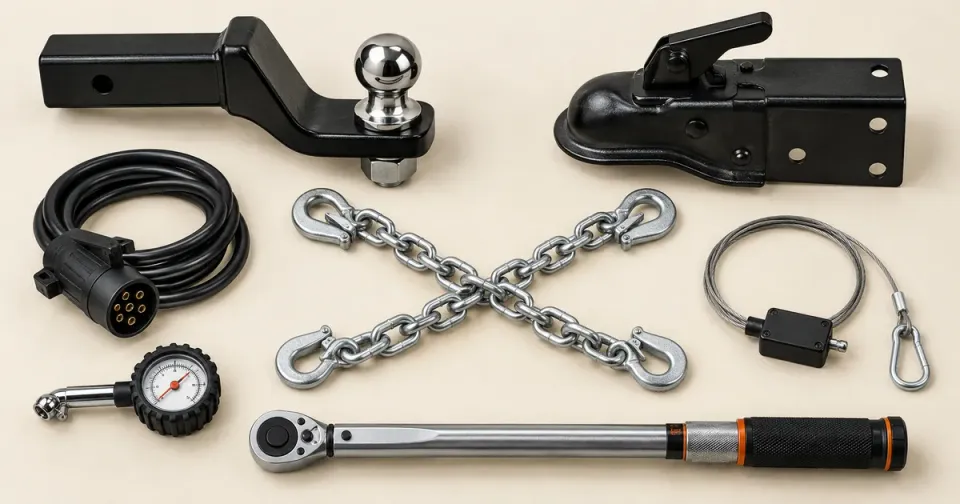
- This guide cannot certify a particular loaded combination or state-law result. The hero is an original centered inspection illustration; its disconnected components are visual context, not an installation diagram.