
Is a Cold-Air Intake Worth It on a Tacoma?
Verify fitment with the merchant before you buy.
Reviewed by DoesItFit Editorial · How we evaluate compatibility
WORTH IT FOR SOUND AND A DOCUMENTED SYSTEM—NOT FOR GUARANTEED SAVINGS
A cold-air intake can be worth it if you want more induction or turbo sound, prefer its exact filter-service path and accept product-specific test evidence. Keep the stock intake if you expect guaranteed fuel economy, towing, reliability or universal horsepower gains. Confirm engine, gas/hybrid powertrain, trim and current emissions legality before buying; “no tune required” applies only to the exact documented system.
Start with what “worth it” means to you
An aftermarket intake changes a system that Toyota already designed and services. Toyota's maintenance guide includes engine-air-filter replacement, and Toyota catalogs a vehicle-specific replacement filter. The stock intake is therefore the correct baseline—not a missing upgrade.
The aftermarket case is strongest when the buyer values a more audible intake, a reusable-filter option or a specific complete system whose application, instructions and legal status have been checked. It is weakest when the purchase depends on fuel savings or a dramatic, guaranteed performance transformation.
| Goal | Is an intake a strong reason to buy? | Why |
|---|---|---|
| More induction/turbo sound | Often | The sound change is immediate and does not depend on fuel savings to justify it |
| Reusable dry or oiled filter path | Sometimes | Service method and interval depend on the exact filter and operating conditions |
| Guaranteed horsepower on your truck | No | Manufacturer dyno results are test-specific and say nothing universal |
| Better MPG or towing | No documented guarantee | The cited sources do not establish either result |
| California-road legality | Only with current approval | Fitment and emissions legality are separate checks |
What a manufacturer dyno sheet actually proves
K&N's 63-9043 sheet reports a 15.6-horsepower gain at 3,500 rpm and 20.71 pound-feet at 3,000 rpm on the tested 2024 Tacoma. It identifies the vehicle, mileage, gear and test date, and it also says results will vary.
That is useful evidence for the tested system under the stated test. It is not a promise for every model year, temperature, fuel, tire, load or modification combination. It also does not establish fuel-economy, towing or durability improvement.
aFe publishes its own up-to power and airflow figures for the Momentum GT family. Those figures can help document what aFe tested, but they should not be numerically ranked against K&N unless the test method and vehicle conditions are shared. For the exact product-family decision, use the K&N versus aFe Tacoma intake comparison.
Sound is the most predictable owner-visible change
Replacing a quiet stock airbox and duct with a higher-flow aftermarket system commonly makes induction and turbocharger sounds more noticeable by design. The cited K&N and aFe systems use enclosed housings rather than a bare filter sitting openly in the engine bay, but enclosure does not make every temperature or sound result identical.
Buy for this experience only if you actually want it. More sound is not evidence of more usable towing power, and a quieter stock system is not evidence of restriction that must be fixed.
Choose the service path before the brand
The current aFe family offers a dry-filter version, 50-70119D, and an oiled-filter version, 50-70119R. K&N 63-9043 uses an oiled cotton filter and publishes an up-to service interval under normal highway conditions.
“Reusable” does not mean maintenance-free. Dust, water, severe use and cleaning technique affect service needs. Follow the exact filter instructions, let washed media dry as directed and apply oil only where the product requires it. Overgeneralizing one brand's procedure to another can create a service problem rather than solve one.
Fitment, tuning and legality are separate gates
For the cited current fourth-generation examples, exact application matters:
| System | Documented scope | Important boundary |
|---|---|---|
| K&N 63-9043 | Current 2024–2026 2.4L-turbo gas application in K&N's selector | Excludes TRD Pro in the cited application; confirm current VIN/trim and CARB status |
| aFe 50-70119D/R | Current 2024–2026 2.4L-turbo gas/hybrid applications | Cited instructions exclude TRD Pro and Trailhunter |
| Stock Toyota system | Vehicle-specific factory intake and scheduled filter maintenance | Use the Toyota filter/application for the exact truck |
The manufacturers describe no-tune installation for these exact systems. That statement should not be transferred to a different intake, engine, sensor housing or tune. The cited standard K&N and aFe systems also carry current California restrictions, so check the live product page and CARB executive-order status before purchase or installation.
Installation quality can erase the value
An intake must preserve a sealed path, correctly installed sensor, supported tube and adequate clearance. K&N's instructions warn that failure to follow the procedure or use the supplied hardware can damage the intake, throttle body or engine. After installation:
- Confirm every coupler, clamp, grommet and sensor connection against the exact instructions.
- Check that the tube cannot contact surrounding parts through engine movement.
- Start the truck and check for warning lights, abnormal idle or an air leak.
- Reinspect hardware after initial driving and service the filter by its own instructions.
- Restore the stock system and diagnose rather than masking a warning light or drivability issue.
Compatibility snapshot
| Tacoma situation | Decision | Evidence boundary |
|---|---|---|
| Stock truck; owner wants more intake sound | Potentially worth it | Exact system must fit and be legal where registered |
| Purchase depends on guaranteed MPG payback | Keep stock | No cited source guarantees fuel savings |
| Towing build seeking more rated capacity | Keep the ratings separate | An intake does not change Toyota's tow or payload rating |
| Fourth-gen TRD Pro or Trailhunter | Do not infer fitment | The cited standard systems have trim exclusions |
| California-registered truck | Verify current CARB approval first | Mechanical fitment alone is insufficient |
| Earlier Tacoma generation | Research its exact engine/application | Fourth-gen evidence cannot be reused as fitment proof |
Bottom line
An intake is an experience-and-service upgrade first. If you want the sound, prefer the exact filter path and can document fitment and legality, it may be worth the price. If your case depends on guaranteed economy, towing or universal horsepower, keep the stock intake maintained and spend the budget where the truck has a measured constraint.
Sources & notes
- Toyota 2024 Tacoma Warranty & Maintenance Guide and Toyota engine-air-filter catalog, accessed 2026-10-15. Establish the maintained stock-system baseline and vehicle-specific filter path.
- K&N 63-9043 product page, instructions and dyno sheet, accessed 2026-10-15. Current source for exact design, application, no-tune statement, service claim, installation warnings and test-specific result.
- aFe 50-70119D dry, 50-70119R oiled and installation instructions, accessed 2026-10-15. Current source for filter paths, applications, exclusions and manufacturer-test claims.
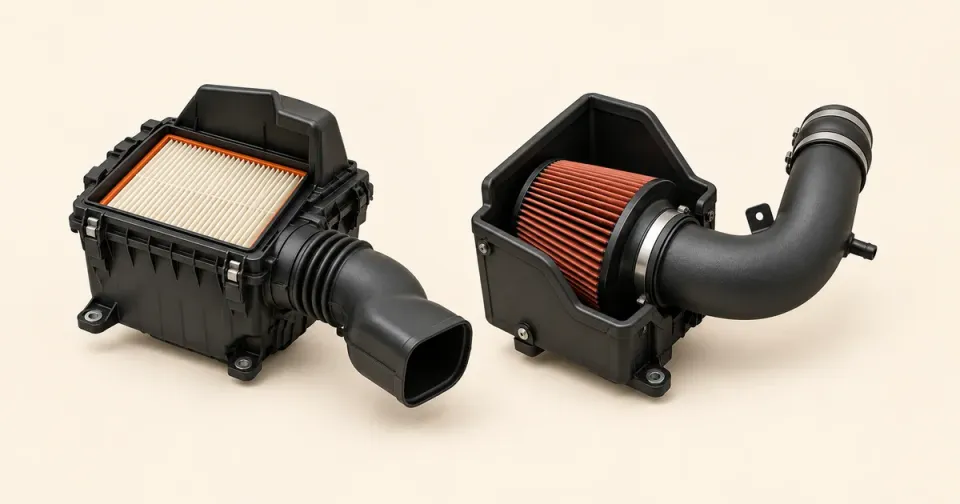
- Prices are intentionally omitted. Recheck selectors, instructions and emissions language before purchase. The hero is an original centered generic illustration, not exact-product, fitment, dyno or legal evidence.