
For Moderate Tacoma Trails, Should You Buy Skid Plates or a Metal Bumper First?
Verify fitment with the merchant before you buy.
Reviewed by DoesItFit Editorial · How we evaluate compatibility
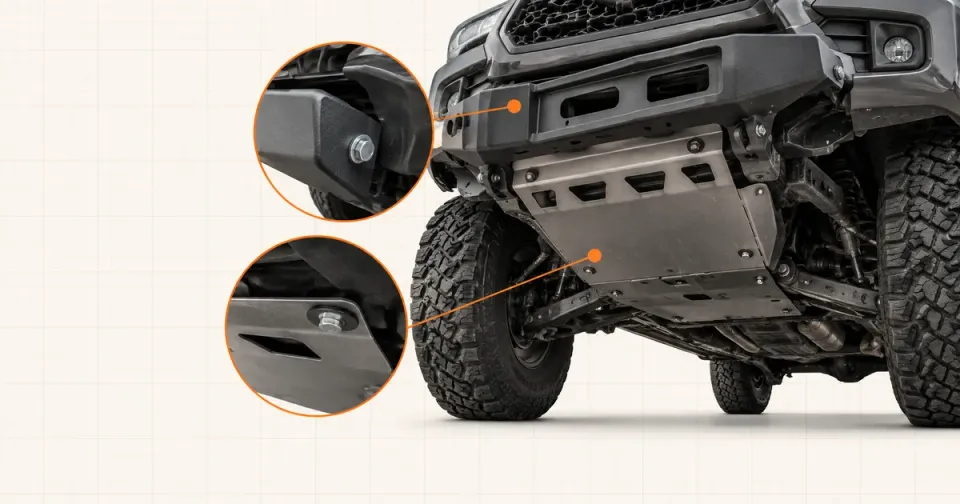
CHOOSE BY THE FIRST CONSTRAINT
Buy the part that addresses your first real constraint. For moderate trails, that is often underbody protection; choose a metal bumper first when recovery mounting, approach clearance or front-end impact protection is the more immediate problem. This is a decision framework, not an approval for a specific bumper or skid on every Tacoma generation.
Choose skids first when the underside is the risk
Skid plates protect specific vulnerable systems from rocks, ruts and debris. If your intended trails are likely to put the engine, transmission, transfer case or fuel tank in contact with obstacles, targeted underbody protection is a direct response to that risk. RCI’s Tacoma skid range illustrates that these areas are separate coverage decisions, not one interchangeable “armor” purchase. See the Tacoma skid categories.
Choose a bumper first when recovery or clearance is the risk
A metal bumper can add recovery points, change approach/departure geometry and, in some designs, house a winch. That makes it the stronger first move when you are already constrained by recovery capability or bumper clearance—not merely because it looks more capable.
For example, C4’s 2016–2023 Lo-Pro front bumper is designed around a recessed 8,000–12,000 lb winch space and requires cutting the center of the factory plastic bumper. Those installation and component requirements are part of the decision. Review its fitment details.
The trade-off most buyers miss: combined weight
Skids, bumpers, a winch, recovery gear and a roof/bed load all accumulate. A bumper decision can also bring a winch, fairlead, wiring, suspension-load and sensor/driver-assistance considerations. A skid system can add substantial mass too. Plan the system before buying the first large part.
A practical order for moderate trails
- Inspect the underside and define the trails you actually drive.
- Add the minimum coverage for the parts most likely to contact obstacles.
- Add a bumper when its recovery, clearance or protection function has a clear job.
- Re-check total added weight and exact fitment after each step.
Bottom line
There is no universal order. For many moderate-trail builds, skids are the more logical first protection purchase because they address low, exposed components directly. A metal bumper moves first when you need its specific recovery or clearance capability now.
Start by mapping the underbody components that actually need protection. See Tacoma Skid Plates: Which Areas Need Coverage, and Should You Choose Steel or Aluminum?.
Compatibility snapshot
| Product/application | First constraint | Result | Required check |
|---|---|---|---|
| Vehicle-specific skid plate | Exposed underbody contact | Choose skids first when the underside is the immediate risk | Confirm exact coverage, drivetrain, and mounting application. |
| Vehicle-specific metal bumper | Recovery mounting, approach clearance, or front-end impact risk | Choose bumper first when that capability is immediately needed | Confirm bumper fitment, winch requirements, sensors, and modification instructions. |
| Combined armor build | More than one real constraint | Plan the system before buying | Account for total added weight and suspension/load consequences. |
| 2016–2023 bumper example | Fourth-generation Tacoma | Not transferable as fitment evidence | Use only a maker's exact application for the receiving truck. |
Sources & notes
- RCI Tacoma skid plates, accessed 2026-09-04. Manufacturer explanation of areas covered and material options.
- C4 Tacoma Lo-Pro winch bumper, accessed 2026-09-04. Product-specific winch capacity, fitment and required bumper modification.