
Which Second-Gen Tacoma Parts Can Fit Your Third-Gen Truck?
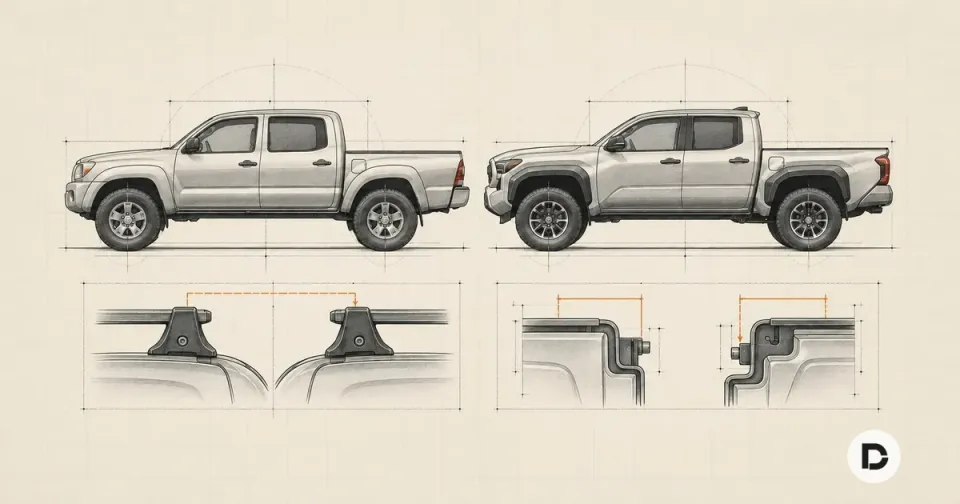
DO NOT ASSUME; CHECK THE EXACT APPLICATION
Some second-gen Tacoma parts have documented third-gen applications; others do not. A 2005–2023 year range is useful only for the exact product, variant and required mounting kit. Identify your destination truck and part before buying or transferring it. A shared generation range for one roof rack or slider does not establish compatibility for another product or category.
Fit Assistant · For your setup
Check the part you want to reuse
Tell us a little about your situation. Fit Assistant will help you apply this guide.
Buying a used part: ask for these details first
Ask for the brand, exact part number, revision if shown, original truck configuration and every included bracket, adapter or wiring piece. Compare that identity with the destination application before comparing the asking price. A used product may be missing the piece that made the original installation work.
If the part is unidentified, say so. The useful next step is identifying it or choosing a documented alternative, rather than treating a donor truck's generation as the part number.
Three common transfer situations
| What you have | What you can conclude now | Useful next step |
|---|---|---|
| Exact part listed for both trucks | A supported application may exist | Match variant, complete hardware and instructions |
| Part family spans both generations but variants differ | Family name is insufficient | Identify the actual ordered configuration |
| Seller says it came from another Tacoma | Identity/application unresolved | Obtain the label, invoice or manufacturer assessment |
What would make reuse worthwhile?
Compare the supported complete transfer with buying the correct complete part. Include replacement hardware, missing adapters, installation and support. If you need a cover or shell, use the narrower transfer guide rather than repeating this whole category checklist. If the question is a roof rack, the cab-specific application matters more than bed length.
A supported cross-generation listing is a useful answer. An unsupported combination is still a useful finding if it saves buying the wrong part. Neither result requires pretending that all second-gen parts share one fitment rule.
Why 2016 is a real fitment boundary
Toyota described the 2016 Tacoma as rebuilt inside and out. The launch changed the body, introduced a new 3.5-liter V6 and transmissions, and revised suspension tuning. Those changes are enough to require a fresh application check for parts that touch the body, frame, powertrain, suspension, wiring or factory electronics. Review Toyota's 2016 Tacoma launch information.
That does not mean every second-generation part fails on a third-generation truck. It means the generation name cannot decide fitment by itself. The product manufacturer must document the exact cross-generation application.
If you are unsure which years belong to each generation, begin with the Tacoma generations and parts-fitment guide.
Which parts can fit both generations?
A part can span 2005–2023 when its maker has engineered and documented it for that range. Two current examples show the correct way to interpret such a listing.
A named roof rack can cross the boundary
Prinsu lists its Pro Toyota Tacoma Double Cab Roof Rack for 2005–2023. That is documented cross-generation fitment for that named rack and Double Cab application. It does not approve an Access Cab installation, a different Prinsu rack or another brand's rack. Installation instructions and the vehicle's own roof-load limit still apply. See Prinsu's 2005–2023 Double Cab rack application.
A slider family can span both generations but still require a configuration choice
Cali Raised LED lists its Step Edition Rock Sliders for 2005–2023, explicitly covering second- and third-generation Tacomas. The order still requires the buyer to select Access Cab, Double Cab Short Bed or Double Cab Long Bed. The broad year range therefore does not make the variants interchangeable. See the manufacturer's slider application and configuration choices.
These examples establish one rule: trust the exact application, not an assumed category rule. One roof rack or slider that spans both generations does not prove that every rack or slider will.
Which parts need the strictest generation check?
The closer a part is to generation-specific geometry, wiring or calibration, the less useful a visual comparison becomes.
Camper shells, tonneau covers and bed-mounted parts
Bed length alone does not approve a transfer. The rail profile, front-wall shape, tailgate interface, clamp locations and cab clearance can change even when sellers use similar “short bed” or “long bed” descriptions.
LEER publishes separate Tacoma product records tied to generation-specific year ranges and part numbers. Its 100R part 501258 is listed for 2005–2015 Tacomas, while a current LEER 180 record, part 500695, is listed for 2016–2023 Tacomas. These are not equivalent products; they demonstrate why a cap's model family, approximate dimensions or appearance cannot replace its exact vehicle application. See LEER part 501258 and LEER part 500695.
For a used shell, follow the narrower second-gen to third-gen camper-shell transfer checklist.
Bumpers, skid plates and frame-mounted armor
Require the destination year, drivetrain, engine, factory skid arrangement and every bracket or relocation kit to appear in the maker's application. A bumper that appears to align with the body may still have different frame mounts, clearances or sensor provisions. A skid plate can also conflict with a transmission, transfer case, catalytic guard or factory crossmember.
Suspension and steering parts
Do not transfer shocks, springs, control arms, steering parts or lift components based on length or bolt size alone. The correct application must account for the vehicle's mounting design, travel, spring/load range, alignment requirements and surrounding components.
Engine, exhaust and electrical parts
Toyota's 2016 launch replaced the second-generation V6 with a new 3.5-liter V6 and introduced new transmissions. Intakes, exhausts, engine protection, wiring harnesses, lighting and electronics therefore need exact engine, transmission and model-year documentation. A connector that plugs in does not prove correct operation or calibration.
Wheels and tires
Shared bolt-pattern data is only one interface. The wheel still needs the correct diameter, width, offset, hub bore, load rating, lug-seat/fastener type and brake/suspension/body clearance for the destination truck and tire. Treat an undocumented wheel transfer as unknown until those checks and a current application agree.
What should you check before moving a part?
- Record both trucks' full model years; do not use “second gen” and “third gen” as the only identifiers.
- Record cab type and bed length for body-, frame-, roof- and bed-mounted parts.
- Record engine, transmission, drivetrain and relevant factory equipment.
- Find the permanent product label, engraved number, invoice or installation manual that identifies the exact SKU and revision.
- Check the current manufacturer's fitment page and installation instructions for the destination truck.
- Confirm that every required bracket, fastener, harness and relocation kit matches that application.
- If the destination application is missing, ask the manufacturer for written confirmation. Do not treat a marketplace seller's measurement as approval.
Compatibility snapshot
| Product/application | Destination fitment | Result | Required check |
|---|---|---|---|
| Prinsu Pro Tacoma Double Cab Roof Rack listed for 2005–2023 | Correct 2005–2023 Double Cab application | Documented across both generations | Confirm exact rack, installation instructions and vehicle load limit |
| Cali Raised Step Edition sliders listed for 2005–2023 | Access Cab, Double Cab Short Bed or Double Cab Long Bed option selected for the truck | Documented when the exact variant matches | Match cab/bed choice and supplied mounting hardware |
| LEER 100R part 501258 listed for 2005–2015 | 2016–2023 Tacoma | Not documented by that product record | Require written approval for the exact cap and destination configuration |
| Unidentified second-gen part | Any 2016–2023 Tacoma | Unknown until confirmed | Identify SKU, revision, mounts and current manufacturer application |
Before you buy
Do not use “second-gen part” as a yes or no answer. The 2016 Tacoma redesign creates a genuine application boundary, but manufacturers can document individual products across it. A transfer is supported only when the same exact product application includes both trucks and all relevant configuration choices. Otherwise, treat fitment as unknown and verify before buying, drilling or installing.
Sources & notes
- Toyota: all-new 2016 Tacoma, verified 2026-10-15. Establishes the redesign boundary and launch-level body, powertrain and suspension changes; it does not decide a specific aftermarket part.
- Prinsu Pro Tacoma Double Cab Roof Rack, 2005–2023, verified 2026-10-15. Supports only the named Double Cab rack application and its published conditions.
- Cali Raised Step Edition Rock Sliders, 2005–2023, verified 2026-10-15. Documents the named cross-generation slider family and separate Access Cab/Double Cab bed choices.
- LEER 100R part 501258 and LEER 180 part 500695, verified 2026-10-15. Show generation-specific product records; they do not establish equivalence between the two caps.
Editorial review 2026-11-06: practical setup/use scenarios and purchase checks updated. Original source-access dates remain visible where evidence was not independently re-established in this pass.