
Will a Mountain Bike Fit Under a Tacoma Cap or Tonneau?
Verify fitment with the merchant before you buy.
Reviewed by DoesItFit Editorial · How we evaluate compatibility
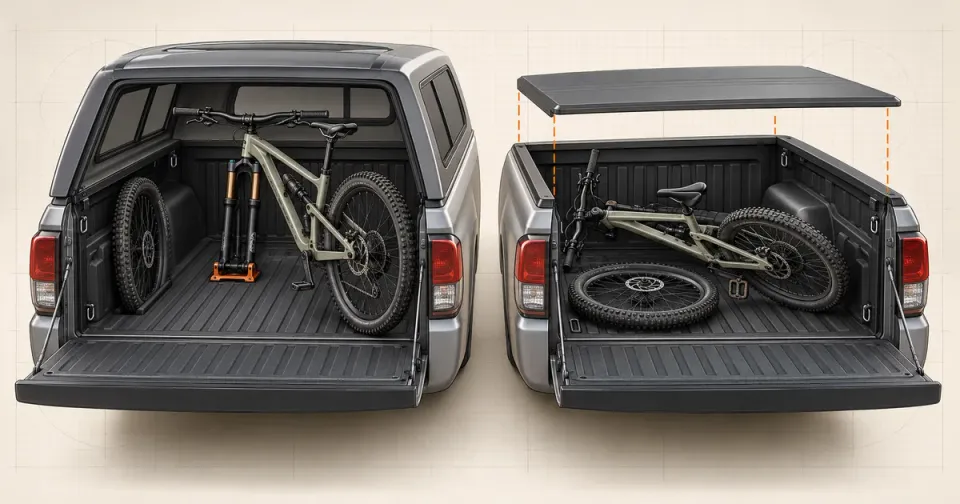
DEPENDS ON THE BIKE AND THE INSTALLED ENCLOSURE
A mountain bike can fit in a Tacoma bed with the front wheel removed, but neither “five-foot bed” nor “cab-high cap” proves it. Upright cap storage depends on the mounted bike's length, highest point and rear-door opening. Side-loading under a tonneau depends on the cover's lowest rail, latch and panel clearance—not Toyota's open-bed depth alone.
Start with the Tacoma's real bed envelope
Toyota's published dimensions show why generation and bed choice matter. For 2023, Toyota lists 60.5- and 73.7-inch bed lengths, a 19.1-inch bed height and a 41.5-inch bed width. For 2024, Toyota lists 60.3- and 73.5-inch inside bed lengths, 20.2 or 21.2 inches of inside depth depending on drivetrain, and 44.7 inches between the wheel wells. Check the 2023 Tacoma specifications and the 2024 Tacoma specifications.
Those numbers are useful baselines, not an enclosed-cargo promise. A cap adds a rear-door opening and roof liner. A tonneau adds rails, clamps, latches, hinges and sometimes drain tubes below the bed rails. A mat, drawer or slide raises the bike from the floor.
Will it fit upright under a bed cap?
Possibly. Removing the front wheel shortens and lowers the bike when the fork is held in a low mount, but three measurements still decide the result:
- Length: measure from the mounted fork axle to the rearmost point of the rear tire—not the bike manufacturer's wheelbase.
- Installed height: measure from the bed floor or raised platform to the highest fixed point after setting saddle and handlebar positions for transport.
- Loading opening: measure the cap's narrowest rear-door width and height, then account for the angle needed to guide the bike into the mount.
Front-wheel-off mounting is a documented product category. Kuat says its Dirtbag can bolt to a truck bed, floorboard, camper shell or another suitable surface, and sells different versions for specific axle standards. Thule says its Bed Rider Pro Compact fits compact pickups with integrated bed rails, including the Tacoma, and supports named quick-release and thru-axle sizes. Review the Kuat Dirtbag variants and Thule Bed Rider Pro Compact.
That documentation proves a mounting path, not cap clearance. LEER's own dimensional guidance says cab-high and raised cap designs do not share one interior envelope and directs buyers to the exact product or dealer for dimensions. See LEER's cap-dimension guidance.
Will it fit on its side under a tonneau?
It may, but do not compare the bike only with the published bed depth. Measure vertically from the actual bed surface to the lowest installed obstruction under the closed cover. Depending on the cover, that may be a rail, latch, folded-panel stack, clamp or drain fitting.
Then place the bike in its intended position with the front wheel removed and measure its highest point. The handlebar end, brake lever, pedal, crank or rear wheel may set the height. Do not force the cover closed or let it carry load from the bike.
Toyota's standard-bed hard tri-fold cover, part PT954-35240, illustrates the issue: Toyota documents a rail-access mounting system, self-latching hardware and cab-end drain hoses, but does not publish a universal bike-clearance dimension. Review Toyota's hard tri-fold cover. The correct answer therefore comes from measuring the installed cover, not subtracting a guessed panel thickness from bed depth.
Use this five-measurement test
Measure with the bed mat, liner, drawer or slide already installed:
- A — usable length: closed tailgate to the forward obstruction at the bike's actual height;
- B — narrowest width: wheel wells, cover rails or cap-opening trim;
- C — lowest enclosure height: bed surface to the lowest cap or tonneau obstruction;
- D — bike transport length: fork axle to rearmost tire with the front wheel removed;
- E — bike transport height/width: the maximum cross-section in the chosen orientation.
Allow working room for loading and securement. If the numbers only match when the cover touches a lever, derailleur, rotor, saddle or tire, treat that as does not fit in that position.
Match the fork mount to the bike—not just the truck
Modern mountain bikes use several front-axle standards. A 9×100 quick-release block is not interchangeable with a 15×110 thru-axle mount. Confirm axle diameter and hub spacing from the fork or bike documentation, then select the exact mount variant.
Also verify how the mount attaches. A product that fits a Tacoma's integrated bed rail may occupy cap-opening space or conflict with tonneau hardware. A “bolt anywhere” block still needs a structurally suitable surface and the maker's installation instructions.
Compatibility snapshot
| Product/application | Tacoma and bike fitment | Result | Required check |
|---|---|---|---|
| Axle-matched fork mount plus measured cap | Exact Tacoma bed, cap and front-wheel-off bike | Can fit if all envelopes clear | Length, highest point and rear opening |
| Thule Bed Rider Pro Compact | Compact pickup with supported rail/axle application | Mount path documented | Cap/cover clearance remains separate |
| Kuat Dirtbag variant | Suitable bolted surface and matching axle | Mount path documented | Structure, position and enclosure clearance |
| Bike on its side under Toyota PT954-35240 or another tonneau | Exact installed cover | Unknown until measured | Lowest rail/latch/panel clearance |
Before you buy
Ask the cap or cover seller for the minimum installed interior clearance, not exterior height. Ask the bike-mount seller to confirm the fork axle standard and Tacoma mounting surface. Record the five measurements with photos before ordering.
For a cover-and-rack system that may carry gear above the bed, continue with how to choose a Tacoma tonneau cover that works with a bed rack. For general restraint planning, use the Tacoma bed cargo-control guide.
Bottom line
Both layouts are possible, but neither is universal. Upright cap transport is usually decided by the fork-mounted bike's length, highest point and the cap door opening. Side-loading under a tonneau is decided by the bike's maximum thickness and the cover's lowest installed hardware. Measure the complete installed system; do not let the enclosure become the bike restraint.
Sources & notes
- Toyota: 2023 Tacoma eBrochure, accessed 2026-10-16. Provides third-generation bed dimensions; it does not establish cap or cover clearance.
- Toyota: 2024 Tacoma eBrochure, accessed 2026-10-16. Provides fourth-generation inside-bed dimensions.
- Kuat: Dirtbag, accessed 2026-10-16. Documents front-wheel-off mounting and axle-specific variants; it does not approve a cap/tonneau combination.
- Thule: Bed Rider Pro Compact, accessed 2026-10-16. Documents Tacoma integrated-rail and named fork compatibility; enclosure clearance remains unverified.
- Toyota: Hard Tonneau Cover PT954-35240, accessed 2026-10-16. Documents cover architecture but no universal under-cover bike height.
- LEER/Century: cap-dimension FAQ, accessed 2026-10-16. Establishes that cap interior dimensions vary by exact design/application.