
What Supporting Parts Are Needed With a Bilstein 6112 Tacoma Lift?
Verify fitment with the merchant before you buy.
Reviewed by DoesItFit Editorial · How we evaluate compatibility
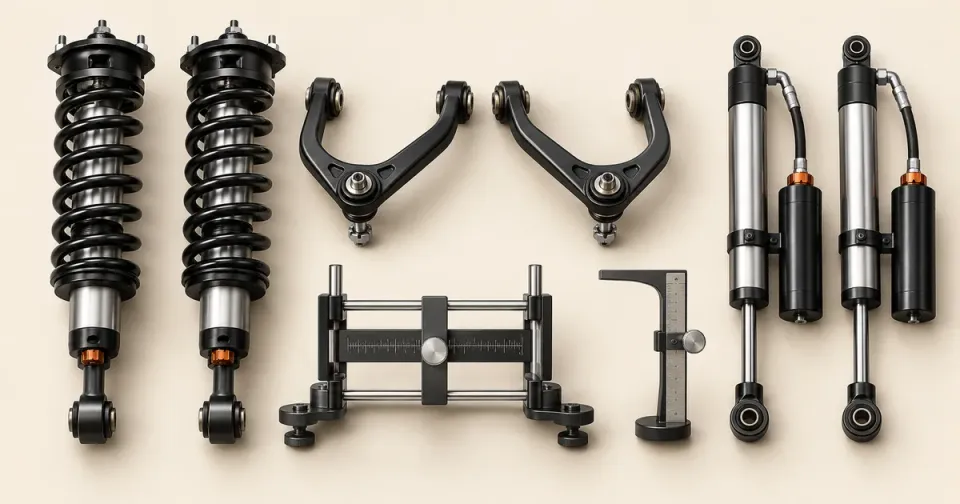
THE 6112 IS A FRONT KIT; BUILD THE REST FROM MEASUREMENTS
Bilstein 47-309975 is a front spring-and-damper kit, not a complete Tacoma lift. Use only the circlip positions Bilstein lists for the exact cab, drivetrain and engine, then schedule professional installation, alignment, brake/ABS checks and headlight aiming. Rear shocks or springs, upper control arms and clearance corrections are separate decisions; none is automatically required for every 6112 setup.
Start with what Bilstein 47-309975 actually includes
Bilstein lists 47-309975 as a B8 6112 front kit for named 2005–2023 Tacoma configurations. The kit contains two 60 mm dampers, two matched front springs and two spring seats. It does not include rear shocks, rear springs or leaf packs, upper control arms, a differential drop or tire-clearance parts.
This matters because “what else do I need?” has two different answers:
- Required work documented in the 6112 installation instructions; and
- Conditional components selected after the truck's exact application, load, target stance, alignment and clearance are known.
Do not turn a generic forum list into a purchase list before resolving those inputs.
The approved circlip chart controls the lift height
Bilstein's marketing page describes a broad adjustable-lift capability, but the installation instruction provides the configuration-specific limit. For listed 2016-and-newer Tacoma applications, the allowed positions produce nominal lift ranges that vary by cab, engine and drivetrain, with documented maximums around 1.8 to 2.2 inches. Many common V6 four-wheel-drive configurations top out at 2 inches.
For listed 2005–2015 applications, some configurations have different permitted positions and nominal results. The instruction marks other circlip settings “do not use.”
Therefore, “set it above two inches” is not a valid universal instruction. First identify:
- exact kit number;
- Tacoma year, cab, engine and drivetrain;
- the permitted circlip position in the current instruction; and
- the expected effect of existing suspension condition and permanent accessories.
Bilstein also says actual lift can vary with the factory suspension, its condition, accessories, modifications and wheel/tire setup. Measure hub-to-fender height before and after; do not infer the final geometry from groove number alone.
Required supporting work—not optional shopping
Bilstein's installation document calls for a professional suspension technician and the correct specialty tools. It also gives several post-installation checks that should be budgeted with the kit:
| Documented task | Why it belongs in the plan |
|---|---|
| Use only the recommended circlip setting | Avoid an unapproved spring-seat/height configuration |
| Inspect and replace affected fasteners as required | Self-locking fasteners and damaged hardware are not universal reuse items |
| Check and adjust caster and camber | Ride-height change alters alignment geometry |
| Check/reset the load-dependent brake compensator and ABS as applicable | The installation changes vehicle height and system inputs |
| Check and adjust headlight aim | A taller front stance can move the beam upward |
| Recheck installation and road behavior | Confirms secure assembly and catches abnormal contact or handling |
The instruction also prohibits impact tools for the installation. These tasks are more universal to the documented 6112 job than any claim that every owner must buy the same UCA or differential-drop kit.
Rear shocks and rear lift are separate decisions
Bilstein recommends B8 5160 rear shocks as a pairing for the Tacoma 6112 front kit. That makes the 5160 a documented system-path option, not proof that a rear shock alone creates rear lift or supports added constant load.
Choose the rear setup from:
- desired front-to-rear rake after the front height is set;
- current rear ride height and available travel;
- permanent topper, drawer, bumper, rack or towing-related tongue load;
- shock application and extended/compressed lengths; and
- the spring or leaf maker's exact load and height guidance.
If rear sag or constant load is the actual problem, solve it with a documented rear spring/leaf decision. A reservoir shock can improve damping and heat capacity, but it does not substitute for the spring carrying static vehicle load.
Are upper control arms required?
Not automatically. Bilstein sells B8 upper control arm kit 51-304683 for listed 2005–2023 Tacoma applications and says it is designed to correct caster alignment while improving ball-joint angles and clearance on lifted suspensions. That explains what the component is for; it does not say every 47-309975 installation requires it.
Make the UCA decision from evidence:
- Can the truck reach the specified alignment range at the final measured height?
- Is the achieved caster appropriate and reasonably balanced side to side?
- Are the ball joint and control arm within their documented operating geometry?
- Is there adequate coil, tire/wheel and body clearance through steering and suspension movement?
- Does the selected UCA explicitly fit the exact Tacoma configuration and wheel/tire package?
An aftermarket UCA can solve a real geometry or clearance constraint, but it also introduces its own ball joint or bushing, torque, wheel-clearance and maintenance requirements. Buy it for a documented reason, not solely because the front lift is described as “two inches.”
Differential drops, bearing changes and spacers are conditional
Bilstein's cited 6112 product page and installation instruction do not state that every Tacoma needs a differential drop, ECGS/needle-bearing change, sway-bar spacer or longer brake line. Do not label those parts mandatory without another exact component instruction or a measured problem.
Instead, inspect the installed truck for:
- CV-joint angle, boot contact or binding;
- vibration or noise that changes with drive mode, speed or load;
- sway-bar, coilover, UCA and frame clearance;
- brake-hose and ABS-wire tension through steering and droop;
- bump-stop engagement and available travel; and
- skid-plate or crossmember interference created by a proposed correction.
Diagnose the actual source before adding a corrective part. Some changes trade clearance in one location for reduced clearance elsewhere.
Tire clearance remains a separate proof
A 6112 height setting does not certify a larger tire. Wheel width, offset, tire's measured dimensions, caster, body mounts, liners, mud flaps and load all influence contact.
Check at the final alignment through full left/right steering and representative compression, including the rear of the front wheel opening. The Tacoma tire-size guide explains why lift height alone cannot answer rubbing. If wheels are changing too, verify the complete interface with the wheel-fitment guide.
Supporting-parts decision matrix
| Item or work | Default status | Trigger |
|---|---|---|
| Correct 47-309975 application and approved circlip | Required | Exact cab/engine/drivetrain row in Bilstein instruction |
| Professional installation and correct hardware handling | Required | Bilstein installation instruction |
| Alignment plus brake/ABS and headlight checks | Required/documented | After installation |
| Rear 5160 shocks | Recommended pairing, not rear lift | Desired matched damping and exact rear application |
| Rear springs or leaves | Conditional | Measured rear-height, load, travel or sag target |
| Bilstein UCA 51-304683 or another exact UCA | Conditional | Alignment, ball-joint-angle or clearance need |
| Differential or bearing correction | Conditional | Exact documentation plus diagnosed geometry/noise issue |
| Sway-bar, hose or ABS-wire provisions | Conditional | Measured interference or tension through travel |
| Larger tires/wheels | Separate fitment decision | Full steering/compression and load-clearance proof |
For a broader comparison of Bilstein, Old Man Emu and Fox system paths, use the Tacoma suspension comparison. It should not replace the exact 6112 installation record used here.
Bottom line
The universal “supporting parts” for a 6112 installation are mostly correct application selection and documented work: an approved circlip position, qualified installation, proper hardware handling, alignment, brake/ABS checks and headlight aiming. Rear dampers, rear springs, UCAs and driveline or clearance corrections follow from the final measured truck. If the desired height requires a circlip Bilstein marks “do not use,” choose a suspension system designed for that target instead of forcing this one past its application.
Sources & notes
- Bilstein B8 6112 front kit 47-309975, accessed 2026-10-16. Exact application and included-component source.
- Bilstein installation instruction E4-WM5-Y690A00, accessed 2026-10-16. Bilstein-authored configuration/circlip table and installation, alignment, brake/ABS and headlight requirements; hosted by an authorized retailer.
- Bilstein Tacoma B8 6112 and B8 5160 overview, accessed 2026-10-16. Supports the recommended rear-damper pairing.
- Bilstein B8 upper control arm 51-304683, accessed 2026-10-16. Exact Tacoma application and caster/ball-joint-angle/clearance purpose.
- Bilstein B8 control arms, accessed 2026-10-16. Supports the control arm's role as a complement to lifted suspension, not a universal mandate.
- ICON Tacoma UCA support note, accessed 2026-10-16. Secondary example showing that UCA need varies with system, height and alignment; not used as a Bilstein application rule.
- The hero is an original centered generic illustration. It is not a mandatory-parts list, installation specification or product endorsement.