
How Does Heavier Wheel and Tire Weight Affect a Maverick?
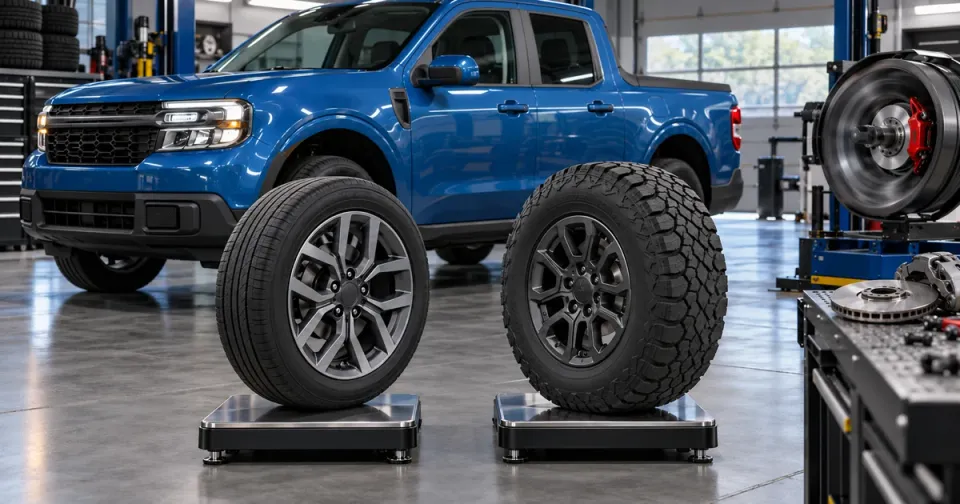
HEAVIER ASSEMBLIES CONSUME PAYLOAD AND USUALLY COST MORE ENERGY TO ACCELERATE
Heavier mounted wheel and tire assemblies add to the Maverick’s actual weight and leave less margin under its weight limits. Weigh four complete assemblies and account for any spare that changes. Match tire and wheel ratings first. Added mass alone does not predict an MPG change for the truck and route you actually use.
Fit Assistant · For your setup
Understand your wheel-weight change
Tell us a little about your situation. Fit Assistant will help you apply this guide.
Diameter gets most attention, but construction can create a large weight difference even at the same nominal size. An LT or reinforced all-terrain tire may be much heavier than a standard-load road tire, and aftermarket wheels range widely.
Calculate the direct weight change as:
`(new wheel + new tire) − (old wheel + old tire)`, multiplied by four, plus any spare change.
That number can be subtracted from remaining payload planning. Fuel-economy impact cannot be predicted accurately from weight alone because tread compound, pressure, width, diameter, aerodynamics, route and temperature also matter. Treat online MPG claims as anecdotal unless the conditions are controlled.
Do not sacrifice load capacity or correct offset to chase a low scale number. Verify bolt pattern, center bore, width, offset, lug-seat type, brake clearance, tire load index and pressure requirements.
A five-minute weight worksheet
Use measured complete assemblies where possible. If you only have separate published wheel and tire weights, keep those as an estimate and include the remaining hardware. Do not compare a bare new wheel with a mounted old wheel.
| Item | Example net change | Planning total |
|---|---|---|
| Four mounted wheel/tire assemblies | +6 lb each | +24 lb |
| Replacement spare assembly | +4 lb | +4 lb |
| Sensors and fasteners | No net change assumed in this example | 0 lb |
| Total additional vehicle mass | Hypothetical example | +28 lb |
This example reduces remaining payload headroom by 28 lb relative to the same truck before the swap. It does not predict MPG, braking distance or ride. If sensors or fasteners also change weight, add their net difference. Count the spare once.
Start from the correct baseline
The existing wheels are already part of the truck's weight. When planning from the factory occupant-and-cargo label, count the net added mass of the swap rather than the whole new set again, along with other post-factory changes. When working from loaded scale readings, do not subtract an accessory again if it is already on the truck on the scale.
Ford's 2026 Maverick owner's manual explains vehicle loading and the truck's limits. The exact truck label and loaded axle weights matter. Lighter wheels do not increase its certified GVWR, axle ratings or tow rating.
What can you conclude about MPG?
A weight total is useful for comparing mass. It is not an MPG calculator. Tire design, width, outside diameter, pressure, route, weather and speed can change alongside weight. An owner's before-and-after result can suggest what to investigate, but it cannot promise your outcome.
If efficiency is your priority, compare suitable complete packages and keep fit, load and brake-clearance requirements as gates. Do not choose a lower-rated component just to reduce the scale reading.
How to compare road noise and fuel use on your own route
| Record | Keep this consistent | Why it matters |
|---|---|---|
| Tire and wheel | Exact size, wheel, cold pressure and load | A tire model name can cover different constructions |
| Sound | Same stretch of pavement, speed and phone position | Pavement and wind can swamp the tire change |
| Fuel | Same route and directions, similar weather, repeat runs | A single trip can mostly measure the day’s conditions |
| Size changes | Check distance against a reliable reference | A larger rolling circumference can affect the displayed result |
For a 225/65R17 shopping list, record the exact Falken WildPeak A/T Trail and Michelin Defender2 specifications separately. Include the wheel and spare when you calculate mass. If the truck feels louder after a change, repeat the same stretch in both directions before deciding whether the difference is tread, pavement or wind. Compare fuel use over several comparable runs and report the range as well as the average.
Tire Rack Falken WildPeak A/T Trail 225/65R17 specification · Tire Rack Michelin Defender2 225/65R17 specification
Bottom line
Compare complete assembly weights and net added mass first. Then decide whether the proposed package offers a benefit you value while meeting fit, load and use requirements. There is no reliable MPG forecast from wheel weight alone.
Check physical fit with the Maverick wheel specification guide.
Compatibility snapshot
| Setup | Verdict | Required check and source |
|---|---|---|
| Four heavier mounted assemblies | Add the difference to vehicle weight | Include the spare and hardware changes and check the loaded scale weight. 2026 Ford Maverick owner’s manual |
| Wheels lighter than stock but wrong for brakes or load | Reject the unverified application | Confirm clearance and component and vehicle ratings. 2026 Ford Maverick owner’s manual |
| Weight figure used to forecast fuel economy | Use a real matched comparison instead | Record driving conditions and tire model as well as weight. FuelEconomy.gov factors affecting MPG |
Sources & notes
Last verified 8 November 2026.
- FuelEconomy.gov factors affecting MPG
- 2026 Ford Maverick owner’s manual
- BFGoodrich tire construction, accessed 2026-10-27. Construction differences.
- Michelin: changing tire size or specification, reviewed 2026-11-06. Size changes need application-specific assessment; this is not a larger-size approval.
Editorial review 2026-11-06: decision examples and setup checks updated from competitor-gap research. This is source-based guidance, not our own product road test. Original source dates remain where evidence was not independently re-established.