
Motorcycle Hitch Carrier vs Trailer for Ford Maverick
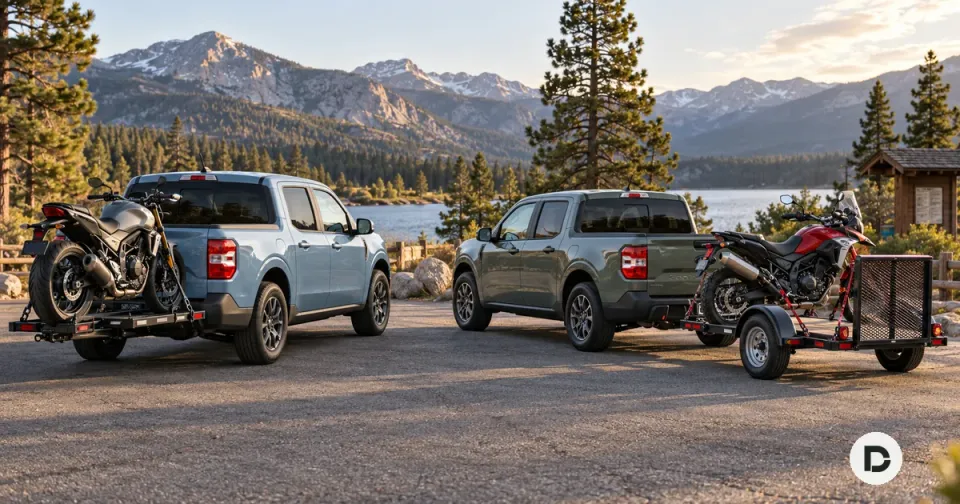
USE A TRAILER FOR MOST ROAD MOTORCYCLES; RESERVE A CARRIER FOR A LIGHT BIKE WITH VERIFIED MARGIN
Add the motorcycle's ready-to-ride weight to the carrier, hitch adapter and tiedowns. That entire assembly is vertical load on the receiver and truck, and its leverage sits behind the bumper. If the total approaches the lowest receiver, vehicle or payload limit, use a small trailer instead. A carrier advertised for 400 or 600 pounds does not make the Maverick capable of supporting that amount.
Ford lists a 400-pound maximum tongue load for a properly equipped 4K Maverick, but that number is not a universal carrier allowance. The exact receiver label, truck configuration and remaining door-jamb payload all still apply. A non-4K configuration may have a lower usable limit.
A steel motorcycle carrier can weigh about 92 pounds before the motorcycle is loaded. Even a roughly 51-pound aluminum carrier plus a 350-pound motorcycle totals about 401 pounds before an anti-rattle device or accessories. That fails a 400-pound screen and leaves no margin for measurement error or dynamic loading.
Decision matrix
| System | Load applied to Maverick | Strongest use case | Main failure mode |
|---|---|---|---|
| Hitch carrier | Bike + carrier + hardware as rear vertical load | Lightweight scooter or dirt bike with verified margin | Exceeds hitch/payload; poor ground clearance |
| Small trailer | Trailer tongue weight counts against payload | Heavier motorcycle or frequent highway use | Exceeds tow/GCWR; missing brakes or wiring |
| Bed transport | Bike and equipment count as cargo | Bike dimensions and secure loading fit the short bed | Tailgate, tie-down or loading-ramp problem |
Ford says trailer tongue weight is part of vehicle payload. The same conservative accounting should be used for a hitch carrier: subtract passengers, in-cab cargo, bed cargo and installed accessories from the exact payload label before approving the carrier.
Carrier geometry matters too. Check receiver-to-ramp rise, departure angle, license-plate and lamp visibility, exhaust path, wheelbase support, tire width and tiedown geometry. Do not use a hitch extender unless both the carrier and receiver documentation explicitly allow the resulting reduction in capacity.
A trailer shifts most motorcycle weight to its axle. Its measured loaded tongue weight still consumes payload, and the combination must remain within the truck's tow rating, GCWR and frontal-area limits. Electric trailer brakes require a functioning controller and wiring path.
Bottom line
Approve a hitch carrier only after weighing the ready-to-ride motorcycle and every carrier component and finding real margin below all limits. For typical street motorcycles, a correctly sized trailer is usually the more defensible Maverick system.
Review Maverick payload, towing and hitch ratings before selecting either path.
Sources & notes
- 2026 Ford Maverick towing information, accessed 2026-10-27. Tow and factory receiver limits.
- 2026 Maverick owner's manual, accessed 2026-10-27. Payload and tongue-weight accounting.
- Haul-Master 600-pound steel carrier, accessed 2026-10-27. Carrier weight and product limit.
- Haul-Master 400-pound aluminum carrier, accessed 2026-10-27. Carrier weight and product limit.