
Which Portable Air Compressor Should You Choose for Your Tacoma Tires?
MATCH THE COMPRESSOR TO YOUR ROUTINE AND POWER SOURCE
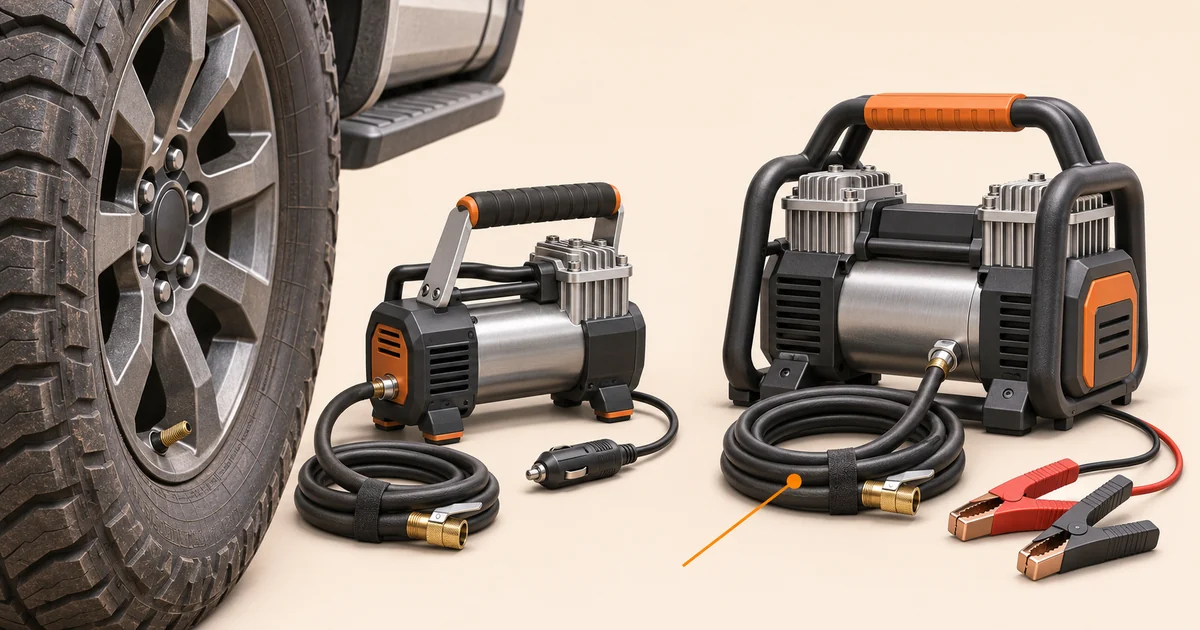
For occasional tire top-ups, compare a compact portable inflator first. For regular post-trail inflation, compare the complete compressor-and-hose system, including its duty limits. Socket power, battery clamps and four-tire operation are different buying choices. Match the exact compressor to the truck's approved connection; a 12-volt label or a high airflow number does not prove compatibility.
Fit Assistant · For your setup
Choose a compressor for your routine
Tell us a little about your situation. Fit Assistant will help you apply this guide.
What tire-inflation job are you buying for?
| Your routine | Start by comparing | What matters most |
|---|---|---|
| Occasional pressure corrections before a drive | Compact portable inflator | Compatible power supply, easy storage and a usable gauge |
| Four tires after occasional off-road trips | A portable compressor rated for that tire/use cycle | Run/cool-down limits and reaching every valve |
| Frequent four-tire trail air-up | A documented multi-tire compressor-and-hose system | Supported simultaneous operation, power requirements and complete-kit size |
| Mainly bicycles, sports gear or other inflatables | A tool intended for those tasks | Correct valves and adapters; a truck compressor may be unnecessary |
A Tacoma commuter who occasionally corrects tire pressure may value a small bag and simple connection more than peak airflow. A driver who airs up the whole truck after every trail outing may value the hose setup and repeated-use limits more. Those are different reasons to buy.
Socket power or battery clamps?
A socket-powered unit avoids a separate clamp connection, but the outlet still needs to support the compressor's voltage, operating demand and starting requirements. Do not assume all Tacoma outlets share one rating. Check the owner's manual for the exact vehicle and outlet, then the compressor maker's instructions.
For a concrete example, VIAIR's EVC85P digital lists an accessory-power plug and a maximum draw of 15 A / 180 W. Its page explicitly tells buyers to check their vehicle's port rating. This is a power requirement to verify, not proof that it works in every truck socket. Review the current EVC85P specification.
VIAIR's 00088 analog 88P instead lists battery clamps and a 20 A maximum draw. That is a different connection and product from the digital EVC88P. Follow both the vehicle's and compressor's instructions for the actual power source; this guide does not provide a universal battery-connection procedure. Check the analog 88P.
Do not solve an underspecified socket by improvising an adapter or changing a fuse. Resolve the supported power route before ordering.
What do airflow and duty limits tell you?
Airflow describes how much air a compressor delivers under specified conditions. A free-air number measured at zero pressure is not the same as flow while filling a tire. Compare figures at the same pressure when the maker provides them.
Duty limits describe the running and cooling conditions the compressor supports. Keep the pressure and temperature conditions attached to the number. VIAIR's current pages, for example, express the named units' duty limits as running minutes at a stated pressure. Do not turn those into a universal four-tire fill-time estimate.
You also need the job's starting and target pressures and actual tire size. A small pressure correction and recovery from a large trail pressure reduction are different demands. Use the truck's specified cold pressure for the supported tire setup; the tire sidewall maximum is not the normal target. NHTSA explains tire pressure and vehicle labels.
Three product routes worth understanding
| Named example | Documented design | Useful buying question |
|---|---|---|
| VIAIR EVC85P digital | Accessory-power plug, digital gauge and preset shutoff | Does my approved outlet support this exact model? |
| VIAIR 00088 analog 88P | Battery-clamp power and a conventional pressure gauge | Is the documented connection and operating routine convenient for me? |
| MORRFlate TenSix PSI Pro Gen2 | Compressor designed around simultaneous four-tire inflation | Will I use its intended hose system and four-tire workflow? |
MORRFlate supplies an important counterexample to “bigger is always better.” Its Gen2 page says the TenSix is optimized for four tires at once and warns against airing up an entire vehicle one tire at a time. That limitation belongs in the buying decision, not in small print after purchase. Read the current TenSix Gen2 operating limits.
These are documented design examples, not a hands-on performance ranking. Check the selected revision and package contents. A preset-pressure feature on one digital model should not be assumed on another product with a similar name.
Will it reach every tire and fit where you store it?
Compare the combined usable power-cord and hose route around the actual truck, including the spare if that is part of your plan. Keep leads away from the hot or moving areas named in the instructions. A hose length on the product page does not prove that every valve is reachable from your approved power connection.
Include the bag, fittings, any valve adapters and the hose kit in the storage plan and total price. Four-tire systems can change both setup time and what must be packed. Choose the routine you are willing to repeat at the end of a trip.
If the tire size itself is still undecided, use the Tacoma tire-size guide first. Maverick readers can use the same tool-selection questions, while keeping their own vehicle's power and tire requirements separate; the Maverick tire-choice guide covers that earlier decision.
Compatibility snapshot
| Proposed combination | Result | Required check |
|---|---|---|
| Socket inflator and an unspecified Tacoma outlet | Unknown until checked | Exact voltage, operating/start demand and approved outlet limits |
| Battery-clamp compressor and a particular truck | Not approved by 12 V alone | Vehicle and tool instructions for the connection and operation |
| TenSix Gen2 with sequential whole-truck inflation | Maker warns against this workflow | Use the intended documented four-tire system or compare another route |
| Different tire size, hose kit or compressor revision | A new selection check | Supported pressure/use cycle, accessories and reach |
Before you buy
- Record tire size and whether the job is small top-ups or repeated whole-truck inflation.
- Confirm the vehicle-approved power connection and the exact tool's electrical requirements.
- Read the pressure, duty and temperature limits for the selected revision.
- Check hose reach, valve adapters and complete package contents.
- Compare stored size and the full setup you will actually use.
Browse Tacoma Guides and the cargo and overland topic for related equipment decisions.
Bottom line
Buy the compressor around your inflation routine. A compact inflator can be the better everyday tool; a four-tire system earns its extra equipment when you use its intended workflow. Verify the power source and operating limits before comparing maximum airflow or price.
Sources & notes
- VIAIR EVC85P digital, checked 2026-11-05. Named accessory-power model, current draw, digital preset and duty conditions; no universal Tacoma outlet approval.
- VIAIR 00088 analog 88P, checked 2026-11-05. Named clamp-powered analog model; distinguish it from the digital variants.
- MORRFlate TenSix PSI Pro Gen2, checked 2026-11-05. Intended four-tire workflow and explicit sequential-inflation limitation.
- NHTSA TireWise, reviewed 2026-11-05. Vehicle-label and cold-pressure guidance, not exact vehicle/tool compatibility.
- Original generic technical illustration; it is not a product photograph, wiring instruction or performance test. Recheck specifications after a revision or power-connection change.