
Does Ironman IM2.5 Suspension Suit Your Tacoma Build?
CHOOSE SPRINGS FOR THE WEIGHT THAT STAYS
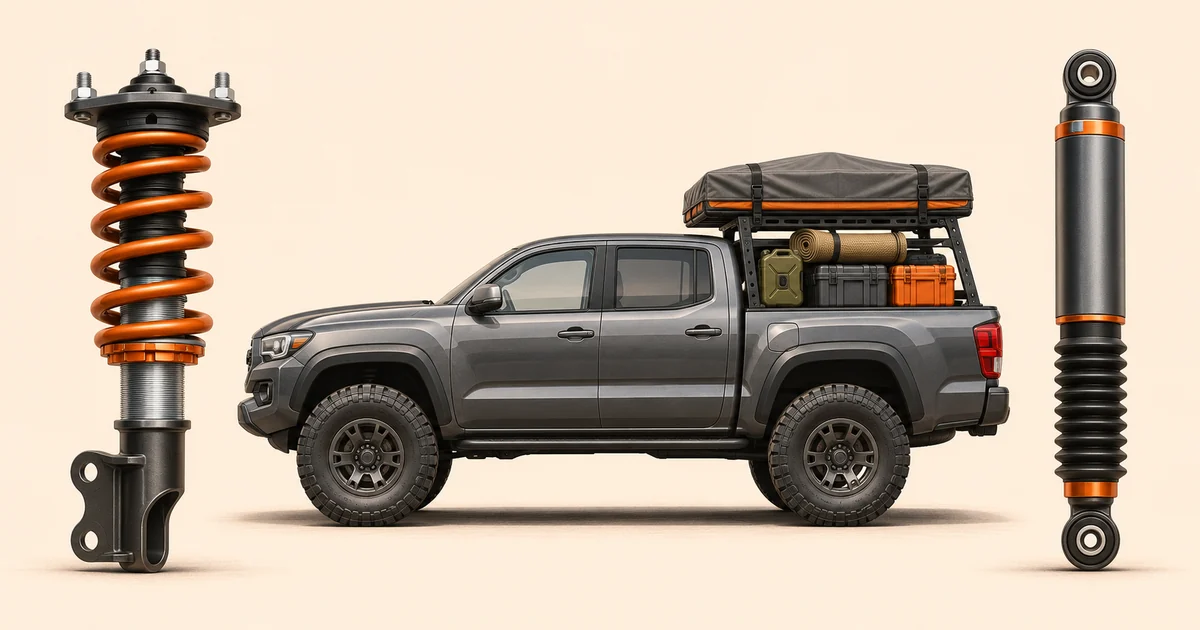
Ironman IM2.5 is worth comparing for a Tacoma used on both roads and trails, but select the spring package for the weight that stays on the truck. The reviewed TOY066KM covers 2005–2023 applications, excludes five-lug models and requires a rear shock-mount modification on second-generation trucks. Stage 2 adds upper control arms to Stage 1.
Fit Assistant · For your setup
Apply this to your suspension plans
Tell us a little about your situation. Fit Assistant will help you apply this guide.
Does the current kit match your Tacoma?
The current TOY066KM page describes a 3-inch IM2.5 suspension kit for 2005–2023 Tacoma. IM2.5 is the maker’s 2.5-inch monotube shock system; that shock-body description is different from the advertised lift height.
Check the exclusions before debating ride quality. Ironman says this kit does not fit models with five-lug wheels. It also says 2005–2015 trucks need a rear shock-mount modification. That work belongs in the purchase and installation discussion, not as a surprise after delivery. Do not extend the listing to 2024+ trucks.
What does Stage 2 add?
| Package | Published contents | Buyer consequence |
|---|---|---|
| Stage 1 | Front IM2.5 coilovers, rear IM2.5 shocks, rear leaf springs, front sway-bar spacers, driveshaft center-bearing spacer, U-bolts and spring bushings | Compare the selected spring combination and complete installed package |
| Stage 2 | Stage 1 plus Pro Forge upper control arms | Price the arms as a specific package difference; still obtain the alignment plan |
These are the reviewed maker’s package descriptions. Have the current order itemize the actual parts and spring selections. A stage number alone is not an alignment result or clearance guarantee.
Ironman calls for professional alignment after installation and publishes a four-year warranty. Review its current terms and ask who handles installation-related issues and component service. Do not treat a warranty period as evidence that your selected spring setup will feel right.
Choose springs for permanent weight
The important distinction is constant load: equipment that stays fitted. A steel bumper, winch or permanent camper affects the truck between trips. Removable camping bins do not represent the same everyday load.
Ironman offers light, medium and heavy load branches and warns that overly heavy springs can ride harshly when unloaded. The public descriptions reviewed here do not supply a universal pounds-to-spring chart for every truck. Use the inventory below to obtain the actual front and rear spring recommendation.
| Weight to describe | Front or rear? | Always fitted or removable? | Weight source |
|---|---|---|---|
| Bumper and winch | Record location | Usually permanent | Product data or measured change |
| Cap/camper and drawers | Usually rear-focused | State whether they stay installed | Actual selected equipment |
| Water, food and camping bins | Record loaded trip position | Often removable | Normal trip load |
| Planned future equipment | Record separately | Not present today | Proposed equipment; do not count as current |
Keep front and rear additions separate. One total accessory figure can hide very different spring needs. The truck’s own load limits remain separate from choosing suspension; use payload after modifications for that calculation.
What does the long-term review actually tell you?
Trail Tacoma’s IM2.5 review describes the author’s 2019 TRD Off-Road build after about 7,500 miles. That is useful owner experience about a particular configuration.
It is not our test, a comparison of every available spring combination or proof of the ride on an empty second-gen truck. Read the reviewer’s equipment and use alongside their impressions. Then compare that situation with yours rather than copying a stage or spring name.
Two example buying decisions
2014 six-lug truck, weekend gear comes out: the model-year range makes the current kit a candidate, but the rear shock-mount modification must be priced. A heavy spring package selected for a camper you might buy next year is not automatically a good choice today. Ask for a current-load recommendation and the later change path.
2019 truck, permanent camper and bumper: bring the separate accessory weights and axle/load information to the supplier. Ask for the actual spring codes, intended constant-load range and installed-height expectation for that equipment. Do not let “overland build” substitute for the load inventory.
Compare complete installed cost
Ask one supplier or shop to itemize the selected stage, front/rear springs, application-specific modifications, installation and alignment. Include shipping, tax and any inspection or correction work identified for the truck. Ask what happens if the future build changes substantially.
A lower kit price does not establish a lower finished cost if another quote includes arms, alignment or the second-gen modification. Nor does an advertised 3-inch lift guarantee space for a particular tire.
Compatibility snapshot
| Product/application | Vehicle fitment | Result | Required check |
|---|---|---|---|
| TOY066KM | Listed 2005–2023 Tacoma, excluding five-lug | Documented candidate | Actual configuration and selected springs · current TOY066KM page |
| Same kit, 2005–2015 | Second-generation application | Modification required | Rear shock-mount work in the quote · current TOY066KM page |
| Five-lug or 2024+ Tacoma | Outside this reviewed application | Do not select from this listing | Correct current maker application · current TOY066KM page · Toyota 2024 Tacoma launch and configuration information |
What finishes the choice?
A kit that covers your truck, springs selected for its current load and a complete installation plan. Fit Assistant can help organize the equipment you know and explain which missing weight matters next.
Browse Tacoma Guides and suspension guides.
Sources & notes
Reviewed 7 November 2026. Current package facts come from Ironman’s linked page; long-term impressions belong to the linked reviewer. This guide does not diagnose suspension problems, prescribe installation torque or promise lift height, ride quality, payload gain or tire clearance.