
How Should You Choose a Tacoma Recovery Rope?
CHOOSE THE RIGHT TYPE OF RECOVERY LINE
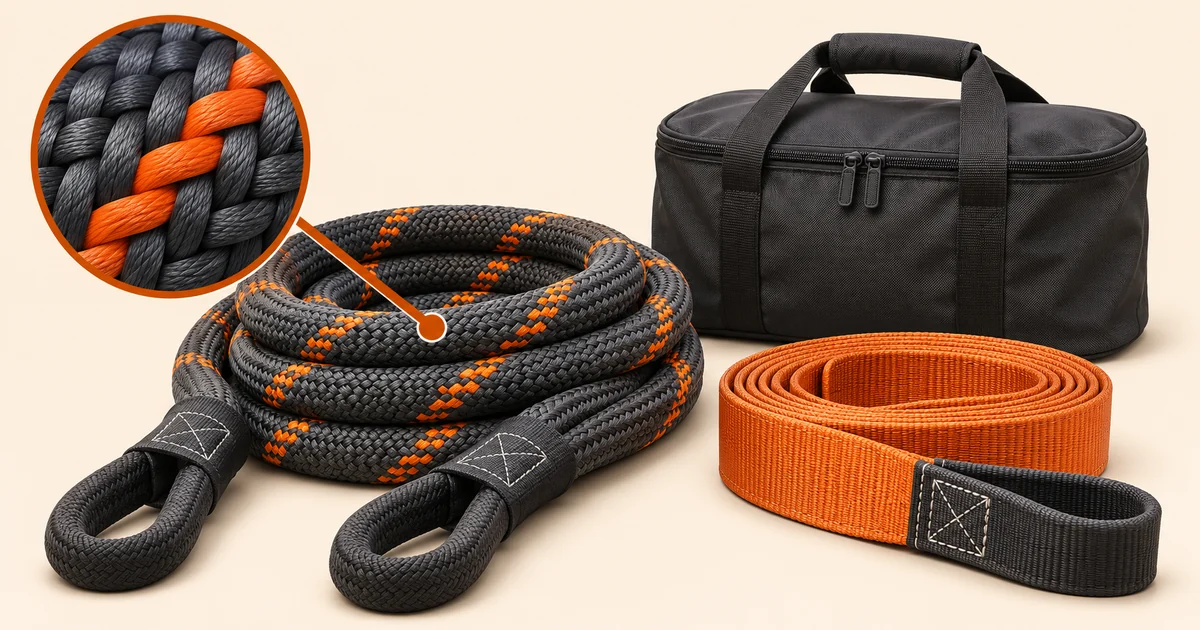
Choose a Tacoma recovery rope using the selected maker’s vehicle-weight guidance and a compatible recovery system—not the largest breaking-strength number or a universal rope diameter. Kinetic rope, snatch webbing, tow straps and winch lines serve different jobs. Breaking strength is not a working-load limit, and neither a rope rating nor a Tacoma badge approves the attachment points or a recovery operation.
Fit Assistant · For your setup
Apply this to your recovery-equipment choice
Tell us a little about your situation. Fit Assistant will help you apply this guide.
Which kind of line are you shopping for?
Describe the task before comparing prices. Similar-looking straps and ropes are not substitutes merely because both have loops.
| Category | Question to resolve |
|---|---|
| Kinetic recovery rope | Is controlled stretch part of the maker-supported recovery system? |
| Snatch webbing | What vehicle-weight basis and components does its maker specify? |
| Tow strap | Is it documented for the actual towing task rather than kinetic recovery? |
| Winch line | Is it the specified line for the winch and system? |
| Cargo restraint | Do not treat a tie-down as recovery equipment |
A recovery kit needs suitable attachment equipment and knowledge as well as the line. If those are missing, a larger rope is not the next useful purchase by default.
Why do selection formulas differ?
Manufacturers describe their own products and selection methods. Keep the rule attached to the product instead of averaging advice from different categories.
Bubba Rope’s FAQ recommends a breaking-strength selection reference of 3.5–4 times the stuck vehicle’s weight for its recovery ropes. It explicitly says there is no official working-load limit for those ropes.
ARB’s snatch-strap guidance uses 2–3 times the relevant gross vehicle weight and identifies the lighter of the two vehicles for its snatch webbing. ARB also explains why an excessively strong strap can fail to deliver the desired stretch.
These are different stated selection scopes. Neither establishes a universal Tacoma rope diameter, nor does one supplier’s rule approve another supplier’s product.
A shopping calculation, not a recovery approval
Suppose a hypothetical loaded vehicle weighs 5,500 lb. Applying Bubba’s stated 3.5–4 reference produces 19,250–22,000 lb. That arithmetic is useful when discussing an appropriate product with that maker.
It does not calculate an actual recovery force or approve a particular rope, attachment, second vehicle or terrain. A 28,600-lb advertised number is not automatically better simply because it exceeds the example. Have the supplier address the actual application and its own selection guidance.
Use real loaded-vehicle information where available. The name “Tacoma” does not include all the weight added by passengers, armor, water and camping equipment.
Read the rating label correctly
Minimum breaking strength describes a failure-related rating under its stated conditions. A working-load limit describes a permitted working load for equipment under specified use. They are not interchangeable labels.
Do not divide one by an invented safety factor and declare a complete recovery safe. Also do not compare a rope’s breaking number directly with the truck’s towing capacity or a shackle’s differently defined rating as though all three mean the same thing.
Ask the supplier to explain the product’s test/rating basis, intended vehicle range, compatible connections and restrictions. A clear answer is more useful than an unexplained “heavy duty” label.
Check the complete recovery setup
| Item | What the order should resolve |
|---|---|
| Both vehicles | Relevant loaded weight and suitability for the proposed task |
| Vehicle attachment points | Documented recovery application and loading direction |
| Connectors | Compatible rating, shape, condition and manufacturer instructions |
| Rope or strap | Exact product, condition, selection basis and storage requirements |
| People using it | Training and understanding of the complete instructions |
A towing ball is not established as a kinetic recovery attachment by its trailer rating. Do not improvise an attachment from a convenient-looking point. Recovery planning belongs with appropriately trained people using documented equipment.
The first recovery-gear guide helps decide whether this belongs ahead of other equipment in your kit. This article deliberately does not specify pull speed, run-up distance or a recovery sequence.
Compare price after suitability
Put the selected line, suitable connectors, storage and any needed vehicle equipment on the same quote. A budget rope can be poor value if the seller cannot identify its intended use or support it with current documentation. A premium name does not inspect the rest of your setup.
Also ask about inspection, cleaning, retirement and replacement support. Previous use, abrasion and storage history matter when evaluating secondhand equipment; a readable label does not prove the rope’s present condition.
Compatibility snapshot
| Claim or choice | Result | Required check |
|---|---|---|
| Bubba recovery-rope weight formula | Maker-specific selection reference | Actual product and loaded application · Bubba Rope’s FAQ |
| ARB snatch-webbing formula | Different product-specific reference | Do not transfer it to every rope · ARB’s snatch-strap guidance · ARB RK11A selection notes |
| Largest breaking number wins | Not a useful universal rule | Correct stretch/application and full system · Bubba Rope’s FAQ · ARB’s snatch-strap guidance |
| Trailer ball or cargo tie-down | Not established as recovery attachment | Documented recovery equipment · ARB’s snatch-strap guidance |
Before you buy
Finish with an appropriate type of line and a supported complete setup. Fit Assistant can help identify the missing shopping information without inventing a safe pull from incomplete details.
Sources & notes
Reviewed 7 November 2026. Bubba Rope FAQ, ARB recovery basics and ARB RK11A selection notes. No original recovery test or universal rating formula is claimed. See our methodology.