
GFC Platform Camper or a Hard Cap for Your Tacoma?
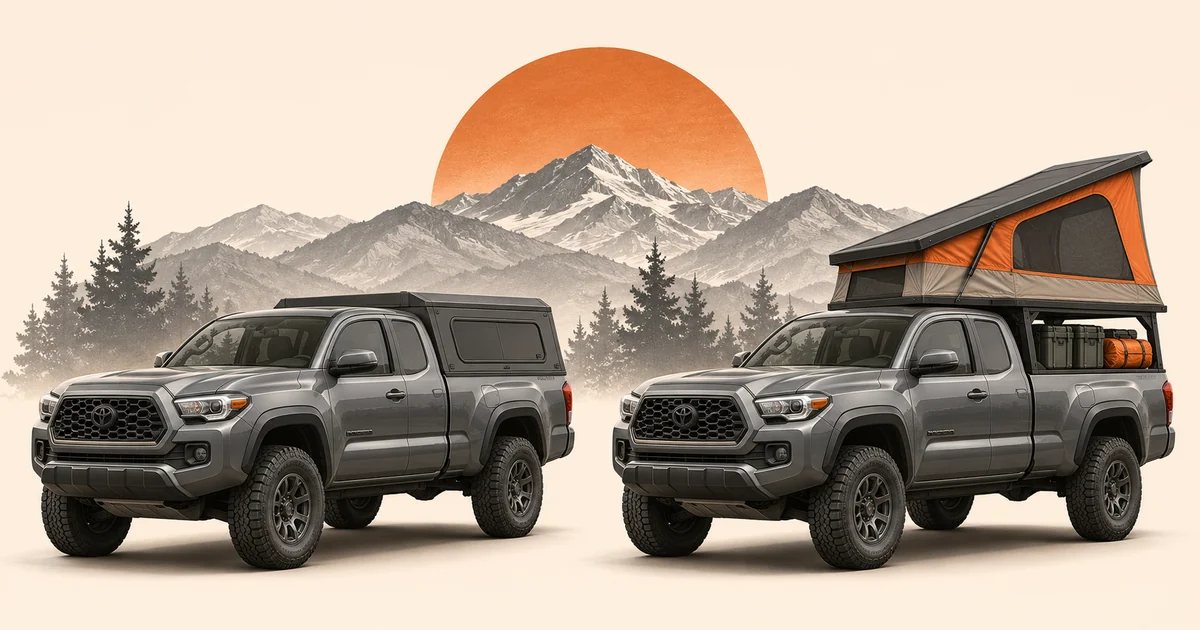
How Does a Lone Peak Pop-Up Compare With GFC for a Tacoma
For a Tacoma that needs a sleeping platform above its cargo, compare a GFC V2 Pro quote with Lone Peak’s exact camper for your bed. Lone Peak lists both five- and six-foot beds for 2024+ Tacoma. If you mainly need locked cargo space and sleep elsewhere, a hard cap deserves the first quote.
Fit Assistant · For your setup
Apply this to your camping plans
Tell us a little about your situation. Fit Assistant will help you apply this guide.
Compare two named current products
“Hard cap” covers many different products. To make the comparison useful, this table uses the GFC V2 Pro Topper, not an assumed average fiberglass shell. Other caps need their own price, weight and equipment comparison.
| Decision | GFC V2 Pro Camper | GFC V2 Pro Topper |
|---|---|---|
| Main job | Enclosed bed plus integrated sleeping loft | Enclosed cargo area; no integrated sleeping loft |
| Displayed base price at review | $7,950 | $3,995 |
| Published weight reference | Midsize camper: 250–270 lb, depending on bed length | Standard topper: 145–160 lb |
| Sleeping layout | Published midsize area: 50 × 90 inches | Bed-level platform or separate shelter must be planned |
| Daily cargo question | Can gear stay below the sleeping area? | Will sleeping gear compete with bed cargo? |
| Final fit and cost | Truck-specific order and installed quote | Truck-specific order and installed quote |
Sources: V2 Pro Camper, V2 Pro Topper, and the maker’s V2/Pro FAQ, reviewed 7 November 2026. Weight ranges are not the exact finished weight of your Tacoma order. Options and installation can change both totals.
What does the sleeping loft solve?
A separate loft can avoid rebuilding the bed’s cargo arrangement each night. That matters if you carry bulky equipment, camp with a partner or want to keep your normal storage in place.
A cap may be enough when sleeping at bed level is comfortable and your equipment can move out of the way. Before choosing it, work through one real evening: where do the bikes, cooler, bags and bedding go, and what moves when it rains?
Neither layout is automatically better. The useful comparison is the amount of rearranging your trips require. Make sure the proposed sleeping space suits the people using it; a published rectangle alone does not establish personal comfort or access.
Put the extra cost in context
The two displayed base prices differ by $3,955. That is a starting comparison, not the complete premium for your finished setup.
| Cost to include | Camper route | Hard-cap route |
|---|---|---|
| Base product | Selected camper/application | Selected cap/application |
| Sleep equipment | Included versus optional items | Platform, mattress, bedding and/or separate shelter |
| Installation | Delivery, install and any wiring work | Delivery, install and any wiring work |
| Accessories | Power, storage and other selected items | Comparable power/storage items |
| Ownership | Care, storage and eventual changes | Care, removal/storage and eventual changes |
Illustrative use calculation: spreading the $3,955 base-price difference across 40 nights gives about $99 per night; across 100 nights, about $40. This is not a payback forecast. It ignores resale, extra equipment and financing, and it does not prove one choice costs less than lodging. It helps you decide how much the layout change is worth to you.
If you camp a few nights a year, test whether the cheaper layout already finishes the job. If frequent trips require unloading the bed every night, that repeated friction may justify comparing a loft more seriously.
Count the truck’s remaining load margin
The maker’s ranges suggest the two routes can differ materially in weight, but do not subtract unrelated endpoints and call that your exact saving. Obtain the selected build’s weight, then include accessories, passengers and normal trip cargo.
Illustrative arithmetic: with a hypothetical 1,100-pound payload label, 400 pounds of occupants and 300 pounds of gear leave 400 pounds before the cap/camper and any other added equipment. A hypothetical 260-pound camper leaves 140 pounds; a 155-pound topper leaves 245. These figures describe the calculation, not your truck or an approved loaded setup. Axle and other applicable limits still matter.
Use Tacoma payload after modifications for the complete load decision. A roof or product load rating does not increase the truck’s payload.
What about older GFC reviews and used units?
Trail Tacoma’s 2.5-year V2 review offers long-term owner experience. It concerns that reviewed V2, not our testing of the current V2 Pro. Current features, inclusions and prices should come from today’s selected order.
For a used purchase, the maker’s compatibility guidance makes vehicle-specific fit important. Do not buy from “Tacoma camper” alone. Identify the unit and have GFC confirm its truck/bed application and required hardware.
Two example decisions
Partner trips, bikes in the bed: compare the loft with the cap’s nightly unloading plan. The question is whether you can keep the gear you need below while sleeping comfortably above—not merely whether either product encloses the bed.
Solo occasional camping, open bed most weeks: a cap or simpler shelter may already work. Include removal/storage needs and the actual sleeping arrangement before paying for a permanent camping layout.
For the broader cap-shopping decision, see choosing a Tacoma camper shell or topper.
Additional fitment checks
| Product/application | Vehicle fitment | Result | Required check |
|---|---|---|---|
| New V2 Pro Camper | Vehicle-specific build | Confirm exact order | Year, bed, options and final installed weight · V2 Pro Camper |
| New V2 Pro Topper | Vehicle-specific hard-cap build | Confirm exact order | Same truck/bed and completed sleep plan · V2 Pro Topper |
| Used V2/Pro | Depends on identified unit | Unknown until confirmed | Maker compatibility and required hardware · compatibility guidance |
What should you decide now?
Whether the separate sleeping loft solves enough real trip friction to justify its cost and weight for you. Fit Assistant can help compare that with your cargo and camping routine before you seek a final quote.
Browse Tacoma Guides and cargo and overland guides.
Which floor space will you use after dark?
For each platform camper, ask to see how you climb in, which panels move, how much floor stays usable and how you get out with the bed loaded. Check the ladder, bedding and closing sequence. When comparing a used Lone Peak, identify the revision and whether the quoted camper is a standard or tall version before comparing the hardware with a current listing. Match the GFC quote to the current V2 Pro and selected options.
Compare the weight of the complete install
Request written weights for the actual camper or cap, mounts, ladder, rack, panels and anything else you will leave installed. Add people and trail gear, then compare the result with the payload label on the truck. If roof cargo is part of the plan, check the maker’s limits for the proposed roof use and the exact rack.
Compatibility snapshot
| Setup | Documented starting point | What to verify |
|---|---|---|
| Lone Peak on fourth-gen Tacoma | Lists five- and six-foot applications from 2024 | Bed branch, height, revision and full fitted mass. Lone Peak vehicle compatibility list Lone Peak V1 and V2 guide |
| GFC V2 Pro | Exact current camper configuration available to quote | Truck and bed selection, included equipment and accessory weight. GFC V2 Pro Camper |
| Hard cap for gear-first use | Quote around the way you load the bed | Compare the clear opening and installed weight with the platform camper quote. Lone Peak vehicle compatibility list GFC V2 Pro Camper |
Sources & notes
Last verified 8 November 2026.
- Lone Peak vehicle compatibility list. Lists 2024+ Tacoma five- and six-foot versions. Match the ordered variant.
- Lone Peak V1 and V2 guide. Separate used revisions and current details.
- GFC V2 Pro Camper. Compare the exact new build and its selected options.
Reviewed 7 November 2026. Prices and weight ranges are dated maker observations; arithmetic examples are labeled and hypothetical. This is a layout and buying comparison, not our field test, supplier quote or a claim that every hard cap has the GFC Topper’s specifications.