
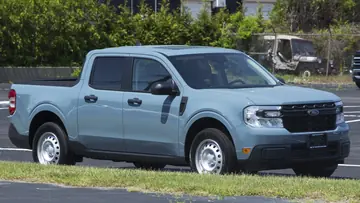

Will a Maverick Tonneau Cover Save Enough Gas to Be Worth It?
BUY THE COVER FOR ITS CARGO VALUE FIRST
Do not buy a Maverick tonneau cover expecting it to pay for itself in gas savings. A cover may be useful for cargo privacy, weather protection and daily bed use, but the evidence reviewed here does not establish a reliable MPG increase for your truck and cover. Decide whether those practical benefits justify the complete price even if fuel savings are zero.
Fit Assistant · For your setup
Apply this to your truck and plans
Tell us a little about your situation. Fit Assistant will help you apply this guide.
Why do tonneau-cover MPG claims disagree?
A useful result needs more than one favorable fuel-economy reading. Truck, cover design, added weight, speed, route, load and measurement method all matter when deciding whether a result applies to you. An aerodynamic explanation alone does not establish the fuel you will save.
RealTruck's fuel-economy article argues for lighter covers and discusses estimated drag and fuel benefits. The reviewed article does not provide a controlled test establishing a result for your Maverick powertrain and selected cover. Its generic estimate should not become your promised payback.
What would make a cover worth buying without savings?
Start with the things that affect your week. Do you want groceries out of sight, easier access to work gear or a place for camping equipment? Compare the selected cover's actual closure and weather-management design; no category makes the bed theft-proof or completely dry.
Then consider the cost in bed use. A retractable canister occupies space. A folding or rolling package changes access when open. The Maverick cover-type guide helps compare those compromises before choosing a named product.
| Your main reason | Put the most weight on | Avoid assuming |
|---|---|---|
| Keep ordinary cargo out of sight | Closure and everyday opening routine | Privacy guarantees theft protection |
| Carry weather-sensitive gear | Actual seals, drains and protected packing | Every cover is waterproof |
| Keep hauling bulky items | Usable opening and removal procedure | All open covers leave the same space |
| Save fuel | Applicable measured evidence | A seller's percentage applies to your Hybrid or EcoBoost |
What does a hypothetical saving look like?
The arithmetic can be useful without pretending to know the improvement. Annual gallons saved equal annual miles divided by current MPG, minus annual miles divided by assumed new MPG. Multiply by fuel price for an annual dollar scenario.
For a purely hypothetical 12,000 miles per year, 30 MPG and $4 per gallon:
| Assumed new MPG | Annual gallons saved | Annual fuel saving |
|---|---|---|
| 30.0 | 0 | $0 |
| 30.3 | About 3.96 | About $15.84 |
| 30.6 | About 7.84 | About $31.37 |
Those are invented scenarios, not measured cover results or expected Maverick mileage. They show why the purchase can depend much more on cargo usefulness than a small assumed MPG change. At zero improvement there is no fuel-payback period.
Do not assume a more expensive cover earns proportionately greater savings. Compare the whole installed price and the features you will actually use.
Can you check your own experience?
Keep comparable records over repeated trips rather than declaring success after one tank. Note route, speeds, weather, load, tire changes and how you measured fuel use. A change in several things at once cannot isolate the cover's effect.
You can still decide the cover is useful even when your records cannot separate a small fuel change from ordinary variation. The point is to understand the purchase, not force a positive result.
Before you buy
Choose a cover you would value at zero fuel savings. Confirm exact Maverick application, bed access, existing rail accessories, installation and maintenance. If the only reason to buy is guaranteed MPG improvement, ask for applicable evidence before spending.
Browse Maverick Guides and bed racks and covers.
Sources & notes
- RealTruck MPG discussion, checked 2026-11-06. Seller's general reasoning, not a controlled Maverick result. No percentage is adopted as a prediction.
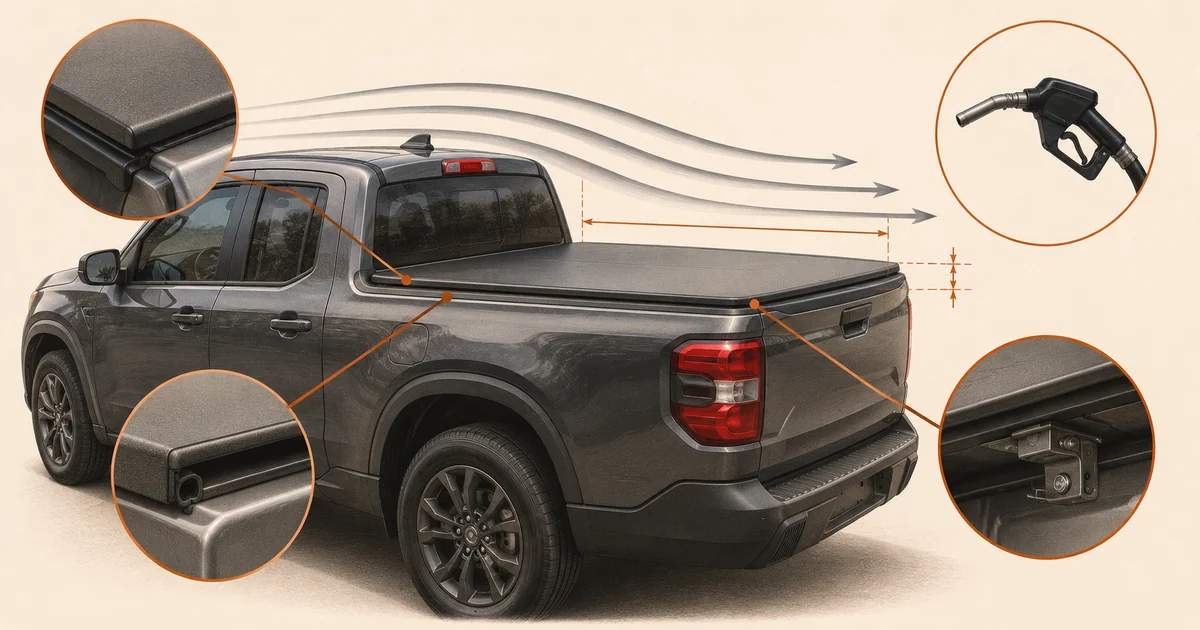
- Scenario values calculated from the displayed assumptions; no fuel-saving performance claim. Original airflow illustration is conceptual, not wind-tunnel evidence.