
What Does a Ford Maverick Need to Tow a Camper?
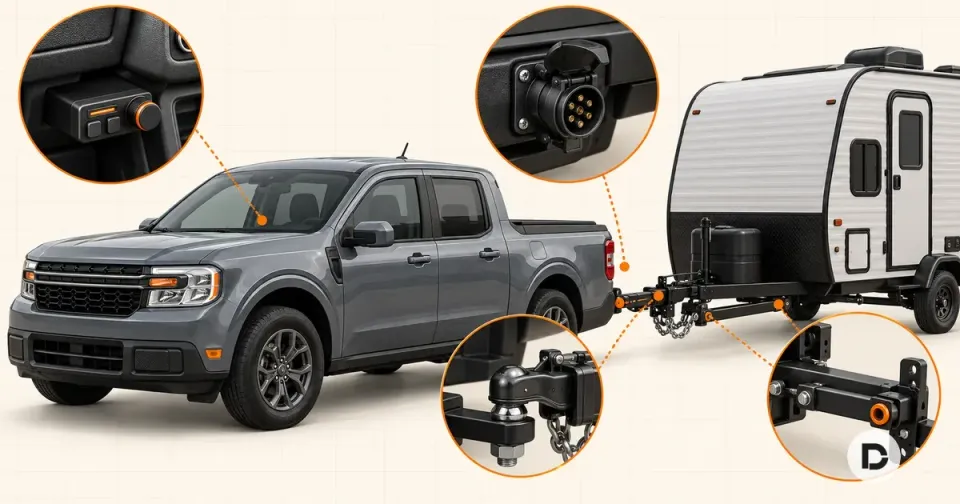
USE THE FACTORY RECEIVER AND BRAKE CONTROLLER; ADD SWAY EQUIPMENT ONLY WHEN APPROVED
A 4K-equipped Maverick already has a Class III receiver, seven-pin connection, trailer brake controller and trailer-sway control. A camper near 3,000 lb still needs functioning trailer brakes and correct tongue weight; use weight distribution or friction sway control only if Ford, the hitch maker and trailer maker approve that exact setup.
Set up and weigh the fully loaded combination before the trip.
Several different products get called “sway bars.” Ford's electronic trailer-sway control is built into the truck. A friction sway-control device and a weight-distributing hitch are physical trailer-hitch components. They solve different problems and are not automatically required just because the trailer is a camper.
For a 2,500-lb dry / roughly 3,000-lb loaded camper
A 2025 Hybrid AWD with factory 4K Tow has the necessary headline rating, subject to every other limit. The package includes the receiver, four-/seven-pin connector and integrated brake controller. Use the seven-pin connection and follow the camper manufacturer's brake requirements.
Before choosing extra hitch hardware, record:
- scale-measured loaded trailer weight;
- loaded tongue weight;
- the truck's door-label payload;
- passengers, bed cargo and installed accessory weight; and
- the trailer and coupler makers' hitch instructions.
Weight distribution is conditional
Ford's 2025 towing selector says a weight-distributing hitch is recommended for certain heavier trailer applications, but that is not permission to attach any system to any receiver or trailer frame. Verify that the Maverick receiver, ball mount/coupler and trailer frame each allow it. Follow the tightest instruction.
If the setup is already stable and within limits, adding excessive spring-bar tension can create new handling or component-load problems. Have the system selected and adjusted by a qualified installer when the documentation is unclear.
Sway control is not a loading fix
Load the camper so its tongue weight stays in the trailer maker's specified range, keep heavy items low and secured, and level the combination within published instructions. If sway begins while driving, reduce speed smoothly and follow Ford's owner's-manual procedure; do not accelerate or make abrupt steering inputs.
An add-on friction sway-control device may be helpful when the trailer/hitch manufacturers support it. It does not raise tow capacity, payload, tongue-weight or frontal-area limits.
Pre-trip checklist
- Confirm `53Q` on the truck's factory build information.
- Weigh the loaded trailer and combination.
- Verify tire pressures and all tire/load ratings.
- Set brake-controller gain using Ford's procedure in a safe area.
- Test running, brake and turn lights plus breakaway operation.
- Cross safety chains, secure the coupler and lock the pin.
- Recheck tongue weight and cargo after loading water or supplies.
Compatibility snapshot
| Decision point | What this guide establishes |
|---|---|
| Verdict | USE THE FACTORY RECEIVER AND BRAKE CONTROLLER; ADD SWAY EQUIPMENT ONLY WHEN APPROVED |
| Confidence and scope | Medium-high confidence · Final setup depends on trailer instructions · Last verified 26 Oct 2026 |
| Before purchase | Set up and weigh the fully loaded combination before the trip. |
Bottom line
The factory 4K package supplies the core truck-side towing hardware. For a roughly 3,000-lb camper, correct loaded weights and functioning trailer brakes are mandatory decision points. Add a weight-distributing hitch or mechanical sway-control device only after the exact receiver and trailer instructions say the combination is allowed.
For another towing & hauling decision, see Which Aftermarket Receiver Hitch Fits a 2025 Ford Maverick?.
Sources & notes
- 2026 Ford Maverick Towing Guide, accessed 2026-10-26. Package hardware, ratings and sway-control availability.
- 2025 Maverick towing selector, accessed 2026-10-26. Brake-controller and weight-distribution guidance.
- 2025 Ford RV & Trailer Towing Guide, accessed 2026-10-26. Setup and load accounting.
- Reddit source question, collected 2026-10-26. Demand language only.