
How Big a Camper Can a Ford Maverick Tow?
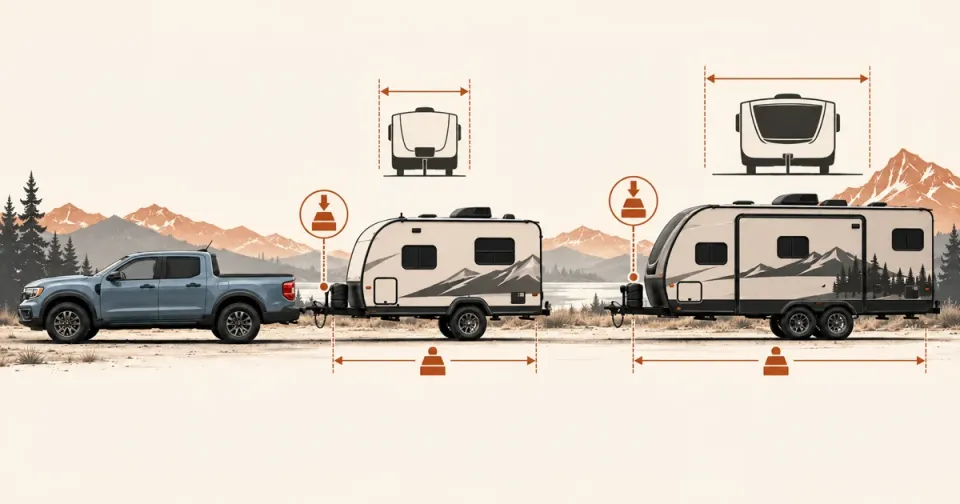
SHOP BY LOADED WEIGHT AND PAYLOAD, NOT CAMPER LENGTH OR DRY WEIGHT
Ford lists up to 2,000 lb loaded trailer weight for the ordinary 2026 Maverick configurations and up to 4,000 lb on properly equipped AWD trucks with factory 53Q. Use the trailer’s loaded weight and tongue load. Compare both against your truck’s payload, combined weight and Ford’s frontal-area limit before choosing a camper.
Fit Assistant · For your setup
Narrow your camper shortlist
Tell us a little about your situation. Fit Assistant will help you apply this guide.
Camper “size” is a poor buying filter. Two trailers of similar length can differ sharply in loaded weight, frontal area and tongue weight. Ford's 2025 guide lists a 29 sq ft maximum trailer frontal area without the 4K Tow Package and 40 sq ft with it.
| Maverick configuration | Ford maximum loaded trailer weight | Frontal-area reference |
|---|---|---|
| Without 4K Tow Package | 2,000 lb | 29 sq ft |
| Properly equipped 4K configuration | 4,000 lb | 40 sq ft |
These are ceilings, not shopping targets. Water, propane, batteries, food, camping gear and installed options all move the trailer away from its advertised dry weight. Tongue weight also consumes the payload shown on the truck's door-jamb label along with occupants and bed cargo.
A 4,000-lb receiver does not make a 2K truck a 4K truck. The 4K package includes vehicle-level equipment and Ford's rated configuration. Likewise, choosing a trailer with a 1,900-lb dry number does not establish that it stays below 2,000 lb when ready to camp.
Turn a promising camper listing into a useful comparison
A listing is a starting point, not the traveled combination. Ask the seller for the exact trailer's GVWR, current weight information, installed options and how the weight changes when equipped for your trip. GVWR is the trailer's maximum permitted loaded weight; it is not proof that your Maverick can tow that amount.
| What the listing says | What you still need | Why it changes the decision |
|---|---|---|
| “Lightweight” or a short body length | Realistic loaded trailer weight | Similar-length campers can carry different equipment |
| A low dry weight | Batteries, water, propane, options and gear | Your trip is not an empty brochure configuration |
| “Under 4,000 pounds” | Exact truck rating and remaining load limits | The advertising ceiling may not be your truck's limit |
| A manageable hitch weight | Loaded measurement and truck payload accounting | People and bed cargo share the truck's allowance |
Compare two real trips, not two empty campers
A solo overnight with minimal equipment and a family holiday with passengers, bikes and extra supplies can leave very different room in the same truck. Write the trip load beside each camper candidate before narrowing the shortlist.
If the truck's towing equipment is unknown, identify it before shopping at the top of a weight band. A receiver alone does not establish the complete rated configuration. For later years, obtain that year's Ford towing guide; the numeric table above is sourced to the 2025 guide and must not be silently copied to every year.
A useful stopping point
You do not need an instant yes/no from an incomplete advertisement. A good outcome is a shortlist with the missing ratings and measurements clearly identified. Have the complete, loaded combination checked and weighed before relying on it; an estimated fit is not departure approval.
What two Maverick scale reports tell you before buying a camper
| Owner-reported scale pass | Front axle | Rear axle | Trailer axles | Combined |
|---|---|---|---|---|
| 2025 Hybrid trip with a loaded utility trailer | 2,420 lb | 2,800 lb | 2,200 lb | 7,420 lb |
| Separate 4K-package owner’s loaded trailer report | 2,220 lb | 2,660 lb | 3,360 lb | 8,240 lb |
The first owner estimated the full trailer at 2,600–2,700 lb. That number is separate from the 2,200 lb carried by its axles on the coupled pass. The second owner reported that the combination exceeded their stated 8,145 lb combined rating by 95 lb. Use the cases to see what a weigh-in can reveal, then use your own truck’s ratings and loading.
For a camper quote, write down the actual trailer weight with water, battery and trip gear, the tongue weight, both truck axle weights, and combined weight. Verify Ford’s frontal-area and other configuration limits before choosing. Weigh as you travel, with occupants and cargo, and ask the scale or qualified shop how to obtain the separate readings you need.
2025 Hybrid owner’s reported axle weights and ticket · Second owner’s scale report · Ford 2025 RV and Trailer Towing Guide
Bottom line
For a 2K Maverick, focus on genuinely lightweight campers whose loaded weight, tongue weight and frontal area leave margin. For a 4K truck, the candidate pool grows, but payload and frontal area can still rule out a trailer below 4,000 lb. Confirm the exact truck, load it as traveled and weigh the combination.
For the equipment distinction, see Maverick 2K receiver vs 4K Tow Package.
Compatibility snapshot
| Setup | Verdict | Required check and source |
|---|---|---|
| 2026 Maverick without factory 53Q | Up to 2,000 lb loaded trailer, 29 sq ft frontal-area limit | Check original equipment, payload and the actual loaded trailer. Ford 2026 Maverick towing guide |
| Eligible 2026 AWD Maverick with factory 53Q | Up to 4,000 lb loaded trailer, 40 sq ft frontal-area limit | Verify VIN equipment and the other ratings for the trip. Ford 2026 Maverick towing guide |
| Camper listing only gives dry weight | Verify actual loaded weight before buying | Include cargo, liquids and tongue weight, and match model-year towing guidance. Ford 2026 Maverick towing guide Ford 2025 towing guide |
Sources & notes
Last verified 8 November 2026.
- Ford 2026 Maverick towing guide
- Ford 2025 towing guide
- 2025 Ford RV & Trailer Towing Guide, accessed 2026-10-27. Maverick GCWR, maximum loaded trailer weight, required equipment and frontal-area limits.
- 2025 Ford Maverick technical specifications, accessed 2026-10-27. Vehicle configurations and dimensions.
- Door-jamb payload label and a certified scale control the individual truck/load calculation.