





Tacoma Camping: 12V Fridge or Cooler?
COMPARE YOUR ICE PLAN WITH YOUR POWER PLAN
Choose a cooler when an ice plan suits your trips and you want a simpler purchase; compare a 12V fridge when controlled cold storage justifies its power, space and mounting needs. For a Tacoma, price and measure the complete arrangement. A fridge’s quart capacity or a power station’s headline watt-hours cannot by itself prove two days of useful operation.
Fit Assistant · For your setup
Apply this to your camping storage
Tell us a little about your situation. Fit Assistant will help you apply this guide.
Which problem are you trying to solve?
An occasional overnight trip near ice is a different decision from repeated remote trips with careful meal planning. Start with how long you are away, where you can replenish ice or energy, and how often you open the box.
| Choice | What you manage | Main trade-off |
|---|---|---|
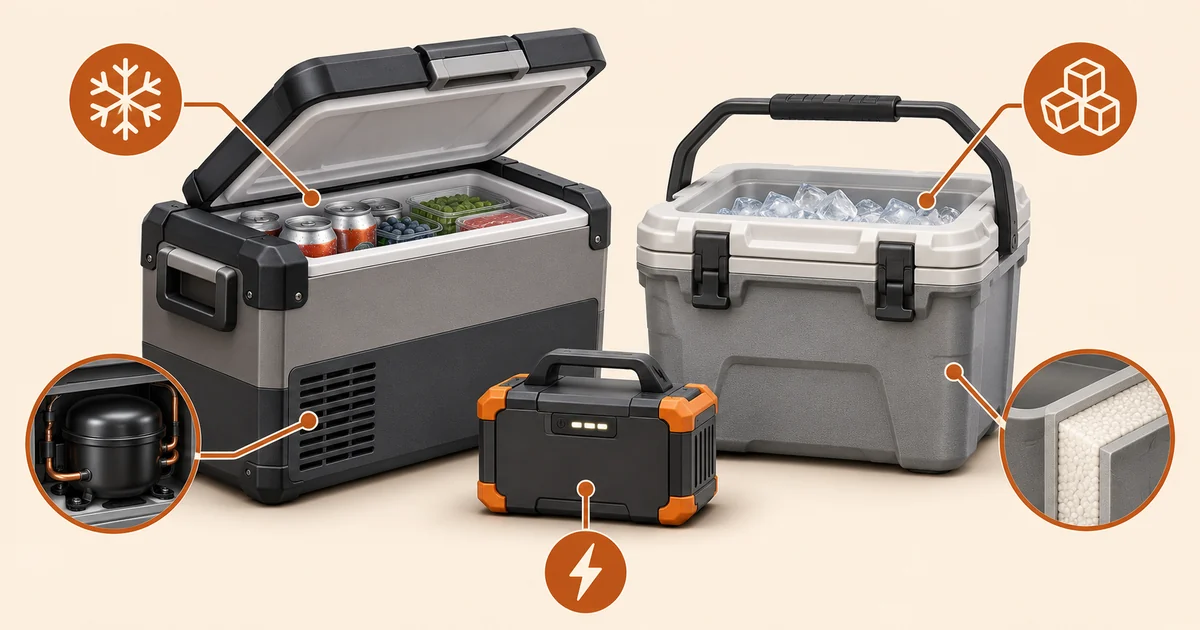
| Insulated cooler | Ice, water, packing and replenishment | Simpler equipment, but ice occupies space and needs a plan |
| Compressor fridge | Energy, ventilation, controls and secure mounting | Powered temperature control, larger complete-system commitment |
| Keep the current cooler for now | Your actual trip routine | Learn what is missing before buying another system |
Neither route wins just because it looks more like an overland build. Ask whether the fridge solves a repeated problem or mainly adds a new power project to a short trip.
Use a specific fridge as the measuring example
ARB’s Elements 10810602 listing gives a 63-quart capacity, about 70 pounds empty, and external dimensions of 17.1 inches high × 19.3 wide × 32.3 deep. It supports 12/24V DC and 100–240V AC.
These numbers establish a starting footprint, not Tacoma installation approval. The lid, handles, power connection, ventilation and any slide require more space than a closed box on a drawing. Add the mount, food and other equipment to the load budget.
The current listing’s temperature range is 0°F to 50°F. Do not borrow a different minimum from an older review or another ARB model. A range specification also does not establish energy use at every ambient temperature.
For a cooler, use the exact maker dimensions and usable packing space too. YETI’s size guide distinguishes external dimensions and internal space. Do not assume a model number equals the same usable capacity as a fridge’s stated quarts.
Measure the operating space, not just the box
| Area | What to check before ordering |
|---|---|
| Bed and cover | Closed height plus lid-opening space |
| Slide | Added height, full extension and access to latches |
| Power connection | Cable/plug space and suitable protected connection |
| Ventilation | Required free space in the exact unit’s manual |
| Cargo arrangement | Reach, removal and room for the other trip gear |
| Weight | Box, slide/mount, battery and packed contents |
A tall box may fit under a cover yet be awkward to open there. A slide can improve reach while adding cost, height and weight. Plan both the travel position and the parked operating position.
A weatherproof product description is not permission to submerge the unit, block its vents or ignore the manual’s connection limits. Use the instructions for the actual unit and revision.
How much battery do you need?
Use measured energy over a representative day, not compressor running watts alone. A fridge cycles on and off, and weather, settings, contents and access affect the result.
Illustration only: suppose a 500Wh power station provides 400Wh usable for your chosen connection, and your measured fridge consumption is 240Wh per day. Then:
400Wh ÷ 240Wh/day = 1.67 days, or about 40 hours.
That falls short of a 48-hour target before other loads. The assumed 400Wh and 240Wh are examples, not measurements of every power station or the ARB Elements.
Without your actual usable energy and representative consumption, “500Wh should do two nights” is a guess. Include other loads and uncertainty. Solar replenishment also needs an expected yield for the actual conditions; a panel’s advertised power is not a daily energy receipt.
ARB’s reviewed product page labels current draw “0.9Ah.” That abbreviated value alone is not a continuous current rating or enough information to calculate your runtime. Do not multiply it into a confident battery promise without the underlying test conditions.
Compare complete trip costs
For the cooler, price the actual box and your likely ice/replenishment routine. For the fridge, include the box, compatible mounting or slide, power source, installation, connections and any additional charging equipment. Add servicing and replacement considerations where relevant.
You do not need an exact lifetime cost before making a useful choice. A written complete-system quote and a realistic trip plan are enough to reveal whether you are comparing a simple cooler purchase with a much larger project.
If a fridge also displaces tools or cargo you need, treat the lost space as part of the decision. The container’s efficiency does not restore the bed space or payload consumed by its support equipment.
Two camping decisions
Two nights, occasional use, ice available nearby: try a suitable cooler and packing plan before buying a power system. If it meets your task, the simpler route may finish the decision.
Repeated remote trips, wants powered temperature control: compare the complete fridge arrangement. Confirm operating space and measure a representative day of consumption before sizing the energy system. A fridge may be worthwhile, but the power plan is part of the purchase.
For a bed layout already dominated by a shell or cover, use the camper-shell buying guide to keep the larger cargo and access decision consistent.
Compatibility snapshot
| Choice or assumption | Scope | Result | Required check |
|---|---|---|---|
| ARB Elements 10810602 | Documented 63-quart example | Candidate, not a Tacoma fit approval | Full operating space and secure mounting · ARB’s Elements 10810602 listing · Elements service manual |
| 500Wh station for two days | No measured consumption | Runtime unknown | Usable energy and representative daily Wh · Elements service manual |
| 400Wh usable / 240Wh per day | Hypothetical example | About 40 hours | Does not prove your actual runtime · Elements service manual |
| Cooler without electrical power | Ice-based route | Useful comparison | Packing, ice duration and replenishment · YETI’s size guide |
Before you buy
Finish with the trip length, realistic storage volume, full operating footprint, complete cost and an ice or energy plan. You can choose a direction now while leaving the exact battery or mount as the next question.
Sources & notes
Reviewed 7 November 2026. ARB’s selected product listing, Elements service manual, and YETI’s size guide support the scoped comparisons. Check the actual fridge’s operating manual; the service manual covers a named older model/revision. No DoesItFit thermal test, runtime guarantee or wiring instruction is claimed. See our methodology.