
Method Wheels for a Tacoma: Standard, Bead Grip or Beadlock?
CHOOSE THE FUNCTION BEHIND THE LOOK
Choose a standard Method wheel for a suitable daily-driver application, consider Bead Grip when its added bead-seat retention serves your trail use, and treat a true beadlock as a separate ownership decision. The 305 NV’s visible lip bolts do not make it a beadlock. Exact wheel fit, road-use restrictions and maintenance still depend on the selected wheel and tire.
Fit Assistant · For your setup
Apply this to your wheel choice
Tell us a little about your situation. Fit Assistant will help you apply this guide.
What is holding the tire to the wheel?
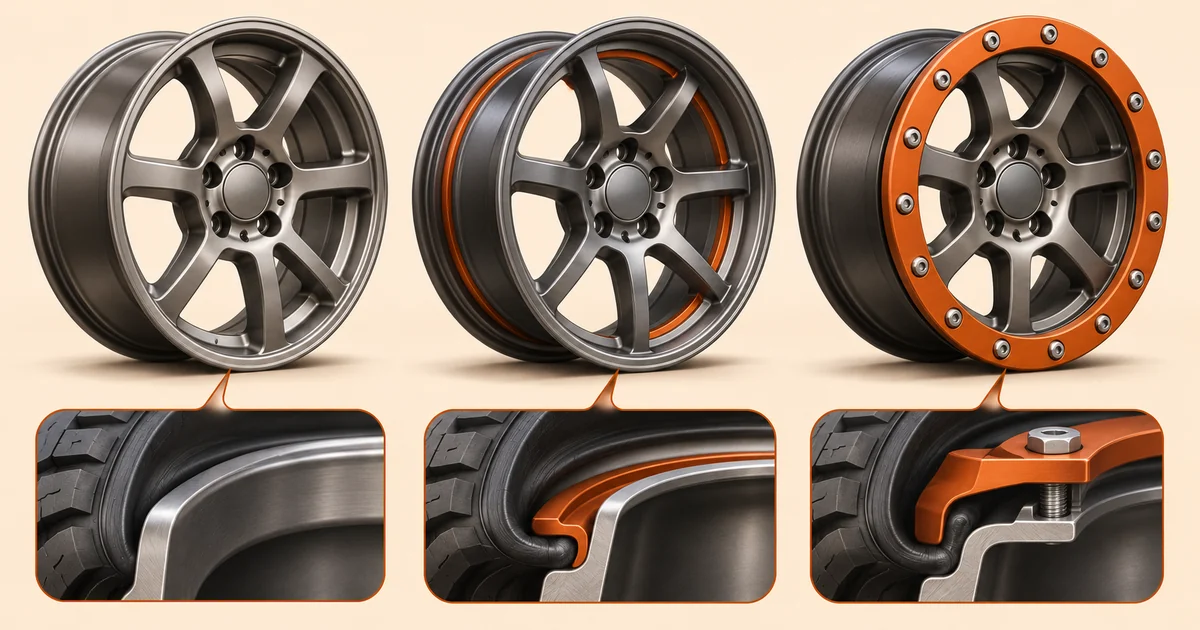
The bead is the reinforced edge of the tire seated against the rim. Three wheels can look similar from a distance while holding that bead in different ways.
| Design | How it retains the tire | What you are buying | What you are not buying |
|---|---|---|---|
| Standard wheel, such as 305 NV | Conventional bead seating maintained by inflation pressure | Wheel design, size and documented load/application | A mechanical tire-clamping ring |
| Bead Grip | Shaped bead seats with added grooves and a more pronounced safety hump | Added bead-seat retention without an external clamp ring | A true beadlock or permission to use any pressure |
| True beadlock | Bolted ring mechanically clamps the outer tire bead | A different retention mechanism | Automatic daily-road suitability or maintenance-free ownership |
Method’s beadlock explanation describes the mechanical clamp. The presence of bolts alone is not the test. Ask what those bolts actually attach to and whether they clamp the tire bead.
Is the Method 305 NV a beadlock?
No. Method describes the 305 NV as having a Street-Loc V.1 lip that simulates a beadlock, with replaceable lip bolts. That is useful styling information, not a clamping function.
For a Tacoma used mainly for commuting and mild forest roads, liking that appearance is a valid reason to shortlist the wheel. You do not need to invent an extreme trail use case to justify the design. Still select a documented vehicle application and tire combination.
Do not apply a whole wheel family’s maximum advertised load to every size or bolt pattern. Record the actual SKU’s rating, size and offset on the quote.
What does Bead Grip add?
Method’s Bead Grip page describes grooves on both the inner and outer bead seats and a modified safety-hump profile. The maker positions it between a conventional wheel and a beadlock for trail use at reduced pressure.
The useful distinction is added retention without a mechanical outer ring. It does not establish one safe pressure for every Tacoma, tire, load or trail. Nor does it eliminate the need for proper tire seating, condition and setup.
If you regularly encounter a trail situation where retention is a real concern, compare the documented Bead Grip application with a standard wheel. If the truck rarely leaves pavement, the extra feature may not solve a problem you have. Neither conclusion depends on the most dramatic product photograph.
When should you investigate a true beadlock?
Start when your intended off-road use calls for that retention mechanism and you are willing to establish the selected product’s operating and service requirements. Confirm road-use permission for the exact wheel, tire compatibility, qualified mounting support and the maker’s hardware inspection instructions.
A beadlock purchase includes more than the wheel price. A shop that mounts an ordinary wheel may not offer the same service for a clamping-ring assembly. Get the assembly and ongoing service plan in writing before buying. Do not copy torque or maintenance instructions from a different ring design.
Compare the whole set cost
| Quote item | Standard or Bead Grip | True beadlock |
|---|---|---|
| Wheels | Actual SKU and quantity; include spare plan | Actual SKU and ring/hardware contents |
| Tire work | Mounting, balancing and valves/sensors | Confirm the shop handles the exact ring system |
| Vehicle fit | Bolt pattern, bore, lug seat, offset, brake clearance | The same vehicle checks still apply |
| Ownership | Cleaning, damage inspection, replacement support | Add the maker’s ring/hardware service requirements |
This worksheet avoids a misleading comparison between four basic wheels and a partially priced beadlock system. Use current quotes rather than assuming all models in one family cost or weigh the same.
Two Tacoma examples
2021 daily driver, likes 305 NV styling: shortlist the correct 305 SKU because it suits the appearance and use. The lip bolts do not supply beadlock function. Compare a Bead Grip option only if the extra retention serves a specific trail need.
A build intended for more demanding off-road use: define the tire, load and terrain before paying for a clamping ring. Ask a qualified installer to compare supported options and explain the road-use and service implications. “More serious wheel” is not a sufficient application check.
For how wheel position changes the fit discussion, use the offset guide.
Compatibility snapshot
| Product/application | Vehicle fitment | Result | Required check |
|---|---|---|---|
| Method 305 NV | Exact selected Tacoma SKU | Unknown until selected | Conventional wheel; simulated beadlock lip · Method describes the 305 NV |
| Method Bead Grip model | Exact selected Tacoma SKU | Unknown until selected | Vehicle/tire application and actual use · Method’s Bead Grip page |
| True beadlock | Selected ring system and truck | Unknown until confirmed | Fit, use restrictions and service requirements · Method’s beadlock explanation |
What finishes the decision?
Know which mechanism you need, why it serves your driving and what the complete installed set requires. Fit Assistant can help compare that choice with your truck and plans without guessing a pressure or promising clearance.
Browse Tacoma Guides and tires and wheels.
Sources & notes
Reviewed 7 November 2026. Manufacturer explanations are linked above. The examples are editorial decision aids, not our wheel tests or exact SKU approvals. Generic illustrations explain categories; they do not reproduce a Method product’s geometry or certify a mounting arrangement.